FWP:
SETS == DOUBLE ACTIVATION; MUSHAIRAH
BONDAGE: {1,5}
JAUHAR: {5,4}
MADNESS: {14,3}
The special enjoyableness of this verse rests on what I call 'double activation'. In classic mushairah-verse style, the first line piques our curiosity but is tantalizingly incomplete. Such enjambment is not too common in ghazal lines, but it's not all that rare either. When after a suitably suspenseful delay we're allowed to hear the second line, we of course hear kaa;N me;N as 'in the ear', since the first line has made us expect to be told what happens when a 'discussion' [charchaa] occurs. Not until the last possible moment are we told that the subject of all this action is 'iron'.
Then with a shock of amusement and pleasure we go back and revise our understanding of kaa;N me;N to mean also 'in the mine' (see the definitions above), since iron is readily and plausibly located in a 'mine'. (Since kaan meaning 'ear' is an Indic-side word, it actually shouldn't be shortened through nasalization in such a way; but Ghalib does what he pleases.)
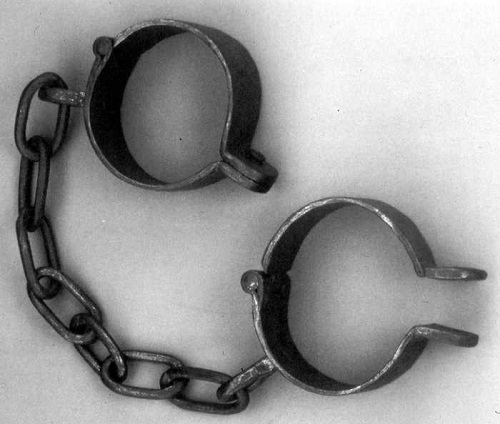
If we emphasize the reading of 'mine', then the iron in the mine, even before it's smelted and forged, somehow longs and quivers to become chains for the speaker's feet. And of course, the reason his feet need chains in the first place is because in the betaabii of his madness he can't be still; now this very betaabii is transferred to the future chains themselves. By jauhar we might then understand 'excellence' or 'essence' (with wordplay involving 'gem' or 'jewel'), since the truest and highest future destiny of the iron (chaining an unchainable madman? approaching a lover of such lofty destiny?) is calling out to it and evoking a response. Or of course, the future temper-lines themselves might already be quivering.
If we emphasize the reading of 'ear', then we imagine that the iron is already forged; it now has little temper-lines that resemble the tiny cilia in the ear, and quiver when a sound reaches them. Thus the bar of iron, having already been through the experience of being forged, has a primitive anthropomorphic identity, and 'listens' to words through its 'ear', and can react appropriately. (If a sword can have a breath, as in {1,3}, doesn't that increase the likelihood that iron might have some sort of resonant, metallic, scratchily ciliated ear?)
Thus the pleasure of the verse rests on the back-and-forth wordplay of the two meanings of kaa;N me;N , which are both fully operative: the 'ear' meaning because of the 'discussion', and the 'mine' meaning because of the 'iron'. For other such tours de force, see {120,3}. There are also such a number of possibly and variously relevant meanings of jauhar (see the definition above) that there's no danger of our exhausting the verse too quickly.
Compare {69,3x}, in which the madman's lament is eager within the as-yet-unthrown stone itself.
Nazm:
That is, my madness is of such an order that iron itself longs to become chains and be honored by nearness to me. Here, the nasalization of the full nuun in kaan seems displeasing. (129)
== Nazm page 129