hai josh-e gul bahaar me;N yaa;N tak
kih har :taraf
u;Rte hu))e ulajhte hai;N mur;G-e chaman ke paa;Nv
1) the tumult/excitement of roses is in flourishingness/glory/spring,
to {this extent / 'here'}-- that on every side
2) while flying, they become entangled-- the feet of the garden-bird
josh : 'Boiling, ebullition; effervescence; heat, excitement, passion, emotion; lust; fervour, ardour, zeal'. (Platts p.397)
bahaar : 'Spring, prime, bloom, flourishing state; beauty, glory, splendour, elegance; beautiful scene or prospect, fine landscape; charm, delight, enjoyment, the pleasures of sense, taste, or culture'. (Platts p.178)
ulajhnaa : 'To be entangled, ravelled, twisted, entwined; to be complicated, made intricate; to be perplexed; to be involved (in difficulties, &c.), to be at a loss... to have the heart set or fixed (on).... to have a liaison (with), form an illicit connection (with).... to carp or cavil (at)'. (Platts p.75)
In this verse Mirza Sahib has used an extraordinary subtlety of meaning. The meaning is that with this spring, spring has come to the garden such that whatever birds fly over the garden, see the spectacle of rose and tulip, and their hearts become captured, and they're forced to abandon any intention of going onward and stay right there. (184)
In the spring, flowers are so abundant that the heart of the birds of the garden doesn't want to go and fly off to anywhere else, but rather, helplessly, they descend right there. (246)
SETS == WORDPLAY
SPRINGTIME: {13,2}
The special pleasure of this verse is in the multivalence of ulajhnaa . Consider some of the possibilities:
= as they fly past, the birds' feet literally become entangled-- in roses, we think, though literally in the 'ardor' or 'ebullience' of roses
= as they fly past, the birds' feet have some sort of sexual contact, some liaison, with the erotically lush and steamy roses
= as they fly past, the birds' feet quarrel with, or complain against, the proliferating roses that obstruct their path
= the birds are unable to fly past, but are dragged down into the garden by the enmeshing rose-vines.
= the birds who live in or visit the garden are unable to take off to leave the garden, since their flight is hindered by the enmeshing rose-vines.
And all the time, it's not the birds that are experiencing these things, but literally their 'feet'. When was the last time a foot fell in love, or had an affair, or quarreled with somebody? I find this a weakness in the verse, almost a minor form of grotesquerie.
But the verse is helped by the richness of josh (effervescence, or lust), and bahaar (flourishingness, or springtime) and yaa;N tak ('up to here', literally; 'to such an extent', metaphorically) and har :taraf ('in every direction', literally; 'everywhere', metaphorically). The mind can't finally settle on either a literal, physical reading (bird feet entangled in rose tendrils) or a metaphorical reading (birds captivated with passion for the wild glory of the roses).
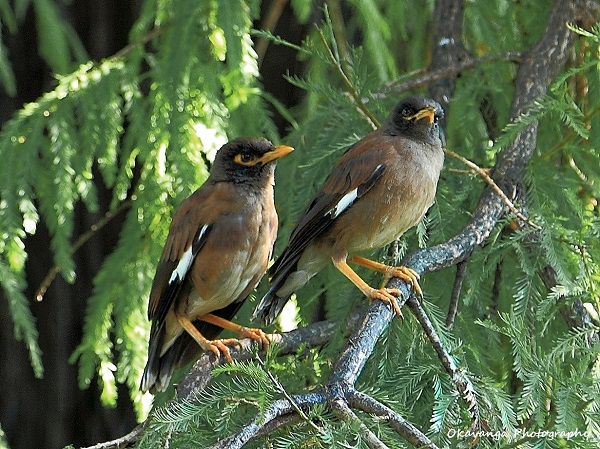
Note for grammar fans: Depending on how we take bahaar , there are two ways to do the grammar of the verse. If we read hai josh-e gul bahaar me;N as 'the tumult of the roses is in [a state of] flourishingness...', we have the structure 'X is Y'. To me, this is the more intuitive first reading. But it's also of course possible to read the phrase as '[there] is a tumult of roses, in springtime,...', so that the basic structure would then be 'X is' or 'X exists'. Both of them work, and in this verse there's hardly any difference; but it pays to keep our analytical tools sharpened.
Nazm:
That is, there's so much growth and flourishing that the verdant atmosphere entangles the feet of the birds in the veins of the roses. And 'for the feet to be entangled' is also an implication that whichever bird passes over the garden doesn't wish to go onwards, and is forced to remain there. (131)
== Nazm page 131