FWP:
SETS == GROTESQUERIE; INEXPRESSIBILITY
TESTING: {4,4}
For background see S. R. Faruqi's choices. For more on Ghalib's unpublished verses, see the discussion in {4,8x}.
ABOUT NOUN COMPOUNDS ('REVERSED IZAFATS'): This verse displays two sets of Persian-style 'reversed izafats' [i.zaafat-e maqluub] or what I call 'noun compounds': 'wound-wait' [daa;G-inti:zaar] and 'pain-test' [dard-imtihaa;N]. These constructions, so versatile and ubiquitous in English ('junk food', 'horse show', 'show horse', 'vacuum cleaner', 'fire hose', 'time machine', 'endurance test'), are uncommon in Urdu. (Cases like :taalib-((ilm are just dropped i.zaafat phrases; a real noun compound would be ((ilm-:taalib ). Ghalib uses such compounded nouns more freely in his early verses, in which he's more willing to warp the syntax of his lines; he includes Indic words too. As in English, the relationship of the two nouns is flexible and must be deduced from the context. Sometimes I have trouble analyzing the niceties of such constructions; for more precision and detail, you should be sure to consult a Persian reference grammar or handbook of rhetoric.
Some examples of noun compounds: {3,11x}; {11,4x}; {12,5x}; {16,7x}; {24,10x}; {40,6x}; {64,1}; {68,3}; {69,4x}; {79,3x}; {79,5x}; {128,2x}; {129,5x}; {130,5x}; {145,7x}; {155,4x}; {206,1}; {208,10}; {211,8x}; {217,8x}; {222,2x}; {227,1} // {307x,1}; {320x,5}; {404x,2}; {404x,7}. (Petrified compound words that have Persian-verb-based second elements are of course another matter, and appear everywhere: consider jigar-sozii and sar-parastii and the like, and the extremely bonded case of dil-chaspii .) On serial izafats that include the (inverted?) adjective-noun pair ;xuunii;N-navaa , see {80,3}. There's also 'loss of the izafat' [faq-e i.zaafat]; on this see {81,8x}.
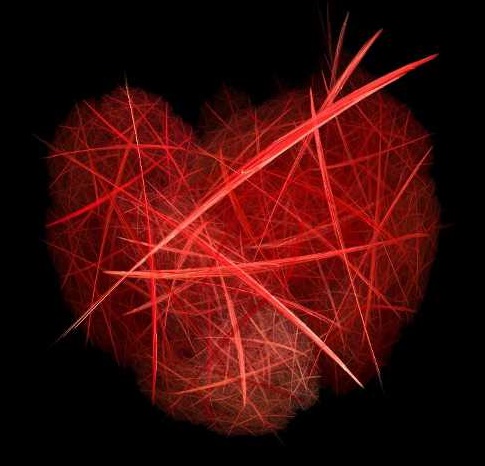
The wordplay with ((ar.z and fa.zaa suggests a vision of the lover's breast as becoming constantly wider and more open (which in principle is of course a virtue). Each wound contributes to the process by literally 'opening up' and exposing a new, formerly inner part, so that the surface area increases. And then each wound itself somehow becomes a whole new heart, ready and waiting for another wound, starting the process all over again in what must quickly become something like a fractal geometry of constantly multiplying wounds and hearts.
Is this grotesque, or what! It reminds me of {62,6} with its vision of many additional blood-spouting eyes.
Anyway, this whole process is apparently so enjoyable that the breast is 'pain-testing'-- because it's constantly looking around for newer and sharper sources of pain, and never gets enough.This pain-testing heart is well worthy to be made, or else to make, an 'offering' or a 'presentation' so extraordinary that it's simply inexpressible in words.
Asi:
Every fresh wound in my heart is, so to speak, a single heart that is waiting for a wound. Then, in such a situation, why do you ask about the offering/breadth and spaciousness of this breast that is testing pain? If there were any limit or reckoning, then it would/could be expressed.
== Asi, pp. 205-206