FWP:
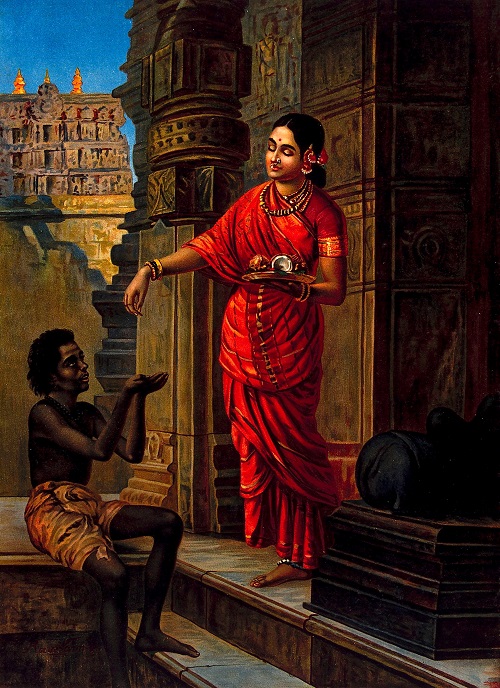
A nice wry tone for a closing-verse-- but at whom is the speaker's ironic, or amused, or sarcastic, or rueful reflection directed?
=At himself, for his absurd insistence on maintaining the role of a lover under even the most inappropriate circumstances?
=At himself, for so readily transferring his lover-ship on what seems to be a strictly financial basis?
=At his former beloveds, since they were obviously not 'people of generosity'? (If they had been, he wouldn't have ended up as a beggar.)
=At his new beloveds, the 'people of generosity' (and/or patrons), since they seem to be buying his loyalty? (Or perhaps they offer him as little as his old beloved did?)
Needless to say, these possibilities aren't mutually exclusive. Quite the contrary, in fact. For a far more bitter-sounding reflection on the relation of beggar to giver-- or poet to patron-- see {110,8}.
This verse also (somewhat invertedly) recalls Ghalib's many poetic exhortations against taking anything from others; on this see {9,1}. Is a beggar who's also a lover more honorable than an ordinary beggar, or more cynical?
Nazm:
The to proves that the clause before it [is a relative one];.... in Urdu it ought to be considered acceptable in speech [to omit the relative pronoun 'if' or 'when'], for it is attractive to omit this pronoun from a conditional clause. (187)
== Nazm page 187