vuh tab-e ((ishq tamannaa hai kih
phir .suurat-e sham((a
shu((lah taa nab.z-e jigar reshah-davaanii maa;Nge
1) that heat of passion-- the longing is that again/then,
{like / with the aspect of} a candle
2) flame would, as far as the pulse of the liver, demand fiber-runningness
reshah : 'Fibre; filament; nerve; vein (of a leaf)'. (Platts p.612)
He says, I have a longing and yearning for such a heat of passion that its flame, like a candle, would run down to the liver. (265)
Again I have a longing for such a heat of passion that its flame would convey its effect as far as the vein of the liver. That is, the way in the wick of a candle flame catches fire upward, and finally the wick of the candle burns, in the same way the flame of the heat of passion would burn me to ashes from head to foot. (Then he realizes that even previously such a thing had already happened.) (364)
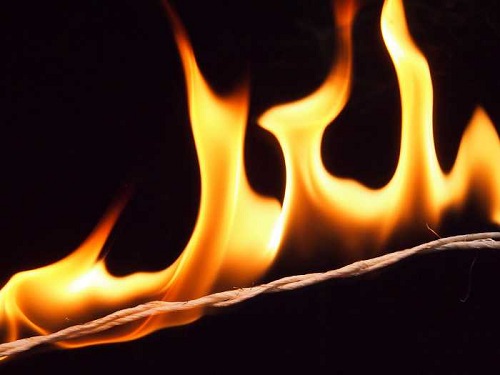
The lover longs for a state in which 'flame' would demand or require, as in the case of-- literally, with the aspect of-- a candle, 'fiber-runningness' down as far as the 'liver-pulse'. The wick of a lighted candle steadily carries the flame down along its own 'fiber', guiding the flame ever deeper into the candle's heart (or 'liver-pulse') while its heat burns and melts everything in its path until it finally consumes the candle entirely.
But then, what's the grammatical connection between the rest of the verse, and the initial 'that heat of passion' [vuh tab-e ((ishq]? It seems to be a free-floating exclamation of some kind, but what kind exactly? Here are some possible contexts for it:
=The lover no longer feels such 'heat of passion', and wistfully longs to know 'again' [phir] its deadly ravages; for another case of such nostalgia, see {234}.
=The lover does feel just such a 'heat of passion', and only longs for it to reach its fatal culmination quickly and put him out of his misery
=The lover now feels a 'heat of passion' far more unbearably intense; he ruefully wishes for the old days in which his passion would behave like a 'normal' flame, like a candle-flame, instead of assuming its strange new form; see for example the fire imagery in {5}.
Because of the opaqueness of the grammar, it would also be possible to think of other arrangements. There might be an i.zaafat on ((ishq , giving us 'the longing of that heat of passion'; and thus generating its own set of further possible readings for the two 'of's. And how about breaking the line differently, so that we get either 'that heat of passion is longing' or, alternatively 'longing is that heat of passion' [vuh tab-e ((ishq tamannaa hai]? In either case, the versatile little kih would be quite capable of introducing an illustrative or explanatory clause; and it would be no more ambiguous than it is already in the main-line interpretation. I'm not going to start teasing out all the possible readings of all these possible permutations, but it's hard to deny that they might exist.
The verse offers a nice touch of wordplay: davaanii looks exactly like divaanii , a shortened form of diivaanii , 'madness', that is used when poets need it for metrical reasons. And although the verse makes no specific reference to madness, the lover's 'heat of passion' is never all that far from 'madness in every fiber' in any case.
Nazm:
That is, I long for that heat of passion the fire of which, like the flame of a candle, would do 'fiber-runningness' down to the liver. To say 'the pulse of the liver' is not devoid of elaboration and [a need for] special pleading [tasaama;h], because there's no pulse in the liver. But here he has taken 'pulse' in the meaning only of 'vein', and by 'liver' is meant the inner part of the breast. In this aspect [.suurat], there's no unattractiveness in saying 'pulse of the liver'. (206)