FWP:
SETS == EK; WORDPLAY
FLAME/STRAW: {21,5}
GAZE: {10,12}
Just look at the complexities (see the definitions above) we'll have to choose among, in order to put this verse together! The whole first line demands to be considered almost literally word by word:
First, nigah (shortened from nigaah for metrical reasons) can refer to either a single 'look' or 'glance', or a steady continued 'gaze' or 'watching'; or it can mean 'care' or 'attention'.
Second, garm has a wide range of meanings, ranging from the mild ('lively', 'brisk') through the emotional ('ardent', 'excited'), to the dangerous ('fiery', 'virulent'). Faruqi points out that the idiomatic sense of a 'hot look' as a sign of anger is especially relevant here, but there's no reason for it to override all other possibilities.
Third, consider that little word ik (short of course for ek ) that appears so centrally in the first line, and emerges at such an emphatic point in the meter. If we take it to mean 'single', then it's elegantly counterpoised to the Persian plural chiraa;Gaa;N in the next line. If we take it to mean 'particular', that might explain its remarkable effects in the second line. If we take it to mean 'unique' or 'singular', then we are well prepared for its bizarre behavior in the very next word, as it 'drips'. And if we take it to mean 'preeminent' or 'excellent', that too works well in showing admiration for its powers described in the second line.
Fourth, of course is that 'dripping' of the fire. As a rule, 'dripping' is a highly unlikely thing for a flame to do: flames go up and drips go down; flames shoot out in tongues and drips shape themselves into little spheres; flames pop and crackle, drips merely go 'plop'. Then, of course, fire will roast you, drips will drown you-- is that a difference (in means), or a similarity (in ends)? What in the world does it mean for fire to 'drip'? Fire is not the oddest of Ghalib's dripping things, however: remember there's also the 'to be a desert' that 'drips' in {17,2}.
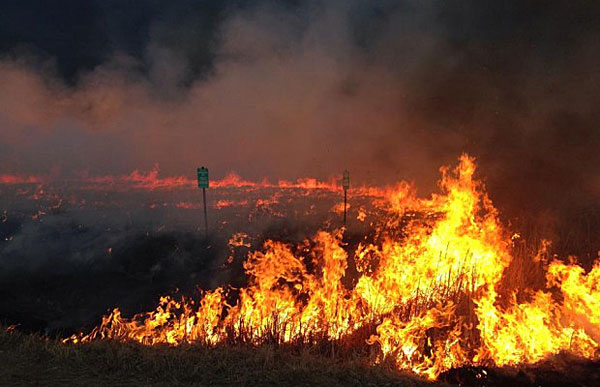
In the second line, we find an astonishing conversion. Something maximally trashy and rubbishy has been made into something maximally elegant and sophisticated; something merely crudely inflammable has been made into not one but many spectacular flames; something that's natural and a mere byproduct has been made into something that's artificial and an elaborate result of artistic skill. And of course we discover the whole array of fire wordplay: 'hot/warm', 'fire', 'light-show', and the kindling: 'dried-grass-and-woodchips'.
Then, all these effects are created 'through me' or 'from me' or 'by means of me' [mujh se]. Which opens up, once again, various choices. The rich patron who sponsors a theatrical show can quite well say, 'The show is put on by me'. The choreographer can make the same claim; so too can the troupe of dancers. In the case of the creation of this light-show, we'll have to decide for ourselves how closely involved the speaker might be, and what his role might be-- is he merely commanding the show, or is he spinning it out of his own burning heart's blood? Is he doing it effortlessly, or even involuntarily, with a single glance (as in {5,4}), or is he doing it carefully over time, with 'watchfulness'? And of course we'll also have to decide what his mood might be, whether 'lively', 'ardent', or 'virulent'. As so often, Ghalib gives us a set of building blocks and then goads or charms us into creating the verse-- or rather, many permutations of the verse-- for ourselves.
For another meditation on ;xas-o-;xaashaak
and fire, see {210,5}. (There's also ;xas-o-;xaashaak and water, in {171,5x}.) For more on chiraa;Gaa;N , see {5,5}.
Nazm:
That is, my warm/hot gaze has lit a fire in the garden; but we do not learn anything of why the gaze is warm/hot. (214)
== Nazm page 213; Nazm page 214