 |
about
|
|
about
|
|
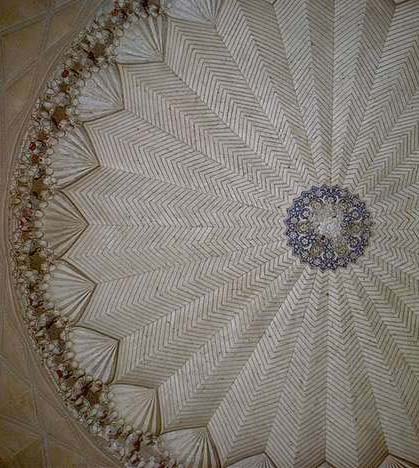
‘A Desertful of Roses’, my title for this project, is loosely based on {147,3}, which really speaks of ‘a desertful of the glory/appearance of roses’. In the true spirit of Ghalib, it’s not at all the same as ‘a desert full of roses’. It might even be like ‘a handful of air’ and thus be nothing at all, since a desert is an empty and rose-free place to begin with. Ghalib likes to measure things in such units: there’s a ‘desertful of fatigue’ in {11,1}, and a ‘cityful of longing’ in {16,2}; in {18,2} we even find a ‘two-world-ful desert’. And when it comes to gardening in the desert, I can’t help but mention the irresistible {214,6}. In these introductory pages I am playing with some austerely roseate images of the inner dome of Humayun’s tomb. Like the other images I will be using to introduce each ghazal, they are from the invaluable archive of the Berger Collection. Nowadays (2020) this html-based website appears bare-bones and archaic, I know. But I want it to live on after my lifetime, and its extreme simplicity can surely help to make it immune to changing technological trends and software evolution. (And in its simplicity it can also be used as a basis on which to build new software structures.) I thank my computer-literate friend Nathanael Shelley for discussing all these matters with me. About Ghalib, you may know a great deal already, and in that case you may want to go straight to the ghazals. If you don’t know much, here’s a timeline of his life, and let me say a few introductory things. Mirza Asadullah Khan (1797-1869) was born in Agra into a military family of Central Asian immigrants; he lost his father and then his uncle in childhood, and lived for most of his life on his share of a pension from the British East India Company (his uncle had served as a Company military officer). He was well-educated and precocious: by the age of twelve, he claims, he was already writing prose and poetry. In both Persian and Urdu, he wrote most extensively in the traditional mystical-romantic genre of lyric poetry called ghazal. His family were well-connected, and he was married at the age of thirteen to a girl from an even loftier family. Soon thereafter he moved to Delhi, where he lived for the rest of his life, except for one long trip to Calcutta. He was lively and sociable, ironic, witty, liberal-minded, with a humanity and a sense of humor that delighted his many friends. Writer of some of the most enjoyable letters in Urdu, he revelled in the new English postal service and conducted a lifelong correspondence with his many Muslim, Hindu, and English friends. Financial difficulties were a constant headache: he never owned books, or a house, or any property except an inadequate patchwork of pensions and stipends from patrons. But even when the roof collapsed during the monsoon, he never for a moment abandoned his vision of the world. He sought to maintain at all costs the leisured, Persianized lifestyle of the Mughal aristocrat he knew himself to be. He tried hard to induce the British to become the kind of literary patrons the Mughals had been; the Rebellion of 1857 was the most painful time of his life. He died in 1869, in straitened circumstances. His wife did not long survive him; they had had a number of children, but all had died in infancy. For a brief overview of Ghalib’s life, told mostly in his own words, see Ralph Russell’s ‘Ghalib: A Self-Portrait’, from Ghalib: the Poet and his Age, ed. by Ralph Russell (Cambridge: George Allen & Unwin, 1972): [on this site]. For the best full-length account of Ghalib’s life in English, much of it told through his letters and other writings, see Russell and Islam. This is an admirable book that deserves to remain in print forever. If you want to read only one good basic book about Ghalib, this is the one. If you are interested in the larger question of Urdu and Hindi and their literary development, here are some good books for background reading. I’ve also put together a few of what I think are especially evocative images of Ghalib’s life and times. Ghalib’s poetry, from his teenage years onward, created a sensation. Written in both Persian and Urdu, it was lavishly praised by its admirers, and bitterly attacked by those who thought he was taking what should be lyrical, romantic, and mystically yearning poetry and twisting it into something far too cerebral and convoluted. The nearest parallel in English literature is perhaps the advent of the Metaphysical poets, with their consciously awkward constructions and unromantic metaphors (think of Donne and his twin compass-legs and his flea). During his lifetime, Ghalib was given a lot of grief about his ghazals—and much less praise than he knew he deserved. He was accused of creating fine-sounding but overwrought and even ‘meaningless’ poetry. Over the past century, though, his genius has shone forth with an authority that has been, if anything, increasing. A whole commentarial tradition has sprung up to assist the reader; there are also the Ghalib Institute and the Ghalib Academy and Ghalib conferences and Ghalib journals and special Ghalib Numbers of other journals—and movies, and wax effigies, and many fancy coffee-table books, and an Indian tv serial. Here are some places within the commentary where I discuss particular points of controversy about Ghalib's own views of his life and poetry:
So now let the curtain rise on what it’s ultimately all about— the poetry itself. Obviously the GHAZAL INDEX, the access point for the 234 ghazals themselves, is at the heart of this project, but most readers will want some explanation first about how the whole thing is put together. The section called ABOUT THE GHAZALS contains a general account of how the poetry is presented here, with information on texts, arrangement, commentary, dating, meter, transliteration, etc. If you don’t know anything about this kind of poetry, however, you might want to begin by having a look at ABOUT THE GENRE, which tries to offer an overview. Please be patient as I gradually build and improve this website. It may seem very limited at first, and not all of the promised parts will be hooked up, but I am looking forward to enhancing it over time. This project is by far the largest piece of academic work I’ve ever undertaken. It was originally planned as a book (in maybe three volumes), and I began to work systematically on it in fall 1999. Then came the events of September 11, 2001. I felt then that I wanted to start making it available immediately rather than after several more years, and to everybody rather than chiefly to a small number of scholars. The website was designed and made in February-March 2002 (which was about as early as I had the skills to do it). The first ten ghazals went online on April 12, 2002. (It amazed and delighted me to see that a small number of people almost immediately began to notice them.) The CSS stylesheets for the ghazal and verse pages, developed by Gary Tubb, were introduced in July 2002. The software for the ‘script bar’ was created by Sean Pue, and was installed in October 2002. I completed the first pass-through of the divan on Nov. 17, 2007, and immediately started the second one, which included many textual improvements, and especially full textual access to the unpublished verses from published ghazals, with commentary on many of them. The second pass-through was finished on May 11, 2010, and I turned then to the Mir project, 'A Garden of Kashmir'. The third pass-through, with many small improvements and increased attention to the unpublished verses, was begun on Sept. 25, 2018, and was completed on Feb. 26, 2020. On that same day I jumped off the cliff into the realm of Ghalib's entirely unpublished ghazals. On Jan. 17, 2021, I finished going through the unpublished ghazals, and at once started a fourth pass-through, reviewing and polishing (and relishing) the divan ghazals. That pass-through was completed on Nov. 16, 2021; I then began a similar, second pass-through of the Mir project. On Nov. 8, 2022, I began another pass-through of Ghalib, mostly for joy. Anybody who has received as much kindness and help as I have could say thanks forever. So let me confine myself to a truly fundamental list: my family; my long-ago Urdu teachers Moazzam Siddiqi, Bruce Pray, Khaliq Ahmad Khaliq; my advisor, ustad, and friend C. M. Naim; my ustad, collaborator, and longtime friend Shamsur Rahman Faruqi; the serendipitously Paninian CSS-maker Gary Tubb; the astonishingly skilful and ingenious script-arranger Sean Pue (who also provided the spark that made me realize that I should do this project); the peerless expert in Ghalibiana Satyanarayana Hegde; and an excellent collaborator during his time at Columbia, Owen T. Cornwall. More recently I've also had invaluable explanatory help and technical support from my friend Nathanael Shelley. In a more general way, I thank my ghazal-loving friends, including Aditya Behl (too soon taken from us), Peter Hook (an invaluable linguistic consultant); David Magier; Andy McCord; Sundeep Dougal; Carla Petievich; Arthur Dudney; Baqar Mehdi; Zahra Sabri; Vijay Seshadri; Nathanael Shelley; all my students (official and unofficial) over the years; the knowledgeable members of the Urdulist, Vasmi Abidi, Irfan Khan, Ali Farzad Sherazi, Saurabh Mangal, Shehryar Zafar, Sifr, Ajay Tiwari, Ateeb Gul, Mahmood Piracha, and others, for commentary and error-correction. And especially to my fellow Ghalib scholar, Owen Cornwall. I should also thank 'Falan Sahib' for the unwitting sanad described in {191,8}. I am also indebted to the National Endowment for the Humanities, which gave me a research grant for work on this project; to my consultant friends Ben Johnston and Dan Beeby of CCNMTL; and finally to Columbia University, my academic home as well as the original home of this project.
|
|
|