|
|
 |
==Plate
tectonics: (c.160,000,000 BCE):
the
South Asian tectonic plate breaks off from Africa/Antarctica, and
starts
traveling northward (*Univ.
of California*). |
 |
==the
Himalayas (c.65,000,000 BCE): South Asia collides with
the
main Asian land mass, and tries to climb on top of it. The collision
gradually
creates the Himalayas (*think
quest*), the highest mountains in the world. They are still growing
a few inches a year as the process continues. |
 |
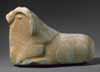
==Cave
paintings: by 5,000 BCE, these
are found
all over South Asia (*IGNCA*);
not surprisingly, they're often hard to date and interpret. Paintings
from
the Indus Valley: *Univ.
of Heidelberg*; *Kharway,
from AIIS*; *art
and archaeology* [*Routes*] |
 |
==Met
Museum timeline: *South
Asia 8000-2000 BCE* |
 |
==Mesopotamia,
in Iraq, is the home of a major, literate bronze-age civilization
(c.3500
BCE onward) that becomes a vital resource for its trading partners in
the
Indus Valley (*British
Museum*). Other early civilizations in the region are now being
discovered,
such as *Jiroft*
in Iran. |
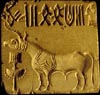 |
==the
Indus Valley Civilization (c.3000-1750 BCE): This major,
widespread bronze-age civilization (*wiki*)
remained unknown for centuries, and was rediscovered only by accident
in
the 1860's, during railroad construction in the Punjab; work on it
began
only in the 1920's. Nobody can read the characters on its famous
seals--
if indeed they're an alphabet at all, as seems increasingly doubtful.
Large
amounts of fascinating and up-to-the-minute material about this very
urban
culture are provided at *harappa.com*.
And the process of discovery continues: *U.
Penn.*. [*Routes*] |
 |
==Met
Museum timeline: *South
Asia 2000-1000 BCE* |
 |
==the
Indo-European languages keep branching out (from some
area
yet to be reliably determined) and spreading widely. Starting from a
single
"proto-Indo-European" mother tongue, they develop major offshoots that
include Latin, Greek, old Persian, and Sanskrit. Discussion and
examples:
*PIE*,
*wiki*;
*Diebold
Center*; *Daniel
M. Short*. |
 |
==the
Mitanni people maintain, from after 1500 to around 1350
BCE,
a Hurrian kingdom in Mesopotamia with a language that displays some
archaic
Indic linguistic features, including at least a few Sanskritic names
and
words, and occasional references to Vedic deities: *wiki*;
*Harvard
Univ.*. |
 |
==the
gathas of the Zend Avesta (Iran) are roughly contemporary
to the Rig Veda (northern Punjab), or perhaps a little earlier, and in
language and worldview they are full of parallels (a "gatha" is a verse
form in Sanskrit too). Worship is accorded to "Mithra" (=Mitra), to the
fire, to "haoma" (=Soma), etc.; there are also intriguing reversals:
the
"daevas" (=Devas) are the demons, not the gods. Texts and translations:
*avesta.org*.
Translation and discussion: *James
Darmstetter (1880)*. |
 |
==the
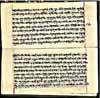
Vedas (c.1200 BCE onward): The
earliest
Indic religious texts take shape in the northern Punjab, in an old form
of Sanskrit. Carefully memorized and transmitted only orally, they are
not written down for many centuries. The oldest and most important is
the
Rig Veda: *K.
L. Ross*; *Sources
of Indian Tradition*; a zoomable map of *Vedic
India*. [*Routes*] |
 |
==the
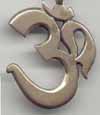
Upanishads (c.1000-500 BCE). In
the
Upanishads, the Vedic fire sacrifices and soma rituals become a
springboard
for metaphysical speculation: *Sources
of Indian Tradition*. The Upanishadic mystical syllable "OM" is
still
very much with us nowadays, and inspires all kinds of modern variations
(*K. L.
Ross*; *himalayan
academy*; or go to *Exotic
India* and do a search for OM). [*Routes*] |
 |
==Met
Museum timeline: *South
Asia 1000 BCE - 1 CE* |
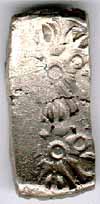 |
==The
earliest coins appear (c.550
BCE): The
earliest Indian coins appear (*nupam*),
issued by the sixteen large quasi-tribal "maha-janapada" kingdoms (*rbi*).
These punch-marked coins have been found in hoards together with early
Greek and Persian coins from the same period (*sacoins*),
which shows the strength of early trading networks. One important very
early mahajanapada, Gandhara, is located in northern Pakistan and
northeastern
Afghanistan. The best research site on these coins: *Ancient
Coins Canada*. [*Routes*] |
 |
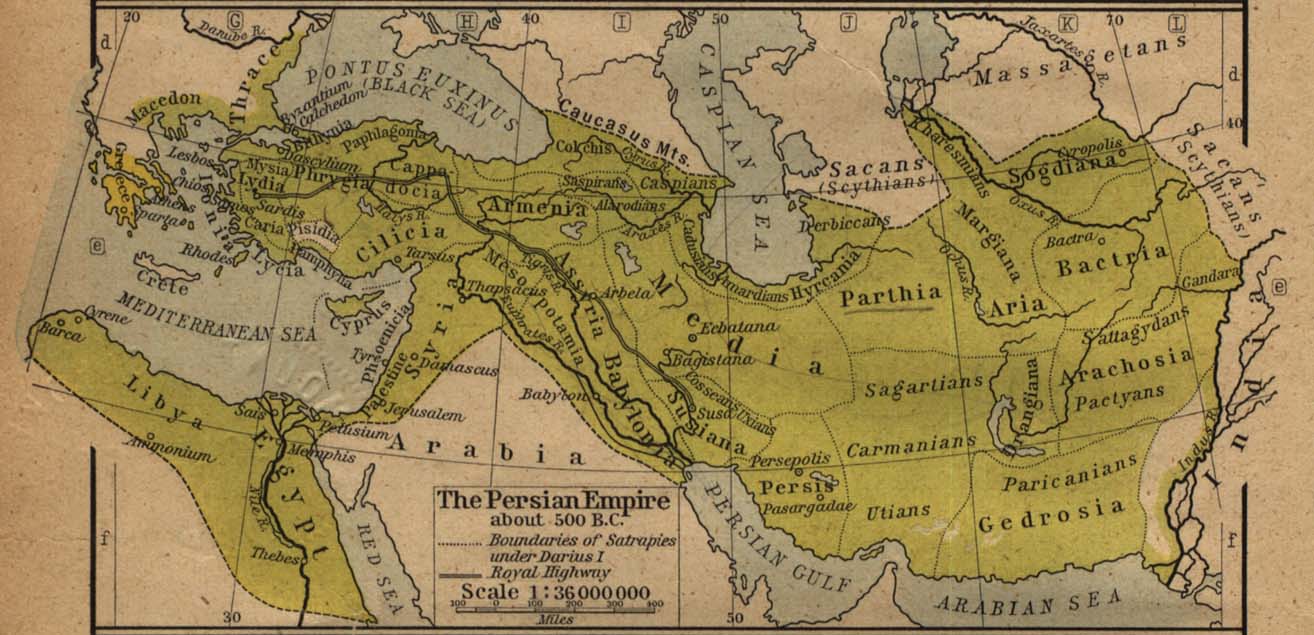
==Persia
rules Gandhara and Sind (from
c.518
BCE to Alexander's arrival): much of what is now western Pakistan
becomes
the eastern border area of the Achaemenid emperor Darius the Great's
(r.528-486
BCE) kingdom (*livius*).
Darius's legacy from his predecessor Cyrus II includes the famous *Cyrus
cylinder* (*a
zoomable view*), an early human-rights charter of sorts. Darius's
capital
of Persepolis is an influential cultural center (*Univ.
of Chicago*), and its carvings include pictures of people from both
Gandhara (*livius*)
and Sind: *"Indian
delegation"*. Recent archaeological studies: *Charsadda*
and *Akra*
(NW Pakistan); *the
Achaemenid Empire and the Magadhan Empire*. [*Routes*] |
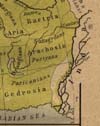 |
==Darius
explores the Indus (c.515): Darius sends Scylax of
Caryanda
to explore the Indus River by sea. Scylax returns two and a half years
later, and records his results in a work now lost. If it had survived,
we'd have a source earlier than Herodotus. As it is, we know about his
journey only from Herodotus: *livius*. |
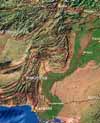 |
==Indus
Sind Hind Hindi Hindu Hindavi India: From this time
forward,
the name of the great river of northwestern South Asia becomes the name
of South Asia in general (or various large parts of it, especially the
northern and northwestern). The name is later also applied to
languages,
religious practices, social organization, and many other things in the
region. The name is thus originally one given by people west of the
river,
to describe people and things east of the river. Some lovely pictures
of
the northern Indus Valley area: *krohn*. |
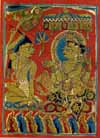 |
==Mahavira
and Jainism (500's CE): Officially the 24th and final
tirthankara,
literally "ford-maker," of the Jain religion, Mahavira is the first one
to enter the historical record. The influence of Jainism on Indian
history
has always been much greater than numbers alone would account for. An
emphasis
on nonviolence and austere living has been at the heart of it: *Sources
of Indian Tradition*; *the
early Jain heartland*. |
|
|