
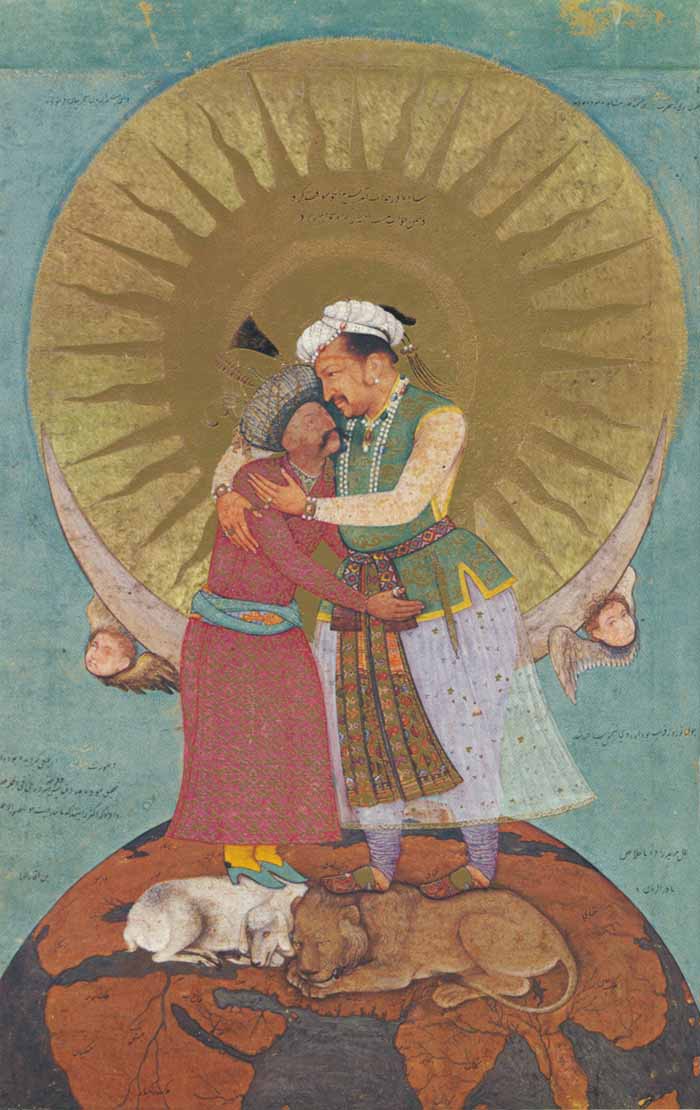
Jahangir's dream of embracing Shah 'Abbas
Source: Stuart Cary Welch, Imperial Mughal Painting. New York: George Braziller, 1978. Image: Plate 21, p. 80; scan by FWP, Aug. 2001
Commentary by Stuart Cary Welch, p. 81:
"Fretful over the possible loss to the Safavis of the strategic fortress of Qandahar, Jahangir had a dream of Shah 'Abbas Safavi appearing in a well of light and making him happy. According to the inscriptions on this miniature, he commissioned Abu'l Hasan to paint it.
Qandahar guarded the Mughals' vulnerable northwestern frontier and had been contested by Safavis and Mughals ever since Humayun had failed to return it to Shah Tahmasp....In 1613, Jahangir sent Khan 'Alam as ambassador to Shah 'Abbas to plead the Mughal case. His mission failed. The Persians took Qandahar in 1622 while Jahangir was too preoccupied with Shah Jahan's rebellion to stop them.
Abu'l Hasan's portrait, according to an inscription, was based
upon
inquiries--no doubt assisted by portraits from life by Bishndas,
who accompanied
the embassy. Eager to please his worried patron, Abu'l Hasan
painted a
frail Shah 'Abbas with fashionably hennaed hands, cowering in the
embrace
of mighty Jahangir. Like the Hindu god Ganesh on his rodent
vehicle, the
royal pair are borne by tactfully selected animals, which in turn
rest
on a terrestrial globe. The Mughal strides on a powerful but
peaceful lion
that has nudged the Shah's miserable sheep into the Mediterranean.
Nevertheless,
the Iranian has the good fortune to share Nur ud-Din ("Light of
Religion")
Jahangir's refulgent halo, the massed light of sun and moon,
supported
by European-inspired angels."
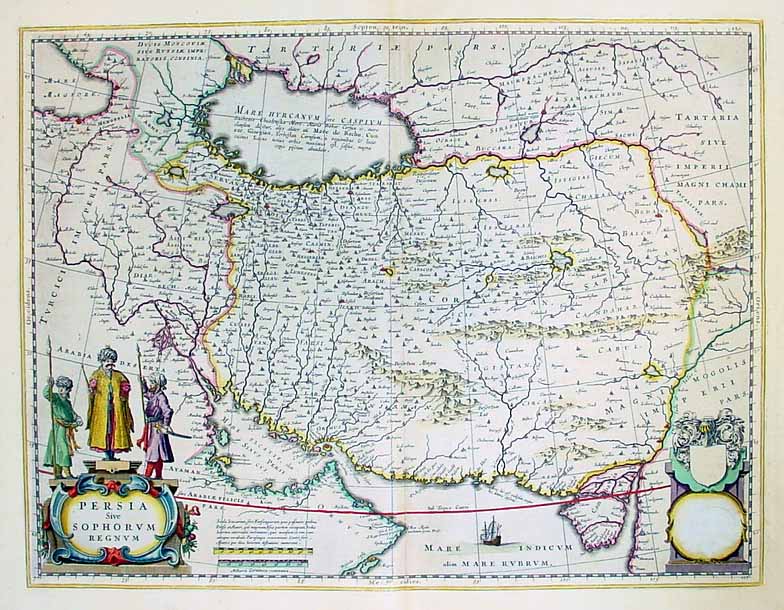
This map from the 1650 Dutch edition of Joan Blaeu's Atlas Novus shows the extent of the Persian empire at the time
Source: ebay, Oct. 2005
== Indian Routes index == Indian Routes sitemap == Glossary == FWP's main page ==