|
TIPU
SULTAN of Mysore (r.1782-99) |
|
|
|
*MAP*
|
You'll find him, by name,
down in
the far
southwest |
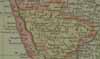 |
Haidar Ali's and Tipu's
domain of
Mysore,
in Joppen historical maps: *Haidar's
domain
in 1780*; *Mysore
in
1784*; *South
India
in 1795*; and the *Wilkinson
maps* |
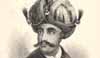 |
Haidar Ali, an able and
energetic
wielder
of power, fought the British in the first two
Anglo-Mysore wars, but
died
suddenly in 1782; the account of *a
British captive*
|
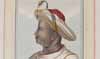 |
Some of the many extant
portraits
of HaidarAli's
son, Tipu Sultan, whose mascot and symbol was a tiger;
see also *"The
Tiger and the Thistle"* |
 |
Right from the first, it was
hard
for the
British to keep track of what he might be up to, and
hard to decide on
the proper response |
 |
In Mysore city, Tipu had a
very
impressive
palace that later burnt down; the new one that replaces
it is still
guarded
by six formidable tigers |
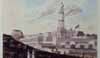 |
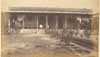
His island-fort town of
SERINGAPATAM (now
Shrirangapatam, near Bangalore) was dominated by a
notable mosque and
conspicuous
temple gopurams |
 |
In Seringapatam Tipu also had
a
summer palace,
the elaborately frescoed Darya Daulat |
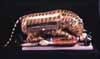 |
His special mechanical tiger
was
designed
to savage a British soldier; the British responded with
their own
symbolic
attacks (Tipu was later duly demonized by *Sir
Walter
Scott*) |
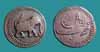 |
He minted some coins with
very
Indic elephant
designs |
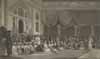 |
Infuriated by Tipu's military
successes,
and fortified by alliances with the Peshwa and the
Nizam, General
Cornwallis
prepared to move against Mysore once again |
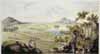 |
The Third Anglo-Mysore War
(1789-92) was
fought in defiance of the Company's prohibition against
such military
expansionism |
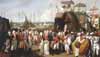 |
In 1792, after his defeat,
Tipu
was obliged
to hand over two of his sons to General Cornwallis as
hostages for his
future good behavior; he later ransomed them |
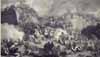 |
The Fourth Anglo-Mysore War
(1798-99) culminated
in the final "Storming of Seringapatam" in 1799 |
 |
Above all, Tipu's death
seemed to
be an
emblematic, dramatic, romantic moment for the British; *an
early Bollywood view of his death*; *the
finding of his body* |
 |
His vicissitudes gave rise to
political
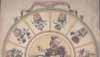
cartoons, his exploits inspired a British board game--
and now he's
depicted
as a religious martyr too |
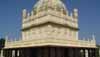 |
The domed tomb near
Seringapatam
where Tipu,
and Haidar Ali and his wife, are buried |
|
|