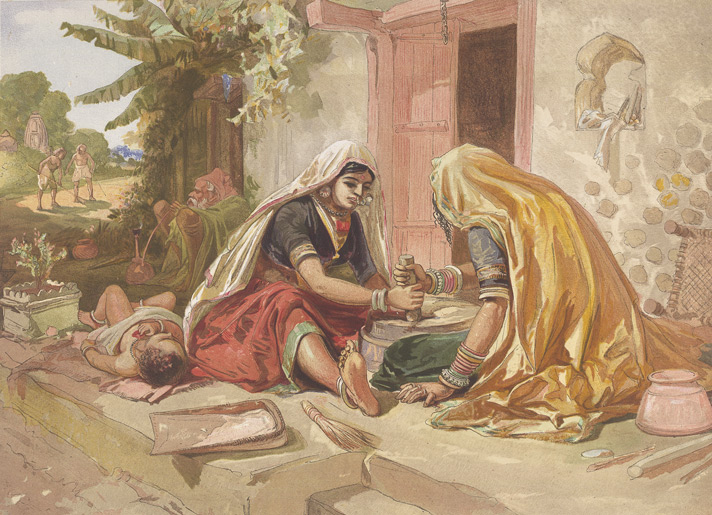
*"Women grinding corn," a chromolithograph by William Simpson, 1867*
ro;Tii kyuu;Nkar muyassar aatii hai
"How do we get our roti?" (a masnavi for children)
translated (very literally) by FWP, July 2009
and dedicated to the "Readings in Urdu Lit" class of spring 2010, who helped to improve it
*the Urdu text of the masnavi*
1) In that you eat roti every day / Tell me, how is roti prepared?
2) If it's cooked from flour / Tell me, where does that come from every
day?
3) If this flour is ground from grain / Then, whose work is this
grinding?
4) In what way do we get wheat? / And where does it come from, and how?
5) It's the farmers' kindness to us / That we get wheat.
6) They bring people their daily bread, / Consider them the
grain-merchants of the Lord's house.
7) Theirs is the work of cultivating every harvest / Theirs is the work
of enduring hard labor.
8) It is they who sow and harvest grain! / In this, the whole creation
is in need of them.
9) Farmers from here and from there, regularly / Bring wheat collected
in sacks.
10) The merchants who are shopkeepers in the bazaars / They are the
buyers of their sacks.
11) Having settled the price of the wheat / They fill their shops with
it.
12) The whole bazaar remains full of wheat-grains / Wherever you look,
there are heaps of wheat-grains.
13) It's they from whom we buy wheat / A rupee's worth, two rupees'
worth, ten rupees' worth.
14) Whatever your dad earns / He too buys and brings grain of that
amount.
15) He brings it and gives it to your mom / She, having sorted through
it and winnowed it and prepared it,
16) Grinds it herself, with her own hands, / She has arranged a
hand-mill in the house.
17) With this very hand-mill she had ground that grain / Which having
eaten and eaten, you've flourished.
18) That poor thing always, at dawn / When you're unaware, still
sleeping,
19) Quickly goes and sits down to grind flour. / She's an amazingly
hard-working creature of the Lord!
20) With this hand she turns the hand-mill / And with that one, she
keeps on putting in wheat-grains.
21) When her right hand becomes tired / Then she changes to the left
hand.
22) Sometimes, when she feels anxious at heart / She begins to repeat
the name of the Lord.
23) Sometimes, having immersed her heart in the Lord / Having sung a
song, she comforts herself.
24) When the flour has been ground, then, so to speak / She considers,
'I conquered a great fortress!'
25) Then having picked through the flour and separated out the chaff /
She takes it up and puts it into a pot.
26) Then she begins to knead the flour, slap-slap / And pounds it with
her fists, thump-thump.
27) She pummels the flour in such a way / As if she wrestles with it.
28) When the flour has been kneaded, she takes / The tava, and puts it
on the stove.
29) From the kneaded flour she makes dough-balls / So that by whatever
means it would be finished quickly.
30) Then, hastily, she puts on the roti / Whether the bread would be
thin or thick.
31) Somebody just take a look at her speed / She put it on the tava--
and in a moment, it's flipped over.
32) Having cooked, served, eaten, fed others / Having washed up the
utensils that got dirty,
33) She took up some other household tasks. / This is her routine,
morning and evening.
34) If at some time fuel is not available / Then she, having taken on
her head the basin of flour,
35) Goes straight, poor thing, to the oven / That is not so very far
from her house.
36) The innkeeper, who maintains the oven-- / Everybody keeps bringing him flour, and having him cook.
37) He remains, morning and night, at the ready / One comes to the
shop, another goes.
38) He sits there, wearing his langoti / With great speed he puts on
the roti.
39) One moment he spreads it on his hands and lifts it up / He lays it
on the baking-pad, and at once puts it on.
40) In his hands, the way it appears / As though he were some swift
fencer.
41) He constantly pounds on the dough-balls, the way / So to speak, a
wrestler strikes his arms in challenge.
42) The rotis come off, one after the other / All hot, sticking
together, well-baked.
43 ) When all the rotis have been cooked and have come off / She covers
them with a cloth and brings them.
44) Meanwhile, all you sisters and brothers / Are playing the tune,
'Mom has come, now she's come!'
45) Hungry, they watch for their mom / But they don't at all understand a mother's love.
46) She keeps on serving all of you / She doesn't even get time to die.
47) Day and night, this is her hardship / To cook, to serve, to sew and
mend.
48) She's always trodden underfoot among you children, night and day /
Even if she'd say something, to whom would she say it?
49) She's conscious neither of good and of bad / Nor of dressing
and covering herself poorly/unfashionably.
50) For her to collapse somewhere, when she has the leisure / Is this
'sleep' really to be counted as sleep?
51) Day declines, and her head lifts: concern over food / Concern over
your father's coming home.
52) Having gone out from home in the morning / When he will return in
the evening, from work,
53) The moment they see him, spontaneously / Small and great will
become silent.
54) The moment he will set foot inside the house / All of you will sit
quietly, out of fear of him.
55) And Amma, having left off her sewing / Will begin to attend upon
him.
56) He doesn't manage to relax, before / She comes, and brings and
spreads out the dining-cloth.
57) At one moment she stands and waves a fan over you / At another
moment she keeps bringing water for you all to drink.
58) She keeps giving to all of you the spicy gravy / Although for
herself, no relish-dish might remain.
59) Whatever is left over, bones and pieces / With it she eats her roti.
60) Her purpose is to feed you / She has no interest in her own eating.
61) If you would find your food savory / Then it's as if she considers
her work virtuous.
62) If if would not be cooked flavorfully, then-- 'you wretch!' / She
feels it in her heart, just a bit.
63) After all, who can do without a mom? / She herself didn't eat-- and
she fed you.
64) What do you care about those struggles, brother / Through which you
get your food cooked?
65) You don't bother about either cooking or cooking arrangements / If
what you want is to eat!
66) If there would be the least little delay in eating / Then you turn
the house upside down with weeping.
67) Don't you know your dad's love? / Don't you recognize your mom's
maternal feeling?
68) Aren't you at all aware of their hard labor? / Don't you notice
their self-sacrifice?
69) You can't give them the return they deserve / Even if you give up
your life for them.
70) Honor them with your heart and soul / Obey and serve them
respectfully.
71) From this, understand your mom's rank and honor: / That under her
feet is Heaven.
72) She has brought you up and reared you through hard labor / You
tormented her, but she didn't curse you.
73) Learn this lesson from Mom and Dad, and remember it: / When you
grow up, you will have to do exactly this.
74) The great thing is when you would give them a hand. / When you grow
up, be of service to them.
75) Don't you ever be lazy and idle-- / Put your heart into your
various tasks.
76) Don't let your reins hang loose-- / Consider shirking to be a form
of theft.
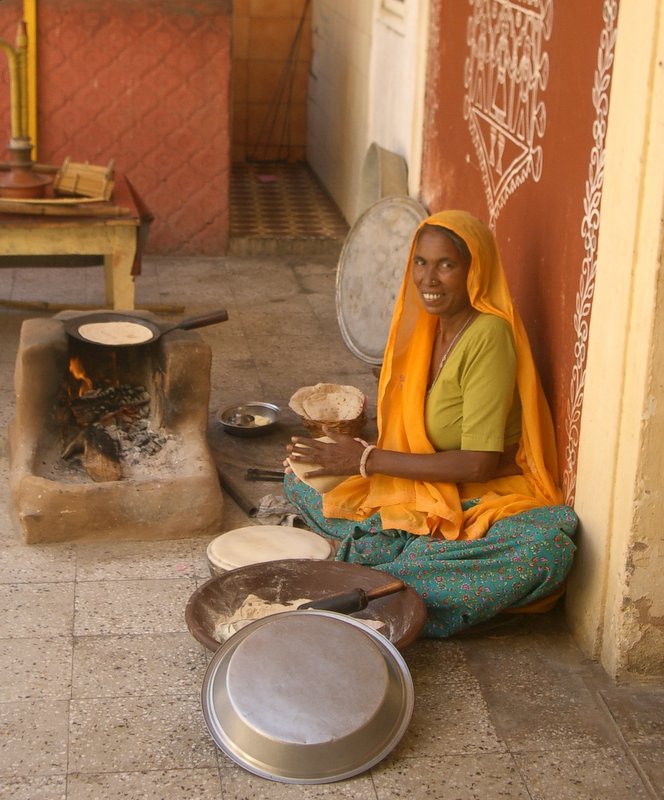
*Roti-making in Rajasthan, 2008*
== *back to HALI index* ==