Background Paper
Macedonia Since Independence:
(De) Constructing a Multi-Ethnic State
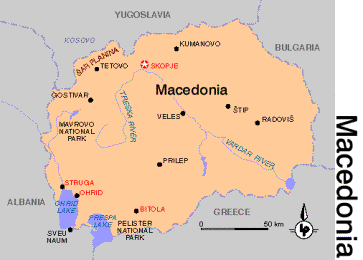
“I really don't see a deep reason for a war…. Normal people hate this situation because finally after all that has happened in the last few months we have realised that the peace that we had is much more valuable than any kind of peace that will come after all this war, negotiations, and I don't know what.”
Maria, a 44yearold Macedonian English teacher living in Skopje.
“[Macedonian leaders] still do not know whether they want to live with us or whether they want to separate from us…Intellectually it makes me smile, it is ridiculous. But from a human perspective, it makes me cry sometimes... I am losing my hopes for a better future… Sincerely, we are afraid. We are afraid because we are sick of wars. We are talking about two nations who have lived together for ages without hate or basic human problems.”
Adelina, a 30yearold ethnic Albanian doctor living in Skopje
Table of Contents
I. Recent Developments: The Upsurge in Violence------------------------------3
II. Macedonia Since Independence---------------------------------------------------4
1. Overview---------------------------------------------------------------------------4
2. Political Structure-----------------------------------------------------------------4
3. Economy: Downturn Since Independence-------------------------------------5
4. Human Development: Living Standards Decline-----------------------------6
5. Society: Managing Minority Tensions-----------------------------------------6
III. Critical Issues-------------------------------------------------------------------------7
1. Constitution------------------------------------------------------------------------7
2. Census 2001-----------------------------------------------------------------------8
3. Education---------------------------------------------------------------------------9
4. Corruption-------------------------------------------------------------------------10
5. The Kosovo Factor---------------------------------------------------------------10
6. Yugoslav-Macedonian Border Negotiations----------------------------------11
7. The Regional Environment -----------------------------------------------------11
8. The Role of the Media-----------------------------------------------------------12
9. Decentralization------------------------------------------------------------------12
10. Human Rights Violations-------------------------------------------------------13
11. Arms Trafficking-----------------------------------------------------------------13
12. Albanian Diaspora---------------------------------------------------------------14
13. Greater Albania-------------------------------------------------------------------15
IV. Civil Society and International Involvement----------------------------------15
1. Overview---------------------------------------------------------------------------16
2. Recent International Involvement----------------------------------------------17
Time Line of Major Recent Events--------------------------------------------------------18
Sources------------------------------------------------------------------------------------------20
* Background paper researched
and written by Zoltan Simon, Program Assistant and Flora Monsaingeon, Intern,
of the Carnegie Council’s Program on Conflict Prevention
Macedonia Since Independence:
(De) Constructing a Multiethnic State
I. Recent Developments: The Upsurge in Violence
In late January 2001 ethnic Albanian rebels in northern Macedonia started a violent campaign with the stated objective of defending ethnic Albanian villages from Macedonian government forces and achieving equal rights for ethnic Albanians in Macedonia. Others have argued, however, that the rebels, known as the National Liberation Army (NLA), are merely a front for criminal networks that want to destabilize the border region in hope of continuing to profit from illicit trafficking. Whatever its origins, the NLA has succeeded not only in destabilizing the border region, but in moving the entire country of Macedonia towards a national crisis.
The NLA started organizing for an eventual confrontation with the government in late 2000. The ranks of the NLA include former fighters of the Kosovo Liberation Army, but many of the fighters are Macedonian ethnic Albanians. After initial sporadic fighting, the government announced a crackdown on the guerrilla group in March 2001. The use of heavy artillery by the Macedonian security forces in its attacks, which has resulted in a number of civilian deaths, has been criticized by international human rights organizations. Since the conflict erupted, approximately 100,000 people have been displaced in this nation of two million; of those displaced, 70 percent are ethnic Albanians who have crossed into Kosovo to live with friends and family. Since June 2001 the emergence of a Slav paramilitary group that targets ethnic Albanians have further deepened the crisis and heightened the possibility of civil war.
On the political level, the Macedonian government believes that the true objective of the NLA rebels is to undermine the integrity of the state and create a separate Albanian entity. In an attempt to prevent the rebels from claiming the support of mainstream Albanian political parties, Macedonia’s Parliament overwhelmingly endorsed a national unity government on May 13, 2001; the unity government, however, has been noticeably lacking a spirit of cooperation since its inception. In late May rumors that ethnic Albanian politicians had struck a deal with the rebels following secret negotiations created a rift in the coalition. In late June Deputy Interior Minister Refet Elmazi, an ethnic Albanian, said that the interior minister and the prime minister, both ethnic Macedonians, were not sharing crucial information with him about the details of the reservist callup, which is essential knowledge in his post. He said that Macedonians are playing a “very secret game.” By early July the ethnic Albanian political leaders were calling for the creation of a new vice presidential post, to be filled by an ethnic Albanian, who would have veto power over most major government decisions. Although the unity government is still intact, there are clear cracks emerging in the unity front.
Just as important as the thinking and actions of the political leaders are the sentiments of the population upon which the politicians depend for support. The NLA tapped into the strong sense of discontent in the ethnic Albanian community that helps sustain their momentum. On the other side, many ethnic Macedonians believe that the government has already agreed to too many ethnic Albanian demands and that it has responded weakly in the face of rebel action. Indeed, many key politicians are under strong pressure to refuse to negotiate with the NLA and to crush unambiguously the rebellion. The continuation of the conflict will likely lead both Slav and ethnic Albanian politicians to harden their positions. Most analysts agree that this most recent round of violence has already set back ethnic relations by years.
II. Macedonia since Independence
1. Overview
The Former Yugoslav Republic of Macedonia (FYROM) is a multiethnic state that gained independence in 1991 after the dissolution of Yugoslavia. Against the backdrop of turmoil that engulfed the Former Republic of Yugoslavia, Croatia, and BosniaHerzegovina in the 1990s, Macedonia was in many ways a model of democratic transition and peaceful coexistence among its various ethnicities from the perspective of the international community at large. Since independence, however, Macedonia has faced serious internal and external pressures that have tested its nascent democratic roots. In particular, the strained relations between ethnic Albanians, the largest minority, and the ethnic Macedonian majority have threatened the country’s stability. Presently, the overriding objective of the current government is the preservation of the integrity of the state against the recent attacks of ethnic Albanian insurgents, while the primary longterm goals are the establishment of more harmonious relations among the various ethnic groups inside Macedonia and the integration of the country into the European and international community, which is viewed as the road to economic development and political stability.
2. Political Structure
Party politics in Macedonia is divided along ethnic lines. The Internal Macedonian Revolutionary Organization Democratic Party of Macedonian National Unity (VMRODPMNE) is composed almost exclusively of ethnic Macedonians and has had a traditionally rightwing, nationalist platform, although recently the party has generally adopted a more moderate tone. Another major political party is the leftleaning Social Democratic Alliance of Macedonia (SDSM), which branched off from the former communist party. Also composed of ethnic Macedonians, as well as Vlachs, the SDSM represents a more moderate platform, although it has recently strengthened its nationalist stance. The Democratic Party of Albanian (DPA) and the Party for Democratic Prosperity (PDP) are the most popular ethnic Albanian parties. The DPA, by far the most radical, appeals mainly to younger ethnic Albanians, and its leader, Arben Xhaferi, is one of the highest profile activists for Albanian rights in Macedonia. Like the Slav SDSM, the PDP inherited many politicians from the communist era.
Macedonia has a parliamentary system where citizens elect one member to parliament every four years through majority elections in 120 constituencies. Since 1991 coalition governments that included parties of both ethnic Macedonian and ethnic Albanian groups have ruled Macedonia. Kiro Gligorov of the Slav SDSM party was elected in 1991 for the first of two fouryear terms as president. In the elections of 1998 the coalition of the VMRODPMNE, Democratic Alternative Party, and the Albanian DPA defeated the ruling SDSM, leading to difficult years of cohabitation. At the same time, the ethnic Albanian leftwing party PDP suffered a major defeat by being completely unseated from the government for the first time since independence. In 1999 Boris Trajkovski of the VMRODPMNE party won the presidency, with the crucial support of Arben Xhaferi of the DPA. In May 2001 a unity government was forged in response to the violence generated by the insurgency of the ethnic Albanian NLA. The unity government comprises eight political parties, including the VMRODPMNE and DPA coalition, as well as SDSM and PDP, the opposition parties since 1998.
Voter turnout for local and national elections is strong, ranging between 70 and 80 percent. These high numbers are particularly surprising in the context of growing voter cynicism among ethnic Macedonians and Albanians alike. Macedonian citizens generally believe that the electoral process is far from legitimate, as scandals on ballot manipulation, violence, and even murders, have accompanied elections since 1994. Most recently, serious irregularities were noted in the presidential elections of 2000. Despite these questionable events and practices, the international community has endorsed election results, leading many Macedonians to believe that the international community is more concerned with the show of elections than in guaranteeing true democratic expression.
3. Economy: Downturn since Independence
In the ten years since independence, Macedonia has had to weather several economic shocks in its transition from a centralized to a marketbased economy. As part of Yugoslavia Macedonia was the poorest republic and the economy was especially reliant on the production of metals and other semifinished goods, most of it destined to other parts of the federation. With the collapse of Yugoslavia and the imposition of UN sanctions on SerbiaMontenegro in 1992, Macedonia was deprived of Belgrade’s subsidies and barred from legally trading with its main economic partner. In 1994 Greece imposed its own trade blockade, crippling the Macedonian economy. From 1991 to 1995 output in Macedonia fell by nearly 40 percent.
In 1996 after the signing of the Dayton peace agreement and the lifting of the Greek embargo, Macedonia began a slow but sustained economic recovery. Economic policies focused on structural adjustments in its banking sector and the privatization of formerly stateowned enterprises. But another external shock, this time the Kosovo crisis and the NATO bombing of Yugoslavia, led approximately 350,000 refugees to enter Macedonia, forcing the Macedonian government to temporarily abandon longterm economic targets.
The Kosovo crisis had an adverse impact on the Macedonian economy, although the macroeconomic downturn was not as serious as previously forecasted. Macedonia lost its main export market in the Former Republic of Yugoslavia and regional political uncertainties led to decreased foreign investment. But the swift return of the refugees to Kosovo after the end of the bombing campaign and increased economic ties with the rest of Europe helped Macedonia register modest growth rates in the second half of the 1990s.
According to World Bank indicators, current GDP is approximately $3.5 billion and services, industry, and agriculture account for 53, 35, and 11 percent of the GDP respectively. The unemployment rate is high, between 30 and 40 percent depending on the estimate, and unemployment is higher in the ethnic Albanian community. With continued structural reforms and the prospect of increased integration with Europe through the Stabilization and Association Agreement signed in April 2000, the World Bank forecasts annual growth rates of 2 to 6 percent in the first years of the decade, although these predictions did not take into account the context of violence and uncertainty that has prevailed since February 2001.
4. Human Development: Living Standards Decline
While the government tried to stabilize and improve the economy throughout the 1990s by adopting orthodox economic policies, the living conditions of most Macedonian citizens steadily declined in this decade. Unemployment and poverty rates soared, and income inequality grew. The inequality is most evident in the ruralurban divide, with about two thirds of the poor living in the countryside. The regions inhabited by Albanians and Roma also show higher poverty rates than the rest of the nation. According to a survey cited by the United Nations Development Programmeon whose reporting much of this section relies in 1996 two thirds of households thought that their situation was worse than the previous year.
The real salary in 1997 was 58 percent of that in 1990, and, according to the UNDP report “Features of the National Human Development Report 1998 for the Former Yugoslavian Republic of Macedonia,” in 1997 Macedonia had the highest unemployment rate among transition countries at 36 percent. Unofficial estimates indicate that the actual rate of unemployment outside the capital is closer to 60 or 70 percent; of those unemployed, only 20 percent receive unemployment benefits.
The government’s inability to provide an adequate level of social security led to a decline in the living standards of most citizens, but those most dependent on government services the old, the disabled, and the unemployedhave been disproportionately affected. Poor overall economic performance and the widespread evasion of taxes are major reasons for the insufficient level of government expenditures on social programs. However, it must also be noted that the unstable regional environment and the expiration of financial support from Belgrade after Macedonia’s independence adversely affected the government’s ability to address the needs of the citizenry.
5. Society: Managing Minority Tensions
Although formerly considered a model of stability in the region, Macedonia’s social stability has always been a delicate balancing act between the majority ethnic Macedonians, who comprise 66 percent of the population, and various minority ethnic groups, including Albanians, Serbs, Roma, Turks, and Vlachs. While comprising only 2 percent of the total 2.1 million population of Macedonia, the Serb minority’s complaints for fairer treatment in the aftermath of Macedonia’s independence could have led to destabilizing actions from the Former Republic of Yugoslavia on behalf of the Serb population in Macedonia. However, this has not happened at least in part because of the granting of certain minority rights to Serbs after direct talks with the Macedonian government in 1992 and 1993. The agreement from these talks stipulated a constitutional change recognizing Serbs as one of the minorities and guaranteed the same government media support to Serbs as to other minorities.
The Albanian minority situation has been a much harder issue to settle for the Macedonian government. Albanian political participation is in many ways the glue that binds Macedonia’s multiethnic identity together. Comprising 23 percent of the total population according to the 1994 census, although this figure is in dispute (see section III.2.) because ethnic Albanians claim that their numbers are closer to 33 percent of the population, ethnic Albanians are the largest and most vocal minority, and the neighboring state of Albania and the Albaniandominated province of Kosovo threaten a wider regional conflict should the Albanian minority lose its stake in state of Macedonia. Beside the controversy over the census, four central complaints of ethnic Albanians in Macedonia are:
- the wording of the Macedonian Constitution, which ethnic Albanians claim reduces minorities to the level of secondclass citizens
- lack of access to higher education in their mothertongue, Albanian
- underrepresentation in government jobs, especially in the police and military forces
- curtailment of rights to display cultural symbols, such as the Albanian flag
These and other destabilizing issues are discussed in detail in the following section.
III. Critical Issues
1. Constitution
Since the constitution of Macedonia was adopted in 1991, ethnic Albanians have refused to accept what they claim is their “secondclass status” as citizens of Macedonia. The key grievance lies with the preamble to the constitution, which describes Macedonia as “the national state of the Macedonian people, in which full equality as citizens and permanent coexistence with the Macedonian people is provided for Albanians…” and other minority groups. Minorities believe that the tone of this statement encourages discrimination against them by the ethnic Macedonian majority. For years ethnic Albanians have advocated a change in the language of the preamble and have requested to be recognized as a “constituent people” of Macedonia, equal in status to ethnic Macedonians. Others argue that the constitution should be “deethnicized,” suggesting that the focus on collective versus individual rights is an obstacle in Macedonia’s path to a modern democracy.
Other constitutional concerns of the ethnic Albanians include equal recognition and status for their language and religion. The constitution stipulates that the Macedonian language is the only official language. Ethnic Albanians argue that the lack of access to public services in Albanian is strongly discriminatory and demand the provision of a bilingual public administration and education system. With regard to religion, the constitution states that “the Macedonian Orthodox Church and other religious communities are free to establish schools and other institutions,” without referring explicitly to Islam.
Although no official negotiations concerning these constitutional issues have begun, the government regularly promises that talks are to begin soon to accommodate the Albanian minority’s demands. Ethnic Macedonian government officials claim that many of these demands can be resolved within the framework of the existing constitution.
2. Census 2001
3. Education
A high quality education system is one of the strongest features of Macedonia’s inheritance from the former Yugoslavia, although inequalities in enrollment among the various ethnic groups and lack of funding have raised serious concerns. The secondary school system is well developed, and there are two universities with a strong range of departments. Since independence, however, the system has been drained of resources. Although the literacy rate remains high at 94 percent, increasingly parents have had to contribute to make up for the shortfall in resources and teaching materials for younger children. University students are also facing the consequences of diminishing resources, with many no longer able to afford the expense of going to Belgrade to continue their studies.
The most controversial issue in education is the rights of ethnic minorities at all levels of education. The high level of ethnic Albanian participation in primary and secondary education, coupled with a lack of educational facilities and qualified teachers, lead to overcrowded classrooms and strong feelings of resentment from minority groups. In the capital, Skopje, there is only one Albanianlanguage high school for the approximately 300,000 ethnic Albanians living in the city.
One flashpoint in the perceived educational inequality in Macedonia has been the controversy over the creation of an Albanianlanguage university in the city of Tetovo in early 1995. Although ethnic Albanians have access to Albanian language instruction in the primary and secondary level, no such provision is made for tertiary education. The university education issue is especially salient to ethnic Albanians because in 1992, the Macedonian government stopped recognizing university diplomas from Pristina University in Kosovo, where many ethnic Albanians from Macedonia enrolled. Soon after its opening, which was done without official approval, the government promptly shut down Tetovo University amid violent protest. The issue remained highly controversial and in July 2000 the Macedonian Parliament approved legislation to authorize the establishment of a multilingual, foreignfunded private university in Tetovo.
The Tetovo University controversy illustrates the tensions between minority rights and national cohesion. Ethnic Albanians regard Tetovo University as a means of preserving their cultural heritage. The government, on the other hand, fears that a separate Albanianlanguage university would be the first step toward the creation of a parallel system for minorities, which would lead to further fragmentation of society and possibly the dissolution of the multiethnic state. Although the Macedonian government had taken steps to address ethnic Albanian concerns with regard to education, such as allowing Albanianlanguage instruction for teacher training at the university, these steps fall short of Albanian demands for equal language rights at universities.
4. Corruption
Rampant corruption among politicians in Macedonia has seriously eroded the government’s credibility, rendered questionable its legitimacy, and hampered its ability to confront the most sensitive issues of interethnic relations in the country. According to a recent survey cited in the 2001 International Crisis Group report “The Macedonian Question: Reform or Rebellion,” only 1 percent of respondents believed that Macedonian politicians were honest. The corruption spans a gamut of issues: electoral fraud in the 1994, 1999, and 2000 elections; close links between politicians and criminal networks, and between politicians and businesses interests; and other unethical and undemocratic government practices, such as the wiretapping of phone conversations. These practices have evoked cynicism from the population at large, and especially from the minority populations who already have a high distrust of politicians and state institutions.
5. The Kosovo Factor
Some argue that the NATO action in Kosovo and the subsequent UN administration, which is gradually granting more autonomy to the province, have already encouraged ethnic Albanians in the region to call for independence. An official recognition of Kosovo as an independent state as advocated for example by the Independent International Commission on Kosovomay add fuel to the fire of ethnic Albanian aspirations in Macedonia. But others point out that the mixed signals from the international community at large as to the future of Kosovo are also a destabilizing influence on the region, encouraging further violence from ethnic Albanians in hopes of dissuading the Western powers from reuniting Kosovo with Belgrade.
The first national elections in Kosovo will be a major event in the gradual transfer of authority from the UN administration to local officials. On November 17, 2001, voters will elect a 120member legislature. One hundred of these representatives will be elected through proportional representation, while the remaining twenty seats will go to nonmajority communities, ten for Kosovo Serbs and ten for other communities. The work of the assembly will be guided by a sevenmember presidency, which will suggest draft laws. The assembly will elect a president of Kosovo, who will nominate a prime minister. The final status of Kosovo is still to be determined fully after the gradual transfer of power to elected officials. This constitutional framework is said to be the result of a joint effort of all Kosovo communities.
Despite these elections, the international community is hesitant to declare a clear timetable for the eventual determination of Kosovo’s statusthe so called “final status” at least partly because of the unpredictable effect this may have on the interethnic conflict in Macedonia. President Kostunica of Yugoslavia has expressed his opposition to having elections in Kosovo prior to the determination of “final status” for the province, meaning that Kosovo Serbs may boycott the upcoming elections. Most international observers agree that free and fair elections must be held in Kosovo and legislative bodies with real governing powers must be put in place. But there is still wide disagreement over Kosovo’s final status and its possible effect on the ongoing conflict in Macedonia.
6. YugoslavMacedonian Border Negotiations
Since Macedonia proclaimed its independence ten years ago, Belgrade has refused to mark the borderline between Yugoslavia and Macedonia because of uncertainties about its exact location. After fourteen rounds of negotiations, Yugoslavia and Macedonia finally signed a border agreement in February 2001. Kosovar Albanians could not legally negotiate a border agreement with Macedonia because Kosovo is not recognized as an independent state. But the exclusion of ethnic Albanians in Macedonia and Kosovothe inhabitants of the borderlandfrom the negotiations, fed ethnic Albanian discontent and seriously damaged interethnic relations in Macedonia. After its exclusion from the negotiations, the ethnic Albanian party PDP voted against ratifying the agreement with Yugoslavia. As an indication of the importance attached to the conduct of the border negotiations, Macedonia’s prime minister has since said that the border demarcation agreement between Macedonia and Yugoslavia was “the main irritator” for the NLA, the insurgency group that set off the latest and most serious round of violence in Macedonia.
For ethnic Albanians in Kosovo and Macedonia, the border had always been porous. Despite having an international boundary between them, Albanians of both countries lived as a community, maintaining close family and business ties. When the Kosovo war broke out, many Kosovar Albanians found refuge with families and friends on the Macedonian side. Since the agreement in February, however, border patrols have been stepped up. This has especially angered the criminal networks that had benefited from lax border controls. The current guerilla offensives on the margins of the province of Kosovo and Macedonia may be a fight to control key points on a smuggling route for drugs and human trafficking known as the “Balkans Golden Triangle,” linking Turkey to Kosovo, before reaching the Adriatic Sea and Western Europe. The Albanian groups controlling the illicit trade are, according to a leading criminologist, the main source of money and weapons for the rebels of Macedonia.
7. The Regional Environment
One of the most difficult challenges for the newly independent Macedonia has been to forge friendly relations with hostile neighboring countries, some of which questioned the legitimacy of the new state. In 1994 while other EU countries formally recognized Macedonia, Greece imposed a trade embargo against its neighbor. Greece was protesting the use of the name Macedonia, also the name of a Greek province, and the star of Vergina as Macedonia’s national symbol, which Greece claims as its national archeological treasure. The embargo was lifted in September 1995 at the urging of the United States and the UN, and relations between the two countries have since improved.
Relations with Bulgaria also proved difficult immediately following independence, as a result of a controversy regarding which language should be used in agreements between the two countries. Since the Macedonian election of 1998, the relations between the two countries have improved, leading to a major expansion in trade and communication between the neighbors. When the most recent internal conflict began in early 2001, Bulgaria and Greece showed readiness to support the Macedonian government by offering arms and humanitarian assistance to restore peace.
Albania has traditionally been concerned with managing the delicate balance between condemning the regional violence of ethnic Albanians and supporting greater rights for its ethnic kin, and it has advocated a settlement through “constructive dialogue” rather than arms. In contrast to the Kosovo crisis, when Albanian territory served as a background for the KLA, there is no such evidence of a similar Albanian role in the current Macedonian crisis.
Relations between Macedonia and former Yugoslavia may have been expected to be the most troublesome from the start. From a comparative regional perspective, the Macedonian secession from Yugoslavia and the consequent declaration of independence produced less turmoil than might have been expected. Yugoslav troops withdrew peacefully from Macedonia, mostly due to the fact that Yugoslavia was already engaged in wars with Croatia and Bosnia. Nonetheless, Yugoslavia continued to consider Macedonia as a southern province and only recognized its independence in 1995. As described above, relations between the two countries were also strained by a dispute over the demarcation of their common border, which Slobodan Milosevic, the Yugoslav president, refused to draw officially.
Recently, relations improved markedly between Yugoslavia and Macedonia owing two major developments. First, after the fall of the Milosevic regime, the new government of Yugoslavia placed more importance on a cooperative relationship with neighboring countries. Within two months of Milosevic’s departure the border between the two countries was officially demarcated. Second, and perhaps most important, the violent insurgencies of ethnic Albanian guerrilla groups in Kosovo and then Macedonia led the two countries to forge closer ties in the face of a perceived common threat to the territorial integrity of both countries. In June 2001 Serbian Deputy Premier Nebojsa Covic said that Serbia stands ready to assist Macedonia in any possible way, but added that the Macedonian conflict should be solved in a peaceful manner.
8. The Role of the Media
Since independence, most Macedonian media organizations have been privatized. Private television is growing rapidly and is regarded increasingly as a credible source for news, but the major television and radio networks remain either under the control of the state or heavily subsidized. While newspapers are editorially independent, the government controls the distribution of written press (in both the Macedonian language and in the Albanian). The electronic media are not free from government interference. The Freedom House, a U.S. non-profit organization, rates the press in Macedonia as “partly free.”
As part of the protection of minorities rights, the Law on Broadcasting Activity requires public broadcasting enterprises that operate at the local level to make available programs in the languages of large minorities in the area. The result of this provision has been a tendency for communities to live in “media ghettos,” segmenting further the population across ethnolinguistic lines, and possibly disrupting the delicate balance of ethnic relations in Macedonia. Increasingly, it is suggested that the media must play a more responsible and constructive role in presenting a multiethnic character.
At the beginning stages of the upsurge in violence this year, media coverage of the crisis was generally considered to be balanced. According to the Internatinonal Crisis Group report, “The Macedonian Question: Reform or Rebellion,” after the breakout of the most recent round of violence in Tetovo, local media coverage “contributed to a mood of public hysteria, reinforcing negative stereotypes in and of each languagecommunity.” Other sources say that the media has not been a major instigator of violence. Continued coverage of the crisis by local media will be critical in fueling or taming rising tensions among the various ethnic groups in Macedonia.
9. Decentralization
The decentralization of government is considered to have the potential to give a greater voice to the average citizen in local affairs, reduce the chances for corruption, and ameliorate ethnic relations in the country. But even the decentralization process has been politicized, highlighting the Macedonian and ethnic Albanian divide and delaying legislative action for the time being.
The aim behind creating greater space for local politics is to introduce a more open, accountable, and vibrant political and civic climate that would lead to increased interaction among the various ethnic groups. At present, local administrative units are too small to sustain such decentralizationthere are 123 local units for two million inhabitants. There are plans to redraw the administrative units in the country, with less emphasis on ethnic divisions. Advocates hope that more control over the management of schools, hospitals, and public services by the local authorities would result in improved government efficiency. Local political administrations could also be in a better position to address violations of individual rights.
Legislative action has been blocked, however, by ethnic Macedonians who fear that decentralization will lead to more autonomy for Albaniansperhaps even leading the way toward federalizationand the oppression of Macedonian minorities in ethnic Albaniandominated areas. At present, draft laws on local selfgovernment have been circulating in parliament for five years, but a decision is far from imminent.
10. Human Rights Violations
Since the outbreak of violence in 2001, human rights abuses by both ethnic Albanian guerrillas and Macedonian security forces have increased the level of ethnic tensions. In the early months of 2001 the NLA began entering and occupying villages in northern Macedonia, using the civilian population as human shields against possible attacks by Macedonian forces. Refugee organizations have expressed their concern over the large numbers of frightened villagers who have decided not to flee from their homes, despite the presence of armed guerrillas. Humanitarian organizations have reported great difficulties in reaching some of these villages where, as a result of the heightened conflict, the civilian population is experiencing shortages of food, water, and medicine. On two occasions it was reported that guerrilla groups had detained and physically abused more than twenty ethnic Serb villagers, subjecting them to mock executions. In early June, the NLA was blamed for the killing of five policementhe second such incident after eight policemen were killed by an NLA ambush in April.
The Macedonian security forces have also committed human rights violations against ethnic Albanians. One of the worst incidents of ethnic violence and police abuse in three years was the February 2000 killing of three police officers followed by riots, widespread beatings of ethnic Albanians, destruction of private property, and the use of tear gas in the Albanian village of Aracinovo. Two ethnic Albanian men died while in police custody during this episode. In March and April 2001 more arbitrary shelling of ethnic Albanian villages, indiscriminate arrests, wanton destruction, and looting on the part of government forces was reported. According to Human Rights Watch, government forces were responsible for the deliberate killing of a young ethnic Albanian man in early April in the village of Selce. The police have also been accused of standing by and even participating in June riots in the city of Bitola, where a mob burned dozens of ethnic Albanian homes and shops. One of the homes targeted was that of Deputy Interior Minister Refet Elmazi, who is an ethnic Albanian. The emergence of a paramilitary group that targets ethnic Albanians in June 2001 has further deepened the crisis. The group, calling itself Paramilitary 2000, has threatened to burn down the businesses of ethnic Albanian shopkeepers.
11. Arms Trafficking
The ready availability of arms in southeastern Europe is one of the most acute threats to peace in Macedonia. Most illegal arms enter the national territory from the AlbanianMacedonian border, and the Macedonian government has accused Albania of supplying weapons to armed ethnic Albanian rebels in Macedonia. According to Macedonia, Albania has not done enough to patrol the border area. Recently, however, Albania has succeeded in detaining a number of illegal arms shipments to Macedonia. On May 15, 2001, Albanian police discovered two vans loaded with guns that were destined for Macedonia. In April Albanian police arrested two Kosovo Albanians for illegal arms trafficking and seized an abandoned lorry that was loaded with more than 1,000 hand grenades. Still, there are questions as to whether Albania has the will or the resources to confront the wellorganized and wellfunded criminal networks operating in the region. There are also reports of arms trafficking from the Kosovo border. In response, NATO has increased its troop levels in the area and has deployed additional monitoring equipment to stem the flow of arms into Macedonia.
Experts on the region agree that the illegal arms shipments have fueled the recent violence in Macedonia. One of the crucial questions is whether the Macedonian government has the capability to confront a wellequipped rebel force. In May 2001, UN police arrested seven people who were transporting fiftyseven landair missiles and missile launchers destined for the Presovo Valley of Macedonia. Antiaircraft rockets have also been found in the possession of the rebels. The more sophisticated weapons that the ethnic Albanian rebels acquire, the more likely that the confrontation with the Macedonian government could radicalize even further.
12. Albanian Diaspora
Since the outbreak of violence in the former Yugoslavia, the Albanian diaspora has assumed an increasingly prominent role in the region. The Yugoslav crackdown on ethnic Albanians in Kosovo prompted the Albanian diaspora to organize itself and pour resources into the region, including arms and volunteers for the KLA. In return, many of the KLA political representatives were chosen from the diaspora community.
These organized support networks abroad are now turning their attention to the ethnic Albanian community in Macedonia. The diaspora has advertised in Albanianlanguage newspapers in the United States, calling for volunteers and donations for the NLA. By the end of March the New York Times reported that the NLA had raised $500,000 in donations from AlbanianAmericans, while more than twenty people from New York had already left for Macedonia. In the region, Kosovo Albanians are the main suppliers of food and shelter to NLA rebels who temporarily cross the border to Kosovo.
But there are other, more moderate members of the diaspora who have expressed their frustration with the assistance to the NLA rebels. They believe that a solution should be sought from within the government, through peaceful means, instead of through violence and confrontation.
13. Greater Albania
Underlying many of the ethnic Albanian demands for more rights in the Balkans region is the threat that unless these demands are met inside of the countries where ethnic Albanians are a minority, such as Yugoslavia or Macedonia, ethnic Albanians will want to create their own Greater Albanian state by linking territory from Albania with Kosovo, the Presevo Valley, western Macedonia, and parts of Montenegro. This threat is perhaps the most important reason for so much Western involvement in the region. For the Macedonian government, Yugoslavia’s loss of control over Kosovo is a daily reminder of what could happen if ethnic Albanians lose stake in Macedonia.
Despite this looming threat, however, there is actually very little support for the creation of such a panAlbanian state. Ethnic Albanians in Macedonia have a far higher standard of living than their counterparts in Albania and most of the 100,000 to 200,000 ethnic Albanians living in Skopje likely do not want to be repatriated. Ethnic Albanian politicians in Macedonia have distanced themselves from the idea of a Greater Albania. There is no strong sense of attachment to Tirana on the part of Kosovar Albanians, who want independenceand not incorporation into a greater territorial entity. There is also not much support for territorial expansion in the mainstream political parties of Albania.
What is intriguing about the idea of Greater Albania is that while the concept has been conventionally associated with minority ethnic Albanians in the region as leverage for gaining more rights, recently, the majority Macedonians and Yugoslavia have begun to use the ‘myth’ of Greater Albania for their own purposes. On May 29, 2001, the Macedonian Academy of Sciences and Arts proposed a territorial and population exchange with neighboring Albania as a solution to the current crisis. The Macedonian government rejected the proposal, but not unambiguously. In its June 2001 report “Macedonia: The Last Chance for Peace,” the International Crisis Group said that government leaders “did nothing to allay suspicions of VMRODPME complicity in publicizing, if not originating, the partition plan.” This way, by holding out the possibility that ethnic Albanians are dispensable for Macedonia, the government is seen as being sympathetic to majority Macedonian concerns that ethnic Albanians are gaining too many rights and privileges at their expense. As for Yugoslavia, a precedent of an ethnically homogeneous Greater Albania could be used to justify the consolidation of Montenegro and Serbian parts of Bosnia and Kosovo into a greater Yugoslav federation. Far from a real political solution to the region’s conflict, the idea of a Greater Albania has proven to be a destabilizing element in the region’s search for sustainable equilibrium.
IV. Civil Society and International Involvement
1. Overview
Approximately 300 associations and NGOs are currently registered in Macedonia. Many of the local organizations have faced difficulties in rallying local financial support and contributions. First, selfhelp has traditionally been the domain of families or villages, and the low level of citizen concern across traditional lines of personal responsibility is one of the major obstacles for the development of civil society and consequently of the nongovernmental, voluntary, and charitable organizations. Second, poor economic conditions have forced the majority of Macedonians to be too concerned with daytoday survival, leaving little time or resources to contribute to voluntary work. Finally, an extra 23percent tax, originally intended to thwart the use of nonprofits as money laundering vehicles, discourages businesses from making philanthropic contributions to support the work of NGOs.
As a result, many of the organizations that operate in Macedonia are internationally or externally funded. The war in Kosovo brought a large number of relief organizations, some registering first in Kosovo and later moving to Macedonia, and others coming to Macedonia directly from third countries. These international organizations have played an important role in easing tensions and acting as mediators between various interest groups in Macedonia. The OSCE and its high commissioner on national minorities, the Working Group on Ethnic and National Communities and Minorities of the International Conference on the Former Yugoslavia, and various UN missions such as the preventive force UNPREDEP have been important factors in preventing the outbreak of violence.
The resolution of the status of Tetovo University in July owed much to the efforts of the OSCE high commissioner on minorities. Recently, the OSCE has also been active in monitoring the presidential elections in October and November 1999 and September 2000 through its Office for Democratic Institutions and Human Rights (ODIHR). The UN continues to monitor issues such as human rights, particularly with respect to the Albanian minority and its access to proper education, health care, etc. The UNHCR also continues to be active by helping with the rehabilitation of former refugee sites and providing the government with technical assistance in drafting asylum legislation for the remaining refugees who have not returned to Kosovo. Since the outbreak of violence in early 2001, most of the NGOs have focused on emergency humanitarian aid as opposed to medium or long term conflict prevention.
2. Recent International Involvement
The recently signed Stabilization and Association Agreement between Macedonia and the European Union, which designates Macedonia as a “potential candidate” for EU membership, as well as Macedonia’s participation in NATO’s Partnership for Peace program, are important incentives to the country’s citizens to keep working together toward a better future. The European Union is backing the Macedonian government’s military efforts to defeat the ethnic Albanian rebels, but also emphasizes the need for a longerterm political settlement. The European Union and the international community’s continued involvement is key to extinguishing the flames of violence before an uncontrollable civil conflict breaks out. But Western engagement can also be problematic. In late June 2001 NATO helped to evacuate armed ethnic Albanian rebels from a besieged town, outraging Macedonians who wanted harsher punishment for the rebels. Later that day, a large crowd of Macedonians broke into the national legislature and shattered windows. The latest violence has shown the limits to the role the international community can play and underscores the fragility of interethnic equilibrium in Macedonia.
TIME LINE OF MAJOR RECENT EVENTS
NovemberDecember 1990 The Internal Macedonian Revolutionary OrganizationDemocratic Party of Macedonian National Unity (VMRODPMNE) wins first free parliamentary elections.
September 1991 Macedonia becomes independent following the breakup of Yugoslavia. The new state is a parliamentary democracy led by a coalition government.
May 1992 Stationing of UN preventive force; the first instance when peacekeeping troops are deployed before the outbreak of conflict.
November 1992 Police kill three Albanian men and a Macedonian woman in the capital, Skopje. Mirhat Emini, then chairman of the PDP, the main Albanian party, appeals to all Albanians not to take to the streets.
April 1993 Macedonia becomes a member of the UN with the official name Former Yugoslav Republic of Macedonia (FYROM).
July 1993 UNPROFOR (renamed UNPREDEP in March 1995) deploys troops to monitor SerbiaMacedonia border for spillover effects.
February 1994 United States recognizes independent Macedonia.
February 1994September 1995 Greece imposes an economic embargo on Macedonia, protesting the new name of the country. The embargo cuts Macedonia off from the strategic port of Salonika.
OctoberNovember 1994 Two rounds of parliamentary and presidential elections are held. Social Democratic Alliance of Macedonia (SDSM)led coalition wins elections and Gligorov is reelected president. VMRO and DP, the main opposition parties of the Macedonian community allege widespread fraud. PDP takes three cabinet seats and deputy prime ministership in the government.
February 1995 Government shuts down Tetovo University, a private university with Albanian language instruction, which had enjoyed near unanimous support of the Albanian community.
September 1995 Greece lifts economic sanctions, which leads to Macedonian membership in the Council of Europe, OSCE, NATO Partnership for Peace, and the PHARE economic program, as well as to trade agreement negotiations with the EU.
October 1995 Unsuccessful assassination attempt on the life of President Gligorov throws Macedonia into uncertainty.
October 1995 Tetovo University reopens with the presence of UN peacekeeping forces.
July 1997 Macedonian police fire on the crowd that called for the right to fly the Albanian flag in the town of Gostivar. Three people are killed, scores injured.
OctoberNovember 1998 Internal Macedonian Revolutionary Organization (VMRO) and Democratic Alternativeled alliance wins elections over SDSM.
February 1999 China vetoes extension of UNPREDEP mandate following Macedonia’s recognition of Taiwan as an independent state.
MarchMay 1999 Approximately 350,000 Kosovar Albanian refugees enter FYROM; most return to Kosovo after UN/NATO establish control of the province.
OctoberNovember 1999 Boris Trajkovski of VMRODPMNE wins presidential elections. Irregularities are noted in the election.
December 2000 New round of voting takes place at 230 polling stations due to irregularities in the November elections. Irregularities are again reported.
December 2000 Boris Trajkovski takes office as president.
January 2000 Killing of three police officers outside Albanian village of Aracinovo sparks police crackdown, leading to the death of a suspect arrested in connection with the murders. A later investigation by the office of the ombudsman finds that police used excessive force in the crackdown and recommended an internal investigation.
July 2000 New law on higher education establishes an internationally funded multilingual university, intended as a replacement for Tetovo University, which would allow Albanians to study in their own language. The government had declined to accredit Tetovo University but allowed it to function.
February 2001Ethnic Albanian rebels in northern Macedonia start a violent campaign with the stated objective of achieving equal rights for Albanians in Macedonia. The violence has been ongoing, with Macedonian troops retaliating.
April 2001 Macedonia signs the Stabilization and Association Agreement with the European Union.
May 2001 New coalition (unity) government created in the face of violence, with VMRODPMNE, SDSM, DPA, and PDP.
May 2001OSCE condemns violent attacks by Albanian extremist groups in northern part of FYROM, saying that the attacks “constitute a threat to the security and stability of the state and of the wider region.”
May 2001Human Rights Watch reports that Macedonian government forces “arbitrarily” shelled and burned an ethnic Albanian village, killing one person.
SOURCES
Acevska, Ljubica Z. Former Ambassador of the Macedonia to the United States. Interview on June 12, 2001.
Ackerman, Alice, Making Peace Prevail: Preventing Violent Conflict in Macedonia (New York: Syracuse University Press, 2000).
AP, “Macedonia Paramilitary Threat Emerges” July 3, 2001.
BBC News Online, “Viewpoint: ‘We don’t need a war’” June 26, 2001. Available online at http://news.bbc.co.uk/hi/english/world/europe/newsid_1408000/1408861.stm.
BBC News Online, “Viewpoint: ‘They want us to leave’” June 26, 2001 Available online at http://news.bbc.co.uk/hi/english/world/europe/newsid_1408000/1408561.stm.
Biserko, Sonja. Senior Fellow, United States Institute of Peace. Interview on
June 25, 2001.
Center of Preventive Action. Draft notes from “Kosovo and its Neighbors” roundtable series (Council on Foreign Relations, April 2001).
Clark, Wesley. “Don’t Delay Macedonia.” International Crisis Group Website. March 20, 2001. Available online at www.crisisweb.org/projects/showreport.cfm?reportid=262.
EIU Country Profile 19992000, (London: Economist Intelligence Unit, 1999).
Bernard A. Cook, ed., Europe Since 1945: An Encyclopedia, vol II. (New York: Garland Publishing, 2001).
Freedom House. “Nations in Transit: Macedonia”. Available online at:
http://www.freedomhouse.org/research/nitransit/2000/macedonia/macedonia.htm.
Gall, Carlotta, “Four Villages Are Seized By the Rebels In Macedonia,” New York Times, July 2, 2001, page A8.
Human Rights Watch, World Report 2001: Macedonia. Available online at:
http://www.hrw.orgwr2k1/europe/macedonia3.html.
International Crisis Group, “The Macedonian Question: Reform or Rebellion,” April 2001. Available online at www.crisisweb.org/projects/showreport.cfm?reportid=268.
International Crisis Group, “Macedonia’s Ethnic Albanians: Bridging the Gulf,” August 2000. Available online at www.intlcrisisroup.org/projects/showreport.cfm?reportid=15.
International Crisis Group, “Macedonia: The Last Chance for Peace,” June 2001. Available online at www.intlcrisisgroup.org/projects/showreport.cfm?reportid=318.
Loomis, Andrew. Project Manager, Search for Common Ground in Macedonia. Interview on June 26, 2001.
Poulton, Hugh, Who are the Macedonians?, 2nd ed. (Bloomington: Indiana University Press, 2000).
Smith, Jeffrey R, “Macedonia’s Press: A View of Strife Through a Distorting Lens,” International Herald Tribune, July 4, 2001.
United Nations Development Programme, “Features of the National Human Development Report 1998 for the Former Yugoslavian Republic of Macedonia,” Country Office FYR Macedonia. Available online at: www.undp.org.mk/nivogore/nhdr’98.htm.
U.S. Department of State 2000 Country Report on Human Rights Practices. Available online at: http://www.state.gov.
USIP Special Report, “The Future of Macedonia: A Balkan Survivor Now Needs Reform,” Available online at: http://www.usip.org/pubs/specialreports/sr67.html.
USIP Special Report, “Macedonia: Prevention Can Work,” Available online at: http://www.usip.org/oc/sr/ssr000327.html.
World Bank Report No. 19411, “FYROM: Focusing on the Poor.” Available online at: http://worldbank.org.
World Bank Report No. 20529, “FYROM: Country Assistance Strategy Progress Report.” Available online at: http://www.worldbank.org.
“World Bank Country Brief: Macedonia.” Available online at http://www.worldbank.org.