Hydroelectric Reservoir and Greenhouse
Gases
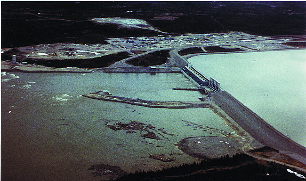
Large-volume reservoirs, built primarily for
hydroelectric power generation, are among the largest man-made water
infrastructures and hold at any given time 10-20% of the global mean river
runoff. Beyond their recognized disruptions of water flow and impairment of
water quality, large-scale reservoirs also result in significant shifts in
trophic structure during the transition from a primarily lotic to a lentic
system. Indeed, the creation of new reservoirs frequently leads to short-term
spikes in nutrient levels and anomalously high in situ productivity including
sharp increases in bacterial biomass. One process invoked to explain such
ecological change is that large-scale erosion and leaching of organic matter
and associated nutrients from surface flooded soils entail a relatively
short-term fertilization and a shift in natural productivity and food web
structure. Following this first phase in "trophic upsurge", a gradual
decline or "trophic depression" is predicted to occur and yield a
more stable community composition and community though the time of onset of
such trophic depression is yet ill defined.
Additionally, the induced increases in carbon cycling
within these systems has recently been recognized as significant contributor of
greenhouse gases (GHG) emissions to the atmosphere. This latter impact has been
the focus of increasing attention from both the research community and the
private energy sector since hydroelectric dams have historically been perceived
as carbon-free alternatives to power generation and accounted as such in energy
production scenarios. Sustained degradation of flooded soil organic matter
(SOM) has been proposed as a working hypothesis to explain observed
supersaturation in CO2 and CH4 in and concomitant
atmospheric evasion rates from reservoirs’ water columns. However, contrary to
this view, carbon stocks in flooded soils do not degrade at the rate necessary
to sustain GHG emissions observed over several decades in these systems. Considering that GHG emissions remain high in some
reservoirs close to 100 years after their impoundment, the impact of flooding
on ecological shifts and carbon cycling in these systems may thus have to be
constrained on timescales of decades to centuries rather than a few years.
Objectives:
In
this exercise, the primary goals are to
- Integrate quantitative
approaches into the analysis of an environmental issue.
- Compare fluxes of GHG measured in different ways and
evaluate potential processes that can act as sources of these gases to the
atmosphere.
- Build a mass balance of carbon stocks in flooded
soils and evaluate the impact of impoundment on terrestrial ecosystems.

Introduction:
Greenhouse gas emissions can
be measures in different ways but one involves direct measurements of gas
fluxes across the water-atmosphere interface using static chambers floating at
the surface of the water (c.f. Figure 1).
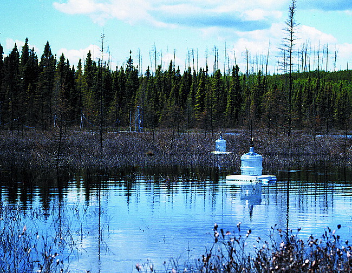
Figure
1. A static floating chamber deployed
in the backwaters of the Experimental Lakes Area Reservoir Project reservoir.
Fluxes of CO2 and CH4 from the surface of the reservoir
are calculated by measuring the rate of buildup of these gases over time inside
the chamber. (Photo and caption from St. Louis et al. (2000), Reservoir
Surfaces as Sources of Greenhouse Gases to the Atmosphere: A Global Estimate. Bioscience, Vol. 50, No. 9, pp. 766–775)
Similar
gas fluxes were measured from the surface of Laforge-1, a 1000 km2
reservoir flooded in 1993 in the boreal region of Quebec (Duchemin et al.
(2002). Hydroelectric reservoirs as an anthropogenic source of greenhouse
gases. World Resource Review. Vol.
14(3), pp.334-353). These measurement have shown that CO2 and CH4
are emitted in substantial quantity from the surface of the reservoir even a
few years after impoundment. The measures daily fluxes are presented in Table 1
below:
Table 1. Diffusive GHG emissions from Boreal reservoir in
Quebec (from Duchemin. 2002. Hydroelectricite et gaz a effet de serre:
Evaluation des emissions et identification du processus biogeochimique de
production. Ph.D. Thesis. UQAM).
|
Reservoir |
CO2 Flux (mg C/m2.d) |
CH4 Flux (mg C/m2.d) |
|
Laforge-1 |
495.6+/-73.9 |
6.9+/-0.8 |
Part I. Diffusive fluxes
from the flooded soil-water interface
We will compare diffusive emissions of GHG
obtained from flooded soil-water vs.
those presented above from water-air measurements. To do this we will need to
calculate the flooded soil-water diffusive fluxes using Fick’s Law of
diffusion:
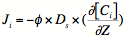 (1)
(1)
Where
Ji ,is the diffusive flux of compound i,  is the sediment
porosity, DS is the diffusion coefficient in sediments, and
is the sediment
porosity, DS is the diffusion coefficient in sediments, and  is the vertical concentration gradient of compound i.
DS
can be calculated using the empirical relation:
 (2)
(2)
Where
D0 is the diffusion coefficient in pure water at a specific
temperature. Combining equations (1) and (2) we obtain:
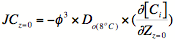 (3)
(3)
Where J C z=0 is the carbon flux at the
soil-water interface. The carbon fluxes can then be calculated for both CO2
and CH4. In the present case, the porosity ( ) was measured for the studied soils and equals: 0.874. The
specific free diffusion coefficient in water at 8oC (D0 (8oC))
will be used for both CO2 and CH4 (1.18 10-3
cm2/s and 1.25 10-3 cm2/s, respectively).
) was measured for the studied soils and equals: 0.874. The
specific free diffusion coefficient in water at 8oC (D0 (8oC))
will be used for both CO2 and CH4 (1.18 10-3
cm2/s and 1.25 10-3 cm2/s, respectively).
1)
Using the values
provided in the table below, please calculate the soil-water diffusive flux of
CARBON in Laforge-1 reservoir (from Houel 2003. Dynamique de la matiere
organique terrigene dans les reservoirs boreaux.. Ph.D. Thesis. UQAM). The flux
should be expressed in mg of C/m2.d. Present your data in a table.
|
Depth (cm) |
CH4 (uM) |
CO2 (uM) |
|
1 |
25.2 |
661.3 |
|
-1 |
39.3 |
1070.5 |
|
-3 |
77.8 |
1610.7 |
|
-5 |
91.2 |
1723.6 |
|
-7 |
101.8 |
1723.7 |
|
-9 |
89.0 |
1632.4 |
|
-11 |
74.8 |
1655.5 |
|
-13 |
66.8 |
1696.4 |
|
-15 |
44.2 |
1622.6 |
|
-17 |
56.1 |
1630.8 |
|
-19 |
43.9 |
1651.5 |
|
-21 |
44.8 |
1606.8 |
|
-23 |
37.5 |
1531.2 |
|
-25 |
36.2 |
1529.9 |
|
-27 |
30.6 |
1546.7 |
|
-29 |
27.2 |
1530.2 |
Remember: uM: micromoles per liter.
2)
Now calculate the total
flux anticipated from soils into the water column over 7 years. To do this,
assume that this flux occurs only during periods free of ice (use an ice-free
period of 165 days). Enter you data in the same table.
3)
How does these
individual fluxes (and the total flux) compare to the flux estimated by
Duchemin et al. (2000) at the water-air for the same period? Enter your
calculations of the water-air flux in the table and in a row below, enter the %
that the soil-water represents.
4)
Are the atmospheric
fluxes measured balanced by the soil-water diffusive fluxes you calculated? If
not, explain what other processes may explain and support the atmospheric
fluxes measured.
Part II. Fate
of carbon in flooded soils.
To quantify the impact of flooding on soil
organic matter, you will calculate a mass balance of soil carbon loads (mass
per unit area) in natural vs.
flooded soils. Use the table provided below (from Houel 2003. Dynamique de la
matière organique terrigène dans les réservoirs boréaux. Ph.D. Thesis. UQAM):
|
Depth (cm) |
Natural (g C/m2) |
Flooded (g C/m2) |
|
1 |
50.5 |
0 |
|
2 |
109.7 |
0 |
|
3 |
180.0 |
0 |
|
4 |
214.3 |
0 |
|
5 |
323.1 |
0 |
|
6 |
391.5 |
0 |
|
7 |
474.3 |
0 |
|
8 |
540.0 |
0 |
|
9 |
787.0 |
592.5 |
|
10 |
900.9 |
600.3 |
|
11 |
1051.2 |
643.5 |
|
12 |
1170.0 |
776.1 |
|
13 |
833.8 |
744.5 |
|
14 |
558.0 |
555.2 |
|
15 |
405.0 |
391.9 |
|
16 |
350.0 |
342.8 |
5)
Using a bar graph, plot the
values of organic carbon vs. depth
(in vertical axis) for both natural and flooded soils (on the same graph).
6)
What can you say initially
from looking at the graph?
7)
Quantify the changes that
occur with depth after flooding: All total losses are ascribed to erosional
losses whereas partial losses are ascribed to degradation losses. Plot in a pie
chart these two losses (in percentage of losses with absolute values in the
chart).
8)
Is the system
balanced, meaning, are the total losses from soils equal to GHG emissions? If
not what do you believe happened to the carbon (remember the principle of
conservation)?