Environmental Chemistry U6220
Lab #4
Part 1: Investigation of the Carbonate-Bicarbonate System (Alkalinity of Aqueous Systems)
Introduction:
An aqueous solution of carbon dioxide produces a mixture of carbonate and bicarbonate ions. Determining the carbonate and bicarbonate ions in each other's presence is often important in environmental chemistry.
1) CO2(g) + H2O(l) --> H2CO3 (aq)
2) H2CO3 (aq) --> HCO3-(aq) + H+(aq)
3) HCO3-(aq) --> H+(aq) + CO32-(aq)
The alkalinity of water is the capacity of solutes to act as a base by reacting with protons. There exists a fundamental difference between the expression of acid-base properties of pH and alkalinity. Whereas the pH can be considered to be an intensity factor which measures the concentration of alkali or acids immediately available for reaction, the alkalinity is a capacity factor which is a measure of the ability of water sample to sustain reaction with added acids (in a sense, it is the ability of a water body to neutralize added acids). In practice, it may be determined by measuring the number of moles of H+ required to neutralize all bases dissolved in one liter of water leaving no further capacity for neutralization of additional protons. We say that alkalinity can be determined by titration of one liter of a water sample to the end point. Acidification of a lake in its natural setting is itself analogous to a macro-scale titration and lakes are sometimes termed well-buffered, transitional, or acidic (strong, intermediate, weak neutralization capacity, respectively) depending on their position on the titration curve.
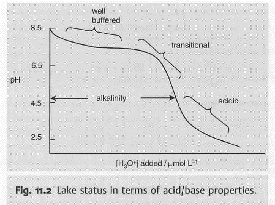
Alkalinity is therefore a useful measure of the capacity of water to resist acidification from acid addition (e.g. acid precipitation). The presence of carbonate, bicarbonate, and hydroxide ions usually imparts most of the alkalinity of natural or treated waters. Initially, your water samples may contain bases and will contain a positive alkalinity. When all the bases have been used up (beyond the end point, alkalinity is negative and is equal to ≠[H+].
Question 1. Based on the pH measured in you initial samples (seawater):
a) What do you think is the most important carbonate species present in you samples, and,
b) Please write the theoretical equation for the total alkalinity.
c) What is the most probably equation for alkalinity? Explain.
The addition of acid to the seawater sample will convert the carbonate to bicarbonate (reverse of reaction 3) until no carbonate remains. The addition of further acid will convert the bicarbonate to carbonic acid until no more bicarbonate remains (reverse of reaction 2). The carbonate and carbonic acid equivalence points may be determined either by titration using indicators or by pH titration.
The first end point determined (in the pH range 8.3-10) represents the completion (equivalence point or stoichiometric end point) of the following reaction:
H+(aq) + CO32-(aq) --> HCO3-(aq)
i.e. the carbonate has been neutralized by the acid-forming bicarbonate ions.
In the pH range 3.2-4.5, all of the bicarbonate ions initially present in the water sample, together with all of those produced from the reaction of the carbonate ions, will be neutralized. The resulting alkalinity is known as the total alkalinity.
HCO3-(aq) + H+(aq) --> CO2(g) + H2O(l)
The importance of the carbonate/bicarbonate system in natural waters stems from its ability to act like a buffer in natural waters. The oceans are described as being buffered since relatively large quantities of acid or base can be added to seawater without causing much change to its pH. However, many freshwater lakes do not have a large buffer capacity and consequently a small addition of acid (e.g. from acid precipitation or industrial effluent) can cause large changes in pH without warning. The carbonate alkalinity and the total alkalinity are useful for the calculations of chemical dosages required in the treatment of natural water supplies.
Question 2.
Consider a natural lake on the Canadian Shield (eastern Canada but also applies to North Eastern US) with an alkalinity of 20 µmol/L, a depth of 10 m, and precipitation inputs of 1m per year. If you know that the pH of the rain is at 4.2, when will the whole lake become acidic? Assume that there is no source of new alkalinity to the lake during the period of ≥study≤ - in other words the alkalinity will decrease linearly through time (Work on a m2 basis and make sure you provide equations and explain your calculations).
Titration (Alkalinity of seawater)
Summary of the Method:
Alkalinity is measured by titrating a water sample with sulfuric acid. The Vernier sensor is used to monitor pH during the titration. The equivalence point will be at a pH of approximately 4.5, but will vary slightly, depending on the chemical composition of the water. The volume of the sulfuric acid added at the equivalence point of the titration is then used to calculate the alkalinity of the water.
Material checklist:
|
1) Computer |
7) 100 ml graduated cylinder |
|
2) Vernier computer interface |
8) 250 ml beakers (2) |
|
3) Logger Pro |
9) Wash bottle with DI water |
|
4) Vernier pH sensors (2) |
10) Utility clamps & Ring stand |
|
5) Sampling bottles |
11) 0.001 M H2SO4 solution |
|
6) 25-50 ml burets |
12) Magnetic stirrer and bar |
Procedure: pH Titration
Caution! Please wear gloves and safety goggles to perform this experiment and beware that H2SO4 is corrosive. Avoid spilling it on your skin or clothing
Note: Please make sure you transfer all the measurements (volume, pH) in your notebook to be able to graph the pH change vs. volume later on.
1) Pour 50 ml of seawater into a beaker.
2) Place the beaker on the base of a magnetic stirrer and drop a stir bar carefully into the beaker. Set the stirrer to a speed that mixes the sample well, but does not splash.
3) Keep the water away from the computer at all times.
4) Prepare the computer for data collection by opening ≥Test 11 Alkalinity≤ from the Water Quality with Computers experiments files of Logger Pro. On the Graph window, the vertical axis has pH scaled from 2 to 10 units of pH. The horizontal axis has volume scaled from 0 to 20 ml. There is also a Meter window, which displays real time pH readings.
5) Insert the electrodes of the pH meter into the beaker.
6) Ensure complete coverage of the electrodes. It is essential that adequate clearance is achieved between the electrodes and the magnetic stirrer or the stir bar will not rotate.
7) Place the burette (previously filled with 0.001M sulfuric acid) over the apparatus so that acid can be run slowly into the beaker. Ensure that you have sufficient room to turn the tap of the burette freely.
8) You are now ready to perform the titration. This process goes faster if one person manipulates the burette while another person operates the computer and enters volumes.
9) Click Collect to start data collection
10) Monitor the pH value on the computer screen. Once it has stabilized, click Keep.
11) Type 0 (the burette volume in ml) in the edit box. Then press Enter.
12) Add a small quantity of H2SO4 titrant (enough to lower the pH about 0.2 units, using 1-2 ml). When the pH stabilizes, click Keep.
13) Type the current burette reading to (the nearest 0.1 ml) in the edit box, then press Enter.
14) Continue adding H2SO4 solution in increments that lower the pH by about 0.2 pH units and enter the burette reading after each increment. When the graph shows the pH value beginning to drop more quickly (at approximately 5.5 or approx. 40 ml total volume of acid added) change to 1 ml increments. Enter a new burette reading after each addition. Note: It is important that all additions of acid in this part of the titration be 1 ml or less.
15) When the pH values start to flatten out (approximately pH 4), again add larger increments that lower the pH by about 0.2 pH units (2 ml), and enter the burette readings after each increment.
16) Continue for two to three more additions, or until the graph clearly shows that the pH has leveled off again.
17) Click Stop when you have finished.
18) Rinse the pH sensor with DI water from the wash bottle. Use a second beaker to catch the rinse water. Return the sensor to the storage solution bottle and tighten the cap.
Question 3:
Graph your results where pH appears on the y-axis and volume H2SO4 appears on the x-axis.
Question 4: (Calculations - Enter all your data in Table 1 below):
1) Determine the volume of H2SO4 titrant added at the equivalence point of the titration. The equivalence point is the point where the titration curve makes the steepest drop in pH.
a. Find the H2SO4 volume just before the start of the steepest pH change
b. Find the H2SO4 volume just after the pH change has leveled off.
c. Calculate the average of these points by adding them together and dividing by two. Record this number, which represents the exact volume of H2SO4 added at the equivalence point (round to the nearest 0.1 ml).
(For an independent determination of the end points, plot the change in pH divided by the change in volume for each increment - DpH/Dvol - on the y-axis against the volume of H2SO4 added, on the x-axis).
2) Calculate the number of moles of H2SO4 per milliliter (mol/ml) used to reach the equivalence point.
The reaction occurring in this titration is:
H2SO4 + CaCO3 --> CO2 + H2O + CaSO4
3) Based on the mole ratio of H2SO4 to CaCO3, calculate the moles of CaCO3 reacted at the equivalence point.
4) Calculate the mass in milligrams of CaCO3 in the sample.
5) Calculate total alkalinity in mg of CaCO3 per liter of water (mg/L).
6) Compare your result to the average ocean water alkalinity (~140 mg CaCO3/L) and the reason for the difference, if there is one.

Part 2: Investigation
of environmental parameters in diverse water systems
Introduction:
In this part of the lab exercise, you will be evaluating water quality parameters from diverse types of water samples within and across different ecosystems.
Parameters measured:
- pH
- NH4+
- NO3-
Question 5:
Predict a pH value for each of your samples BEFORE you analyze them. Write these estimates in the first column.
Measure all parameters for each sample using the set up Vernier sensors. Record the value from the meter on the computer screen and enter this value in Table 2 below (make sure you rinse the sensor after each measurement and that you place it back in its storage bottle).
|
Sample |
PH (predicted) |
PH (measured) |
NH4+ (mg/l) |
NO3- (mg/l) |
|
- Tap water |
|
|
|
|
|
|
|
|
|
|
|
Central Park |
|
|
|
|
|
- Large ≥lake≤ C.P. |
|
|
|
|
|
- Small creek into lake |
|
|
|
|
|
- Small inlet |
|
|
|
|
|
|
|
|
|
|
|
- Seawater |
|
|
|
|
Question 6:
Explain the observed pH values. For example, do your measured pH values match the predicted values? If not, how can you explain the measured values vs. your predicted values?
Question 7:
Why do you observe such differences in the NH4+ and NO3- content of the different samples? (You need to find out what is the source of these compounds in natural waters and why you observe them in low levels in some of your samples)?
Question 8:
What is the reason for high levels of NH4+ and NO3- in natural waters such as in lakes? What sort of environmental effect could this have?
Question 9:
Why would NO3- be a problem if you were to find it in high concentration in the tap water (i.e. >5-10 mg/L)? What would that indicate? What type of environmental effect would it have? What is the most sensitive population?
Question 10:
Take the freshwater sample with highest pH and based on the following information calculate the concentration of NH3. Calculate then the total Ammonia-N by adding the measured NH4+ to your calculated NH3 values:
NH4+ <--> NH3 + H+ pKa = 9.26
Question 11:
Acidify your sample to pH<6 (by adding small amounts of acid solution: 2-4 ml) and measure the NH4+ concentrations. Is this result similar to the one calculated above (question 11)? What does this tell you about equilibrium of acid-bases?