Environmental Chemistry U6220
Lab #3
Introduction:
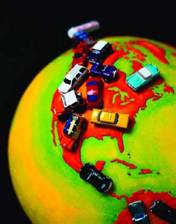 Lead
(Pb) is often considered as one of the oldest human-made atmospheric
contaminants and lead poisoning today is still regarded as the single most
significant preventable disease associated with an environmental occupational
toxin (Silbergeld, 1995; Mielke, 1999; Mielke t al., 1999; Ryan et al., 2004;
though I would like to argue that mercury and arsenic are not far behind).
Aside from the long-standing Pb additions to paint products in the late 19th
and early 20th Centuries, leaded gasoline has been recognized as a
major source of Pb to the environment through atmospheric redistribution and
concentration close to roadways and urban regions (Mielke, 1999). The phaseout
of leaded gasoline in the late part of the 20th Century has led to
significant improvements in air quality and a reduction in a major source of Pb
exposure to humans (see Nriagu, 1990 for details on the “rise and fall” of
leaded gasoline in the US). Because of a concomitant drop in blood Pb levels of
children from urban centers, some investigators initially suggested a causal
relationship and thus stressed the removal of the Pb inputs (leaded gasoline)
as the major remediation effort to curtail Pb toxicity in young children.
However, recent research suggests that although blood Pb levels have continued
to decline in the U.S. population, a significant number of children still have
elevated levels (Pirkle, 1998; Mielke, 1999). Scientists argue that in spite of
the successful public health efforts to remove Pb from population-wide sources
such as gasoline and lead-soldered food and drink cans, new efforts must
address the difficult problem of leaded paint, especially in older houses, as
well as Pb in dust and soil (Pirkle, 1998; Mielke, 1999; Mielke t al., 1999).
Lead
(Pb) is often considered as one of the oldest human-made atmospheric
contaminants and lead poisoning today is still regarded as the single most
significant preventable disease associated with an environmental occupational
toxin (Silbergeld, 1995; Mielke, 1999; Mielke t al., 1999; Ryan et al., 2004;
though I would like to argue that mercury and arsenic are not far behind).
Aside from the long-standing Pb additions to paint products in the late 19th
and early 20th Centuries, leaded gasoline has been recognized as a
major source of Pb to the environment through atmospheric redistribution and
concentration close to roadways and urban regions (Mielke, 1999). The phaseout
of leaded gasoline in the late part of the 20th Century has led to
significant improvements in air quality and a reduction in a major source of Pb
exposure to humans (see Nriagu, 1990 for details on the “rise and fall” of
leaded gasoline in the US). Because of a concomitant drop in blood Pb levels of
children from urban centers, some investigators initially suggested a causal
relationship and thus stressed the removal of the Pb inputs (leaded gasoline)
as the major remediation effort to curtail Pb toxicity in young children.
However, recent research suggests that although blood Pb levels have continued
to decline in the U.S. population, a significant number of children still have
elevated levels (Pirkle, 1998; Mielke, 1999). Scientists argue that in spite of
the successful public health efforts to remove Pb from population-wide sources
such as gasoline and lead-soldered food and drink cans, new efforts must
address the difficult problem of leaded paint, especially in older houses, as
well as Pb in dust and soil (Pirkle, 1998; Mielke, 1999; Mielke t al., 1999).
In this lab, we will address the issue of atmospheric Pb levels in a major urban center of North America: New York City. First, we will reconstruct the recent historical changes in atmospheric Pb levels using filters collected (and analyzed) over the last 30 years in the city. We will then compare the trends in ambient air levels with trends in tetra-ethyl Pb consumption in gasoline in the U.S. Secondly, we will examine a longer time series of Pb deposition in the New York City metropolitan region during the 20th Century. Based on this latter analysis, we will evaluate the role of leaded gasoline and other potential sources of Pb to the environment in major urban systems.

Part 1: Leaded gasoline, a source of urban atmospheric contamination
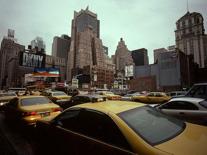
Please download the Excel spreadsheet “Pb Atmosph-NYC”. In this spreadsheet you will find historical data of lead concentrations in atmospheric Total Suspended Particulates collected over the last 30 years in the city of NYC. The data was extracted from a much broader data repository managed by Columbia’s Mailman School of Public Health (World Trade Center Environmental Contaminant Database). In part one, please graph the required plots and answer the following questions.
1) Plot the curve of lead consumption in gasoline in the U.S. from 1970 to 1992.
2) Add to this plot all the data from the Pb levels in Total Suspended Particulates from 1975 to 1992.
3) Calculate the average and standard deviation (SD) for of ambient Pb levels for the period provided and plot that as well on the same graph.
Question 1: Comment on the temporal trends in Pb consumptions and Pb levels in air particulates for the period 1970-1990.
a) Are these trends related? How can you show that graphically and/or mathematically?
b) Are these two trends consistent with information from the literature (your readings, EPA Air Quality website, etc)?
c) How can you explain the wide annual variability observed in PM values? Are averages appropriate to describe the trend in Pb ambient levels (why)?
d) Based on these data, can you make inferences as to what seemed to have been the major source of Pb to urban environments such as NYC in mid-20th Century (1950-1970)? Explain your reasoning.
e) How could we reconstruct atmospheric Pb concentrations in urban sites like NYC for periods prior to continuous air filter sampling?

Part 2: Reconstruction of historical inputs of Pb to urban environments: The case of New York City.
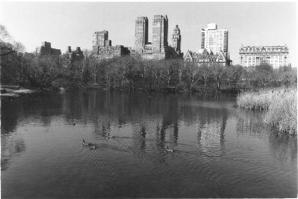 Well,
you’ve guest it. The last question to Part 1 was an introduction to this
section of your lab. Here, we are going to use sediment records collected from
the artificial lake in Central Park. The lake was excavated in the mid-1860s
and has had a relatively constant and undisturbed accumulation of sediments
since (Chillrud et al., 1999). Researchers from Lamont (Chillrud et al., 1999) have
reconstructed the flux of atmospheric Pb to the surface od the lake over its
entire history and have come up with a very interesting discovery. Let’s follow
their footsteps and do their work anew.
Well,
you’ve guest it. The last question to Part 1 was an introduction to this
section of your lab. Here, we are going to use sediment records collected from
the artificial lake in Central Park. The lake was excavated in the mid-1860s
and has had a relatively constant and undisturbed accumulation of sediments
since (Chillrud et al., 1999). Researchers from Lamont (Chillrud et al., 1999) have
reconstructed the flux of atmospheric Pb to the surface od the lake over its
entire history and have come up with a very interesting discovery. Let’s follow
their footsteps and do their work anew.
In the attached spreadsheet “Central Park Sediments” you’ll find several different types of sedimentary data from the lake. The first and second columns provide the depth intervals and average depth of each core section, the third provides the density of each section, the fourth the years each interval has taken to accumulate (i.e. 5 years means that the 2 cm accumulated in 5 years and that the sedimentation rate for that interval is 0.4 cm/yr), the fifth provides date (calendar year) of the mid section of each interval, the sixth gives the excess Pb concentration (the Pb derived from atmospheric deposition), and the last four columns give data for municipal solid waste (MSW) incineration in NYC from 1910 to 1995 (Walsh et al., 2001), as well as the consumption of tetra-ethyl lead (TEL) in leaded gasoline in the U.S.
Question 2:
Calculate the Pb accumulation rates in Central Park Lake sediments using the sedimentary data provided (Pb accumulation should be in mg/cm2.yr).
Pb flux = [Pb] x sediment accumulation rate
sediment accumulation rate = sediment density (r) x sedimentation rate (w)
sedimentation rate = depth/age
1) Plot the Pb flux to sediments (mg/cm2.yr) vs. date (calendar year) for the period 1900-1990.
2) On the same graph, plot the curve for Pb consumed in gasoline in the U.S. for the period 1910-1990.
Question 3:
Based on these data, when is(are) the maximum value(s) of ambient Pb observed in NYC? Does this correspond to the input values of Pb consumption from gasoline production?
3) Now plot the sedimentary Pb flux (mg/cm2.yr) vs. date (calendar year) of each sediment interval and add the municipal solid waste (MSW) incineration curve on the same graph.
Question 4:
What does this tell you about other potential sources of Pb to the atmosphere in urban systems (you will need to read the two papers cited above: Chillrud et al., 1999 and Walsh et al., 2001)? Would you say that leaded gasoline was the principal contributor of Pb to the atmosphere of NYC in the 20th Century?
Question 5:
Now that leaded gasoline has been phased out of the U.S. market (along with the Mexican and Canadian ones), is Pb toxicity a historical issue or is it still a current concern in the U.S.? Explain your reasoning.
Extra-Credit Question
For those in need of a little challenge, here it is. Please use the values of Pb consumption in gasoline for the U.S. to calculate the total amount of Pb used by this industry during its history. The small trick is that you HAVE to use the method outlined below:
-) first, graph the historical data and obtain a function of Pb production as a matter of time
-) second, you need to integrate the curve between the two intervals to calculate the total Pb consumption,
-) third, compare this result to a step forward summation of each yearly consumption value. Do these two estimate concur?
References:
Chillrud, S.N., R.F. Bopp, H.J. Simpson, J.M. Ross, E.L. Shuster, D.A. Chaky, D.C. Walsh, C. Chin Choy, L-R. Tolley, and A. Yarme 1999. Twentieth Century Atmospheric Metal Fluxes into Central Park Lake, New York City. Environmental Science and Technology, Vol. 33(5): 658-662.
Mielke, H.W., C.R. Gonzales, M.K. Smith, and P.W. Mielke. (1999). The urban environment and children’s health: Soils as an integrator of lead, zinc, and cadmium in New Orleans, Louisiana, USA. Environmental Research (Section A), Vol. 81: 117-129.
Mielke, H.W. (1999b). Lead in the Inner Cities. American Scientist, Vol. 87(1): 62.
Nriagu, J.O. (1990). The rise and fall of leaded gasoline. The Science of the Total Environment, Vol. 92: 13-28.
Pirkle, J.L., R.B. Kaufmann, D.J. Brody, T. Hickman, E.W. Gunter, and D.C. Paschal (1998). Exposure of the U.S. Population to Lead, 1991-1994, Environmental Health Perspectives Vol. 106(11): 745.
Ryan, J.A., W.R. Berti, S.L. Brown, S.W. Casteel, R.L. Chaney, M. Doolan, P. Grevatt, J. Hallfrisch, M. Maddaloni, D. Mosby, and K.G. Scheckel. (2004). Reducing children’s risk from lead in soil. Environmental Science and Technology, Vol. 38(1): 1A–24A.
Silbergeld, E.K. (1995). The international dimension of lead exposure. International Journal of Occupational and Environmental Health, Vol. 1(4): 336.
Walsh, D.C., S.N. Chillrud, H.J. Simpson, and R.F. Bopp. (2001). Refuse incinerator particle emissions and combustion residues for New York City during the 20th Century. Environmental Science and Technology, Vol. 35(12): 2441-2447.