Newsletter Blog



OCULAR
SURGERY NEWS
Sight-saving mission to the Philippines
by Antonio M. Gonzales, MD
Special to Ocular Surgery News, 9/7/95
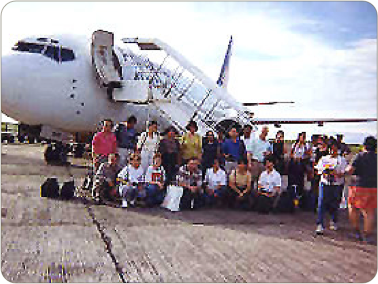
The Philippines, an Asian country of 7,000 islands with a population of 55 million, has few physicians in its rural areas. Surgeons and specialists, especially, are concentrated in the metropolitan areas. For two weeks in March 1995, 100 volunteers from the Philippine Medical Association in America, including nurses and physicians of various specialties from several hospitals in New York and New Jersey, embarked on a medical and surgical mission to tile Philippine islands of Iloilo and Aklan. The ophthalmology team included myself and Atul Agarwala, MD, chief resident at Harlem Hospital. After our arrival in Manila, enduring delays in 90 degree F traffic and checking in our medical supplies and luggage, we boarded a plane for a two-hour flight from Manila to the islands. At the airport there we were greeted by a crowd of people eager to be treated by American-trained physicians. Our reception was festive as a band, dressed in tribal costumes, beat drums and played trumpets as we walked across the tarmac. Some members of our team could not help joining in and dancing to the rhythm of their music. That evening we were treated to a hospitality dinner dance.
The next morning, the team was transported by bus and jitney to the hospital, an hour's drive from our hotel. The major highways and city streets were paved, but there were still unpaved roads in the rural areas, and the trip was delayed because of a flat tire. Upon arrival at the hospital, there was a huge crowd patiently waiting for us-- children, adults and elderly who had traveled miles from neighboring towns, with grins on their faces to see that we had arrived. We set up our portable operating microscope, unpacked our supplies of prepackaged sterilized instruments and other materials, set up the OR and conducted final screening on the patients who were to have surgery. We were impressed with the range of ocular pathology we saw, including dense cataracts, advance pterygia, traumatic and infectious corneal scars, and untreated end-stage glaucoma. The gravest patient of all was a girl with possible rhabdomyosarcoma. Since we were working with limited facilities, we decided to send her to Manila for further diagnostic evaluation and management, paid for out of our emergency funds.
With the help of anesthetists and nurses from other institutions, we performed 27 cataract surgeries, one combined cataract and trabeculectomy, two strabismus surgeries and one orbital dermoid surgery. As surgery progressed from 8 a.m. to 8 p.m. we also trained local ophthalmologists, who drove several miles from neighboring towns. Operating in the rural hospitals was a challenge. We performed surgery side by side in the same room. There were occasional interruptions because of electrical blackouts. There were shortages of linens, gloves and other materials. Fortunately, we had brought with us adequate supplies for surgery. In planning for the trip, we expected to do phacoemulsification with our portable Mentor Odyssey phaco unit. However, the cataracts we saw were densely mature, brunescent with hard nuclei. We had to choose between ICCE with anterior chamber IOL or ECCE with posterior chamber IOL and primary posterior capsulotomy, since a Nd:YAG laser was not available. We were concerned that should uveitis-glaucoma-hyphema syndrome or cystoid macular edema develop after our departure there would be no one to take care of the patients. Therefore, we chose to perform ECCE with PCIOL and leave the posterior capsule intact. Despite the magnification obtained through our portable Mentor CM-III microscope, the maturity of the cataracts made it difficult to perform continuous circular capsulorhexis. Instead we performed multiple-puncture can-opener anterior capsulotomies and delivered rhe cataracts with the tumbling technique. We were confident that the chances of secondary posterior capsular opacification would be less following a thorough cortical cleanup, which we were able to accomplish with our machine. We did not find it necessary to polish the posterior capsule in all cases. Our technique yielded good results. We had only two cases of posterior capsular tears, for which anterior vitrectomy with AC IOL implantation was performed. There were more than 100 candidates for ocular surgery. We operated on those for whom we thought we could have the greatest impact, those who could not see with either eye
On our last day, we tried to perform as many surgeries as we could and finished at 11 p.m. In the middle of the night, we were on a 20-minute boat ride across the Pacific Ocean en route to our accommodations at Boracay Islands, a tourist beach resort. Our pilot navigated his way with only a flashlight. The islanders knew their way around the islands amazingly well. We encountered no difficulties other than getting in and out of the boats. There were no docking facilities, so we had to be carried on the islanders shoulders or wade in the knee-to-hip-deep waters. The next day we were flown to the island of Cebu for an overnight stop on our way back to Manila. There, we visited the shrine of Ferdinand Magellan, built on the spot where he planted the cross in 1521, proclaimed the Philippines a colony of Spain and celebrated the first Catholic mass there. About two miles from there we also visited the place where he was killed, the island of Mactan, where stood a statue of Lapu Lapu, chief of the tribe responsible for Magellan's death. The medical mission treated a total of 2,000 patients with various illnesses: diabetes, hypertension, upper respiratory infection, thyroid, fracture, hernia, cleft palate and other congenital anomalies. Despite the difficulties encountered, the medical-surgical team accepted an invitation to return.
The project was sponsored by the Philippine Medical Association in America, Phil-Am Lions Club of New Jersey and the Rotary Club of Iloilo. Medical and surgical supplies were donated by Alcon Laboratories, Allergan Medical Optics, Surgidev, Staar Surgical, Pharmacea, Iolab, Storz Ophthalmic Inc. and The Brothers' Brother Foundation.
September 7, 1995
Ocular Surgery News - Iloilo & Aklan