Why the MagLift? Pushing farther and further.
What if the force of gravity that a weightlifter has to overcome could be replicated with a magnet? The design and idea behind the MagLift was based on this underlying question. The use of magnetic resistance, sourced from a magnetic particle brake, would provide users with a compact but powerful exercise machine that could be accurately adjusted by simply controlling the current that flows into the system.
Not only does the use of a magnetic particle brake make the MagLift an incredibly lightweight erg machine, but it also makes the MagLift a viable exercise machine in microgravity environments – on the International Space Station, for example. The MagLift was designed with the intention of supplementing the already existing exercise equipment in space, as muscle and bone atrophy has been observed in astronauts who have failed to exercise sufficiently. The erg motion allows the user to work out his or her entire upper body; however, the concept behind the MagLift can be applied to all motions and all muscle groups.
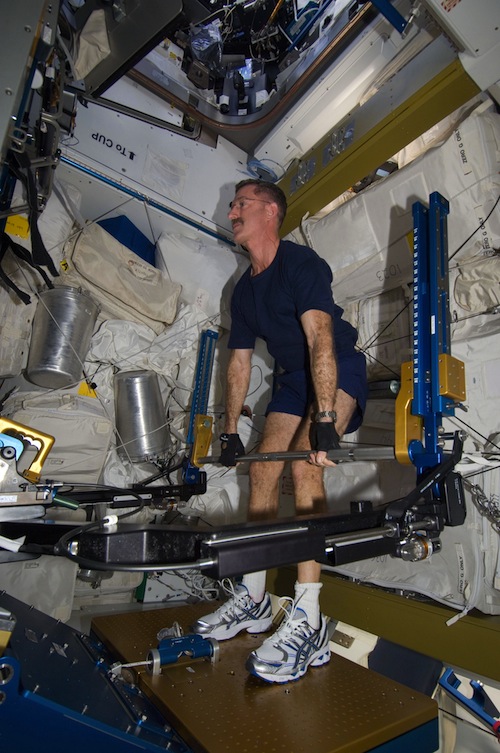 The ARED aboard the ISS
http://www.nasa.gov/mission_pages/
station/research/experiments/1001.html

Where Can It Go? Anywhere Big Enough to Live
The MagLift Project takes first steps in revolutionizing exercise machines and fitness centers on Earth and in space. Modern day weight-lifting machines operate on systems of pulleys to redirect the force of stacks of massive plates -- the MagLift can easily be incorporated into such a system as the source of resistance for a variety of different exercises and configurations. With its lightweight and compact body, the MagLift is a powerful piece of exercise equipment that provides an unprecedented level of flexibility and mobility in assembly and usage. It is equally at home in residences and training compounds.