Brian Metzger
Department of Physics
909 Pupin Hall
New York, NY 10027, USA
Phone:212-854-9702
Brian Metzger
Phone:212-854-9702
I am a Professor in the Department of Physics at Columbia University and an active member of the Theoretical High Energy Astrophysics (THEA) Group. I am also currently a Senior Research Scientist within the Center for Computational Astrophysics at the Flatiron Institute.
My Ph.D. was completed in the Departments of Physics and Astronomy at UC Berkeley under the supervision of Professor Eliot Quataert.
Click here for my CV and publication list.
I am interested in a broad range of topics in theoretical astrophysics, focused on high energy and stellar astrophysics. A unifying theme of my research is a connection to transient (or 'time domain') phenomenon, motivated by many sensitive, wide-field telescopes coming online in the next decade across the electromagnetic spectrum. I am excited by the scientific potential of the generation of gravitational wave interferometers, such as Advanced LIGO, and the promise for a future era of "gravitational wave astronomy".
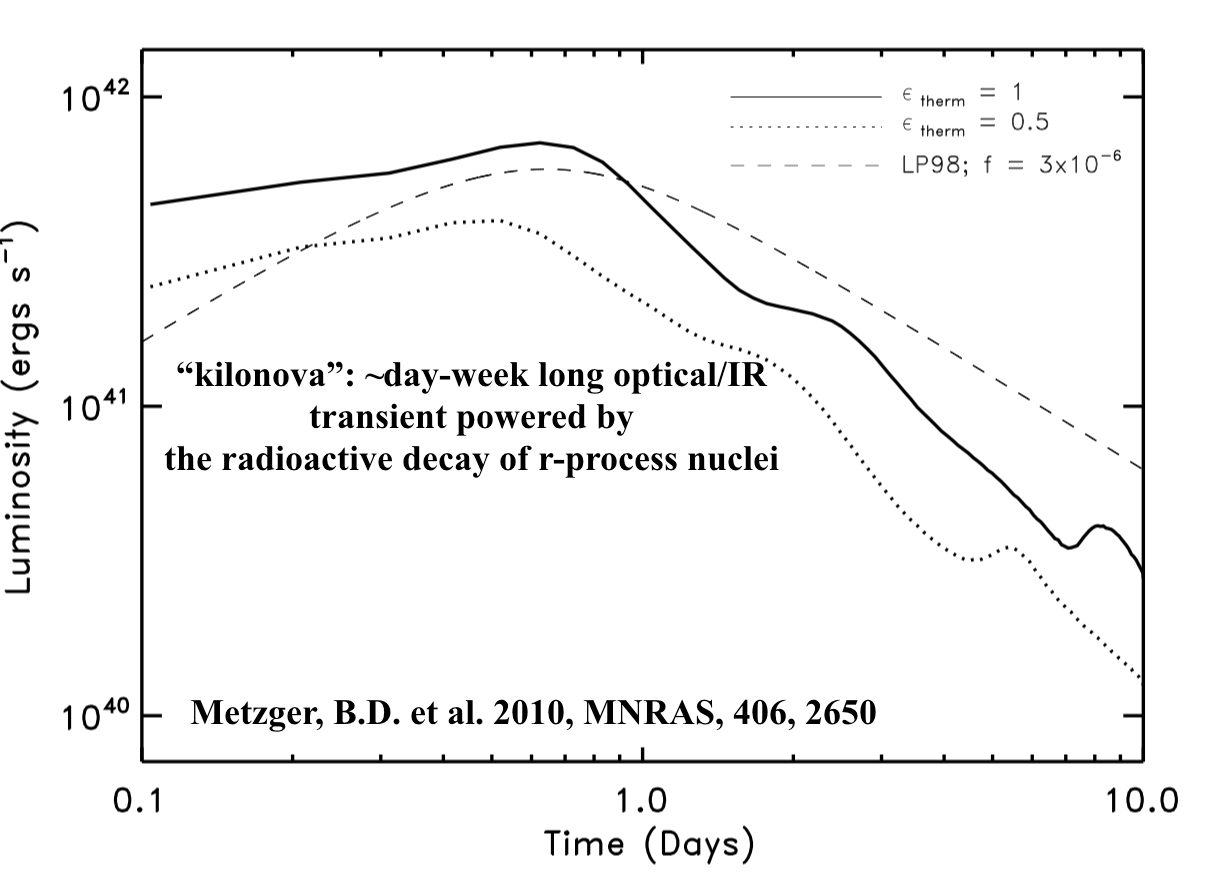
One area of my group's focus are theoretical predictions for the electromagnetic counterparts of binary neutron star mergers. Among the most promising counterparts is a day to week-long thermal optical/infrared counterpart, powered by the radioactive decay of heavy elements synthesized in the merger ejecta. In 2010, our group made the first predictions for this so-called "kilonova" emission, which included a realistic treatment of the relevant nuclear heating. To the left, I show an example predicted light curve (luminosity as a function of time since the merger) from 1% of a solar mass of r-process elements ejected from the merger at 10% the speed of light. The discovery of kilonova emission following a binary neutron star merger would provide the first direct evidence for the production of rare elements such as Gold, Platinum, and Uranium.
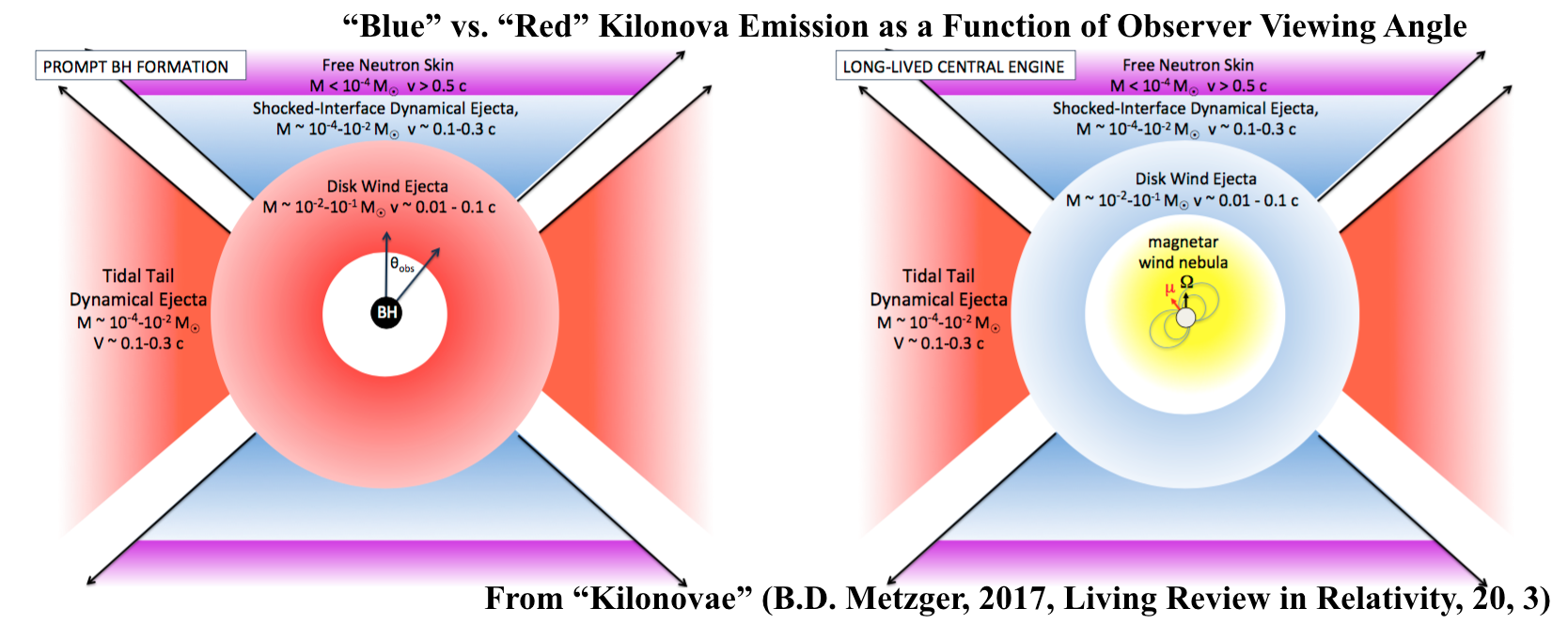
I recently completed a review on Kilonovae for Living Reviews in Relativity, which describes (among other things) the possible diverse signatures we may see from these events depending on the properties of the merging binary and the viewer's inclination angle with respect to the binary axis. Observers in the binary plane of the merger may observe mostly "red" (infared) emission from matter ejected in the binary plane, while observers from higher inclinations first observe relatively "blue" (optical) emission, similar to our 2010 predictions, from matter driven in the polar direction
My list of publications can be found on astro-ph or the Astrophysics Data System (ADS).
My Ph.D. thesis, titled "Theoretical Models of Gamma-Ray Burst Central Engines," can be found here. My dissertation was awarded the Dissertation Prize by the High Energy Astrophysics Division (HEAD) of the American Astronomical Society. In 2014, I was named an Alfred P. Sloan Research Fellow.Previous Undergraduate Students: Justin Ripley (CU'14, Princeton PhD, now UIUC), Aaron Kennon (CU'17), Charles Zivancev, Miguel Martinez (CU'19), Maggie Smith
Previous Graduate Students: Andrey Vlasov, Aleksey Generozov (UT AUstin), Ben Margalit (U Minnesota), Andrea Derdzinski (Zurich), Dhruv Desai (Griefswald), Chengcheng Xin (Harvard), Navin Sridhar (Stanford)
Current Graduate Students: Semih Tuna, Ani Patel, Sean Li
Former Postdoctoral Researchers: Nicholas Stone (Einstein Fellow, now Assistant Professor @ Wisconsin-Madison), Daniel Siegel (Einstein Fellow, now Professor at Griesfwald), Jennifer Barnes (Einstein Fellow, now at 3M), Elad Steinberg (now Researcher @ HUJI), Eric Coughlin (Einstein Fellow, now Prof. at Syracuse), Tatsuya Matsumoto (now Prof. at Tokyo U.), Floor Broekgaarden (now Assistant Prof. at UC San Diego), Mathieu Renzo (now Assistant Prof. at U Arizona), Ore Gottlieb (now Assistant Prof. at MIT)
Current Postdoctoral Researchers: Tejas Prasanna, Itai Linial, Rebecca Diesing