|
|
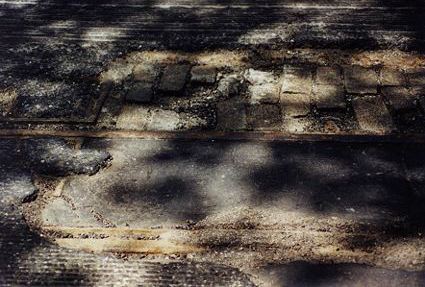
The original street pavement around the tracks was paving stones.
UPDATE... August 27... I've heard from a few people about the technical name for these stones. I called them cobblestones, but although this is a popular term it is not correct for this type of stone. An American calls them Belgian Blocks, and a Canadian calls them setts.
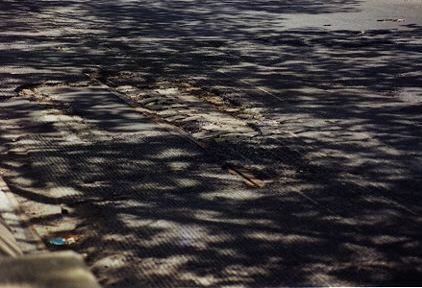
Here, up near Barnard, is an exposure showing paving stones, and this is also one of the few places where both running rails are visible, just barely. However, it's not a perfect sample section, since one side of the conduit slot has sunk, and it and the slot itself is covered by dirt.
On the cover of the book Across New York by Trolley (Quadrant Press) is a color photograph of 42d Street taken some time in the 1940's. It shows a paving stone surface between the rails but smooth blacktop on the rest of the street. Broadway probably looked like this by the end of the streetcar era too, since photos with streetcars show a blacktop surface, but I can't find one where I can see clearly what's between the rails on Broadway.
In the same book is a photograph taken in the 1940's showing two streetcars passing at the Barnard crosswalk, 117th Street, almost this location.