from C B Fairchild, Street Railways , 1892
|
from C B Fairchild, Street Railways , 1892 |
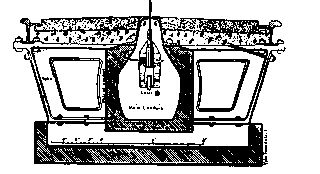
The drawing shows a cross-section of the 125th Street cablecar track. Yes, there were cablecars in Manhattan once (but not here on Broadway), in the 1890's. The same track construction was applied to electric conduit track, so the illustration will apply here.
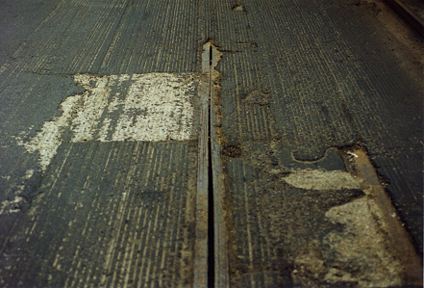
The street surface is at the top of the diagram. At the right and left top corners, we see the running rails for the streetcar's wheels: unlike the simple capital I cross-section of railroad rails, these have a shelf along the inner side to hold open a path for the wheel flanges. In the center, we can make out the thin somewhat S shaped cross sections of the two iron edges of the conduit slot. In the photo, at one place the slot has become almost closed near a white concrete patch signifying some post-streetcar roadwork. In service, the slot had to be kept open between 5/8 and 3/4 inches by constant inspection.
The diagram shows a cable grip coming from an unseen cable car down to hold one of the two cables in Manhattan's unusual two-cable system (the loose cable is below and right of the grip). In the conduit system, the plough was smaller than the cable grip, which had to have moving parts. For that reason I think the inside dimension of the electric conduit was probably a bit smaller than this, but I'm not sure it was very much smaller.
Most of that structure shown is cast iron. The dark area around the conduit is concrete poured on site.