Columbia
University Herbert Irving Comprehensive Cancer Center
Experimental
Therapeutics / Phase I Program
Introduction
The
Columbia University Herbert Irving Comprehensive Cancer Center (HICCC)
Experimental Therapeutics/Phase I program aims to lead the development of new
treatments for cancer. The Experimental Therapeutics/Phase I team comprises a
group of doctors, researchers, nurses, and coordinators dedicated to enrolling
and caring for a diverse population of patients in early-phase clinical trials.
This
semester, a multidisciplinary team of students from across the Columbia
University campus worked with the HICCC to aid them in their mission,
specifically by pursuing two initiatives. First, the team worked to develop a
comprehensive strategic positioning statement for the Phase I program. Second,
the team focused on identifying and prioritizing high-level strategic recommendations
to support the strengthening of the positioning statement.
The Business Problem
HICCC’s
Phase I Program sits at an interesting moment in its history. The program is
known for its clinical and research expertise, diverse patient population, and
quick trial activation, but it struggles with patient accrual. It is also
currently in the process of recruiting a new Director.
Historically,
the program has found it “easy to open trials, but hard to close them.” This
remains a weakness, considering how clinical trial partners look for sites that
can quickly activate trials and successfully enroll patients. Additionally,
HICCC is looking to leverage its location and patient population to better
compete with strong regional contemporaries, using the unique qualities of
HICCC to expand patient access to Phase I trials to people who otherwise
wouldn’t have access to them.
Project Objectives
Given
the business problem, the HICCC Phase I program sought to enhance its strategic
positioning within the experimental therapeutics space. The team had two
objectives:
- Strategic
Positioning Statement: Develop a strategic positioning statement for HICCC’s
Phase I program
- Strategic
Recommendations: Identify high-level strategic recommendations that will
support their strategic position
Type of Analysis
Data Collection
The
team conducted key interviews with internal (leadership, physicians, staff) and
external (biotech companies) stakeholders. Questions for the internal team
included: 1) What are the strengths and weaknesses
of the program? 2) How would you define the success of the program? 3) What do
you look for in biotech partners? Meanwhile, core questions for external
stakeholders included: 1) What do you
look for in Phase I Clinical Trial sites? 2) If you’ve had experience working
with them, how would you evaluate HICCC as a clinical trial site? We also
conducted a site visit and reviewed HICCC’s internal documents to supplement
our understanding of our interview findings. Lastly, desk research on best
practices in clinical trial recruitment (e.g., peer-reviewed articles and case
studies) was also completed.
Analysis
The
team developed the 5P framework (Fig. 1) to ensure that the strategic
positioning statement and recommendations encompass all areas of focus for the
HICCC Phase I. A SWOT (Strengths, Weaknesses, Opportunities, and Threats)
analysis highlighted strategic areas that the HICCC Phase I Program should
focus on sustaining and improving, which became the basis for the strategic
positioning statement. A prioritization matrix analysis emphasized strategic
options that are high priority. This addresses both project objectives,
respectively.
Final Recommendations
Strategic
Positioning Statement
The
SWOT analysis showed that HICCC’s Phase I Program should leverage its strengths
and establish internal alignment, thereby improving patient enrollment.
Therefore, the team arrived at the following strategic positioning statement
for the Phase I program.
The
HICCC Phase I Program should aim to:
- Sustain High-Quality Trials
- Improve Patient and Provider
Awareness of Ongoing Trials
- Establish Internal Alignment on
Highlighting Capabilities
- Establish Internal Alignment on
Strategic Direction
Strategic
Recommendations
The
team consolidated ten options that the HICCC Phase I program can explore. After
completing a prioritization matrix analysis (Fig 2.), the team recommends
high-impact, low-effort initiatives for the HICCC Phase I Program, namely:
- Empower physicians to more
easily refer patients to clinical trials through a culture that better
recognizes referrals and better technological tools
- Build an internal culture of
increased mentorship and professional development opportunities
- Capitalize on technology
platforms throughout the Phase I process, from identifying the eligibility
of patients for particular trials to performing enrollment via telemedicine
platforms
Contributors: Joseph Alukal (Irving Medical
Center), Janelle Panganiban (Mailman School of Public Health), Peter Richards
(Columbia Business School), Hirohime Shu (Columbia
Business School), Jonathan Wu (Columbia Business School)
Figures
Figure 1.
The 5P Framework for HICCC Phase I Program
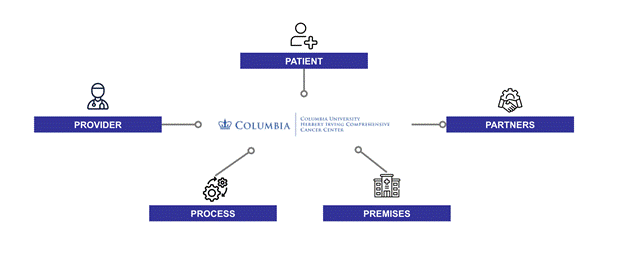
Figure 2.
Prioritization Matrix

Figure 3.
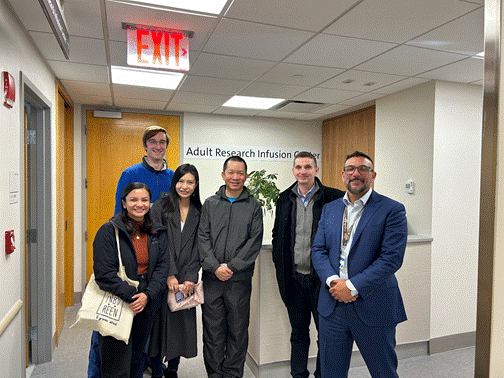
Team Visit to HICCC Phase I Program