Project Background
Diasome, a clinical-stage pharmaceutical company, has developed a
delivery system called Hepatic Directed Vesicle (HDV) insulin. HDV platform
directly targets hepatocyte cells to restore hepatic glucose and lipid control.
This technology has been shown to restore hepatocyte metabolism and treat
metabolic diseases, making it unique in the obesity treatment space.
Project Objective
We
were tasked with developing a market entry & competitive positioning
strategy for Diasome in the event of either the
acquisition of Diasome or for their HDV technology to
be licensed.
Project Approach
Based
on independent research and conversations with Diasome
management we determined the strategy would ultimately be similar for
acquisition and licensure, then took the following approach to developing the
appropriate strategy.
● Identify the key strategic
choices and options for market entry.
● Analyze the competitive
landscape (approved and pipeline drugs specifically indicated for obesity), and
pinpoint key success factors based on mechanism of action (MoA),
route of administration (RoA), efficacy, safety, and dosage frequency.
● Review recent out-licensing
and acquisition transactions between early-stage biotech and large
pharmaceutical companies to form a thesis on likely financial terms in either
scenario.
● Analyze potential partner
traits based on criteria such as financial terms, financial performance, and
competencies in product development and commercialization.
● Synthesize and interpret
information gathered from data to develop our strategy.
Key strategic choices
Our
approach hinged on identifying key strategic choices for any candidate
considering entry into the obesity market: entry
vs non-entry, oral formulations vs injectable formulations, and GLP-1 receptor
agonist (GLP-1 RA) formulations vs dual agonist formulations.
We
then outlined 4 possible strategies to reach our goals:
- Introduce an oral GLP-1
formulation to the Market.
- Introduce an oral dual agonist
formulation to the Market.
- Introduce an injectable GLP-1
formulation to the Market.
- Introduce an injectable dual
agonist formulation to the Market.
Underlying Key
Recommendations
The
final recommendations made to Diasome regarding how
they should enter and position themselves were segmented based on the key
choices on MoA and RoA and
Key Partner.
Mechanism of Action (MoA): GLP-1 receptor agonist (GLP-1 RA) formulations vs dual agonist
formulations
- 68% of potential anti-obesity
drug consumers with weight loss goals ≥ 20lbs express interest in
using an anti-obesity drug and are not doing so currently, making this
segment ripe for cultivation.
- As expected, as weight loss
goals decrease so does interest with only about 50% willingness to try
anti-obesity drugs in those with weight loss goals < 20 lbs.
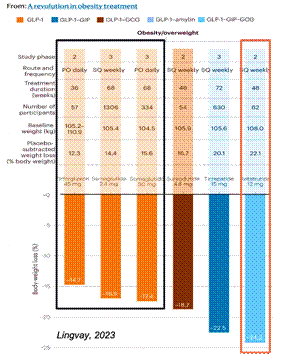
- GLP-1RAs are already failing to
meet tomorrow’s expectations for efficacy as they trail the clinical
efficacy of Phase II and III dual and triple agonist formulations. (Fig 1)
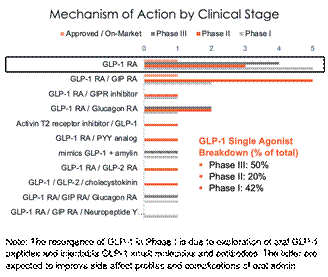
- The anti-obesity drug pipeline
is already diversifying away from GLP1 RAs for injectable formulations. We
expect oral formulations to follow a similar pattern. (Fig 2)
Route of Administration (RoA): Oral formulations vs injectable
formulations
- Consumers want a pill but with a
caveat. They want the ease of administration injectables have, i.e. no
fasting, can be taken with other meds, etc.
- Anti-obesity pipeline still
predominated by injectable options despite consumer desires for an
efficacious oral. (Fig 3)
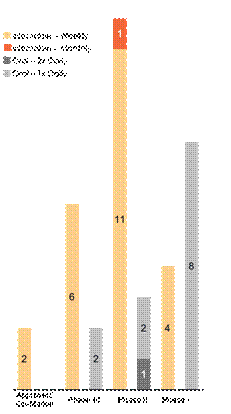
Figure 3: Route of Admin (RoA) vs Clinical Stage
Other
Considerations: Comments on Dosage & Safety
- Daily ≠ a dealbreaker – if
an oral delivers on efficacy and is easy to fold into daily routines,
daily admin won’t alter preferences for oral.
- Though a pain point for users,
clinical trials reveal that consumers are by and large willing to tolerate
the usual side effects of a GLP-1 agonist.
Key Partner: Out-License or Acquisition
Out-Licensing: Diasome
keeps ownership but gives limited rights for use; Brings immediate payments and
royalties over a series of time; Leverages external resources, reduces risk,
and focuses on core strengths.
● The average share of upfront
total deal value between 2010 and 2020 was 11% for preclinical-stage biotech
companies.
● The average total deal value
between 2010 and 2020 was $175M for preclinical-stage biotech companies.
● The average disclosed royalty
percentage as of 2020 was 16% for out-licensing deals.
● Recent deals (Lilly and OSI
Pharmaceuticals; AstraZeneca and Eccogene) show
potential for outsized deals, far exceeding these average values.
Acquisition: Means Diasome cedes ownership and transfers
control completely; Involves a lump-sum payment or a mix of cash and stock;
Integrates tech, talents, and pipelines, offering faster development but
altering company dynamics.
● In analyzing recent
acquisitions of early-stage (pre-clinical, Phase I, and Phase II) biotech
companies operating in the metabolic disease category, we found that the mean
EV/Revenue multiple was 29x and the median was 16.1x.
Recommendation
Of
the 4 strategic options outlined, we realized choices 1 (oral GLP-1 RA) and 3
(injectable GLP-1 RA) were not viable strategies due to Diasome’s
projected timeframe of 6-8 years, pipeline dynamics, and measures of efficacy
when compared to emerging dual-agonist injectables. As such, we were left
either with an injectable dual agonist formulation or an oral dual agonist
formulation scenario. Our assessment is that Diasome
would only provide a valuable contribution to the consumer if the company could
leverage its HDV technology to enhance the oral option’s efficacy by increasing
bioavailability to achieve weight loss efficacy levels competitive with today’s
Phase II injectables – 22% placebo-adjusted weight loss at 48 weeks while
maintaining or improving current safety levels and side effects.
If Diasome can execute this, they are positioned to succeed.
They would unlock value creation and produce a competitive drug in the
anti-obesity market. However, this recommendation relies on the oral
formulation’s ability to deliver on the recommended standard of efficacy.
Final Thoughts
Overall,
it was an extremely enriching and fulfilling learning opportunity for our group
to collaborate with the Diasome team. We value the
strategy-centric project that we worked on throughout the semester and hope our
work was impactful in the process. Thank you to Professors Carri Chan, Peter
Tollman, and Taylor Sewell for the constant guidance and support as well.
Contributors: Simone Counts, Tola
Ebunlomo, Melissa Leo, Mary Ellen Morris-Delaney, Krusha Zota