Exo Imaging: Executive Summary
Michael Adjei-Mosi, Sarah Besnainou, Rachel Curry and Stacey Gouker
Overview
Exo
recently released its Point-of-Care Ultrasound (POCUS) ecosystem,
and wants to get it into the hands of as many physicians as possible,
with the ultimate goal of standard use in PCP settings. Our task was to move
past the beachhead of emergency departments and identify in which physician
population and for which cardiac disease states Exo’s ecosystem should be
deployed next.
Problem Summary
POCUS
is not currently part of the standard of care in many clinical settings, and
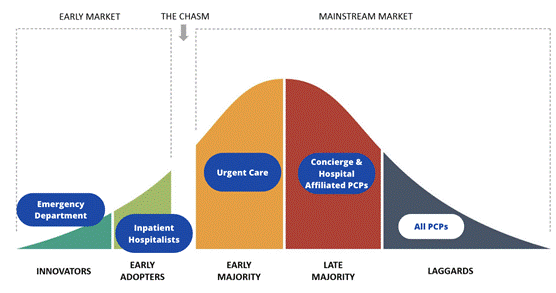
Exo strives to cross the chasm and drive wide adoption of POCUS. We needed to
determine where to dedicate Exo’s resources in terms of who should adopt POCUS
next and what technology to prioritize for that physician population.
Solution Summary
Drive
further adoption of POCUS to detect cardiac disease by selling Exo’s ecosystem
into Inpatient Hospital settings, a logical next step after EDs.
The primary Exo ecosystem users in this setting will be hospitalists,
intensivists, and residents, some of whom will go on to become primary care
practitioners. Prioritize the technology to produce 5 key findings in the
following order: pericardial effusion, all valve function, RV & LV size,
fluid & CVP estimation, and wall motion. Focusing technology on these
findings will help with the detection of 8 key disease states: myocarditis,
pericarditis, pulmonary embolism, cardiomyopathy, heart failure, endocarditis,
cardiac tamponade and heart valve disease.
Market Analysis
The
inpatient hospital physician population was selected based on a variety of
factors including current ultrasound adoption, the number of physicians
currently trained in POCUS, and the level of clinical evidence already
existing. After outlining barriers to adoption and
opportunities, it was determined that emergency departments were already
competitively penetrated, urgent care centers were inconsistent with treating
cardiac disease, and there were too many clinical and operational gaps to go
straight to primary care. Therefore, the inpatient hospital physicians present
a strong initial target population that also provides a bridge to primary care
providers.
We
started with a list of 70 cardiac diseases and narrowed it down based on
prevalence, ultrasound detectability, and patient value. After analyzing each
disease, we came down to a list of eight cardiac diseases. To provide concrete
recommendations for Exo’s AI technology, we selected six ultrasound findings
that were high yield when evaluating the eight cardiac diseases with POCUS.
Then, we ranked the six findings based on the overlap between the eight
diseases, in order for technology development.
Impact
We
provided Exo with an estimate of the value they can deliver to Inpatient
Hospital settings. We concluded Exo’s ecosystem will drive a 20% decrease in
average length of hospital stay, achieve up to a 95% decrease in the time
required to get clinical answers from imaging, and deliver cost savings of $0.9M
- $1.8M per year in Inpatient Hospitals who adopt the technology.