 The
one indisputable fact about the evolution of Ise Shrine, however, is that
it took its final institutional shape as we know it today in the late seventh
century. This was a period of native reaction against the pervasive Chinese
influences of the Taika Reforms of the mid-seventh century. But one irony
of this process of native reaction is that it relied in many ways on Chinese
techniques. The shrines, for example, are oriented facing due south, in
orthodox Chinese style, and the plan of the buildings is in general symmetrical.
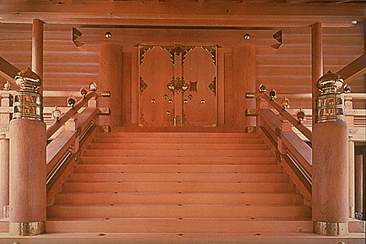
This view of the front entrance of the main sanctuary gives a good sense
of Chinese-like showiness, though with one important exception: the Chinese
would have painted the wood.
The
one indisputable fact about the evolution of Ise Shrine, however, is that
it took its final institutional shape as we know it today in the late seventh
century. This was a period of native reaction against the pervasive Chinese
influences of the Taika Reforms of the mid-seventh century. But one irony
of this process of native reaction is that it relied in many ways on Chinese
techniques. The shrines, for example, are oriented facing due south, in
orthodox Chinese style, and the plan of the buildings is in general symmetrical.
This view of the front entrance of the main sanctuary gives a good sense
of Chinese-like showiness, though with one important exception: the Chinese
would have painted the wood.