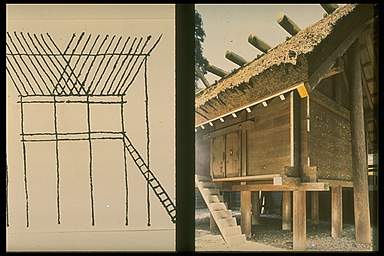
 Here,
for example, we see a comparison of one of the storehouses at the Outer
Shrine of Ise with a drawing of a primitive storehouse found on a bronze
bell from about the first century AD. In this truly primitive Japanese
building, the rafters of the roof were joined to the ridgepole with rope,
and hence the extension of the rafters into the air which you see was quite
simply a way of assuring that they would not slip free. But at Ise, such
untidy projections are reduced to a single elegant pair of extending beams
at either end. Similarly, the extra pillars standing free from the main
frame of the building in the primitive drawing here originally needed to
support the heavy roof, but with the highly sophisticated carpentry at
Ise, such a column which you see on the far right is for purely aesthetic
effect.
Here,
for example, we see a comparison of one of the storehouses at the Outer
Shrine of Ise with a drawing of a primitive storehouse found on a bronze
bell from about the first century AD. In this truly primitive Japanese
building, the rafters of the roof were joined to the ridgepole with rope,
and hence the extension of the rafters into the air which you see was quite
simply a way of assuring that they would not slip free. But at Ise, such
untidy projections are reduced to a single elegant pair of extending beams
at either end. Similarly, the extra pillars standing free from the main
frame of the building in the primitive drawing here originally needed to
support the heavy roof, but with the highly sophisticated carpentry at
Ise, such a column which you see on the far right is for purely aesthetic
effect.