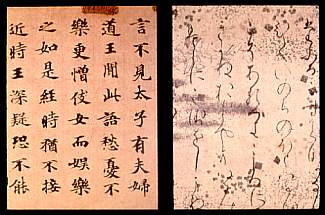
 Here
you can see the contrast of kana with a traditional Chinese text
on the left. The Chinese is clear and formal, and was written exclusively
by men, mostly in connection with government and religious affairs. The
Japanese kana are far more delicate and connected, conveying a sense
of the spontaneity and naturalness so prized in the world of Genji.
In Heian times, kana was known as onna-de, or "women's script,"
in contrast to the exclusively male Chinese, and was used by men and women
alike for poetry, personal diaries, and private letters. Kana not
only enabled the actual writing of the Tale of Genji, but also visually
expresses its aesthetic values.
Here
you can see the contrast of kana with a traditional Chinese text
on the left. The Chinese is clear and formal, and was written exclusively
by men, mostly in connection with government and religious affairs. The
Japanese kana are far more delicate and connected, conveying a sense
of the spontaneity and naturalness so prized in the world of Genji.
In Heian times, kana was known as onna-de, or "women's script,"
in contrast to the exclusively male Chinese, and was used by men and women
alike for poetry, personal diaries, and private letters. Kana not
only enabled the actual writing of the Tale of Genji, but also visually
expresses its aesthetic values.