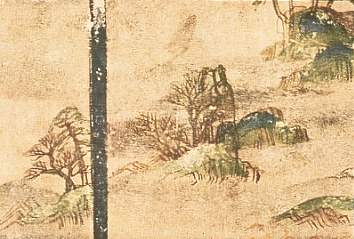
 But
what must be taken very seriously, according to Lady Murasaki, is the much
more difficult task of representing the ordinary landscape, which she describes
as "a scene of mountains, the rush of water, the familiar sights, graced
with the lovely lay of land thereabouts, the gentle roll of green, wooded
knolls." While Chinese themes were thus identified with the exotic and
unreal, true Japanese landscapes were seen as familiar, gentle, and near
at hand. To be Japanese, the logic continues, is to be natural and unpretentious,
relying on intuition more than imagination. This is a revealing example
of the way in which Heian culture was working towards a definition of what
was distinctively Japanese, as opposed to Chinese.
But
what must be taken very seriously, according to Lady Murasaki, is the much
more difficult task of representing the ordinary landscape, which she describes
as "a scene of mountains, the rush of water, the familiar sights, graced
with the lovely lay of land thereabouts, the gentle roll of green, wooded
knolls." While Chinese themes were thus identified with the exotic and
unreal, true Japanese landscapes were seen as familiar, gentle, and near
at hand. To be Japanese, the logic continues, is to be natural and unpretentious,
relying on intuition more than imagination. This is a revealing example
of the way in which Heian culture was working towards a definition of what
was distinctively Japanese, as opposed to Chinese.