May 17, 2008
Bedford Stuyvesant:
Including Weeksville (Hunterfly Road),
Weeksville Gardens (1632 Pacific Street),
154 Albany Avenue, 42 Albany Avenue
Written by Alice (Felbinger) Korfman
It may be that my expectations of Brooklyn were erroneously conditioned by my experience of
Manhattan. Or perhaps names like Utica, Troy, and Schenectady Avenue loomed
large in my consciousness because they had loomed even larger in the experience
of my father, William Felbinger (1901 - 1983). Dad was born and raised in the
Bedford-Stuyvesant neighborhood of Brooklyn. He enjoyed telling us stories
about his childhood and spoke of locations in tones bordering on the
reverential. The Brooklyn he imparted to my imagination consisted of wide
avenues and buildings of enormous proportions. On the sunny morning of May 17,
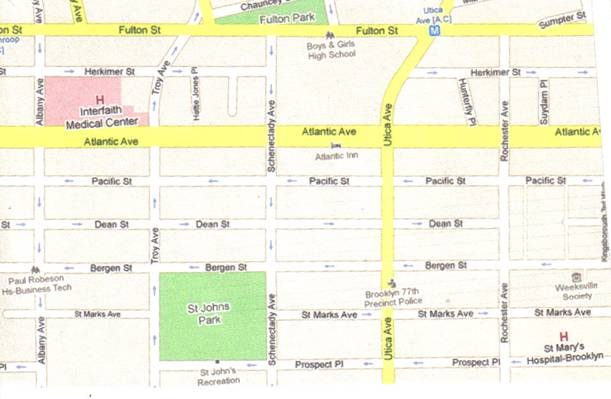
2008, when my brother John and I got off the A train at Utica Avenue and Fulton
Street, we were stunned by the smallness of the streets. Though Utica Avenue
sported a yellow line down its center, each opposing lane appeared to be barely
wide enough for a car. In the early days of Brooklyn, long before my father was
born, Fulton Street had been used by horses and wagons to cart produce from the
farms of Long Island to Manhattan via the Fulton Ferry. It was easy to imagine
horse-drawn carts meandering these narrow lanes. In
truth, the horses and wagons were still traveling these streets during my
father's boyhood.
The neighborhood of Bedford-Stuyvesant began in the 1840s and 50s as a development of a sleepy farm town. It included the African American community of Weeksville, which was settled by free African American farmers, laborers, and artisans as early as the 1830s. This was to be the first stop on our tour of addresses relating to our father's childhood. Historic Weeksville is officially located at 1698 Bergen Street, but its historic buildings are known as the Hunterfly Road houses for the side street they occupied. We expected to be able to tour these houses, but it was a day for expectations to be blown out of the water. We arrived to special festivities already in progress. White-clad elders of the African American community were seated on the lawn. The beat of African drums pulsed energetically to accompany young people performing traditional dances from Gambia. The power of the dancing and the escalating intensity of the drumming portrayed a richness of African culture dynamically alive and well in Brooklyn.
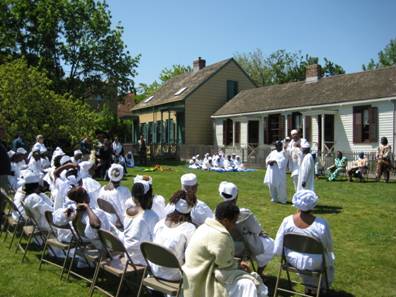
We enjoyed two lengthy
dances but finally decided it was time to move on as we had other locations to
visit. Before leaving, however, we were intercepted by Pam Green, one of
Weeksville's directors of tourism. She was deeply concerned that we had missed
out on the tour. She explained, apologetically, that the day's festivities were
not typical for a Saturday. She also wished to know what had drawn us to
Weeksville, possibly because Weeksville does not see as many white visitors as
it deserves. It was already evident to us that the elders were likewise
curious. We had certainly been noticed by them. During a break between dances,
the elder presenting the next dance troupe graciously acknowledged our presence
among the spectators. We, too, were elders of the community, he said, which
demonstrates that having gray hair has some advantages. We assured Pam that we
had not been disappointed. The drumming and dancing had been spectacular. We
explained about our family tour, how our father had told us that his boyhood
friends had been a veritable League of Nations. Among them had been an African
American boy, possibly from Weeksville. The family's last address in Brooklyn,
1632 Pacific Street, is now a nearby apartment complex called Weeksville
Gardens. Pam's eyes sparkled with interest and delight. We were no longer just
average tourists. Now we were seekers and sojourners in the realm of personal
history, as were so many African Americans who visit Weeksville. We talked more
about Dad and what the neighborhood had been like when he had lived there a
little over 100 years ago. We also mentioned Dad's great uncle Fred Fichtelmann
who had left Germany, intending to go to New Orleans which coincidentally had
also had a considerable free black population prior to the Civil War. For
whatever reasons, Uncle Fred decided to settle in Brooklyn instead of New
Orleans. It ultimately explains why, when his sister, Maria Barbara Fichtelmann
and her partner, our great grandfather Johann Georg Felbinger, left Germany,
they settled in Brooklyn as well. Other Felbingers headed to Illinois and
California, but our branch of the family became New Yorkers, and more
specifically, Brooklynites.
After saying our goodbyes to Pam, we walked back along Bergen Street and north to Pacific Street, where the Felbingers had lived sometime after 1905 until about 1920. We weren't expecting original buildings. Much of old Brooklyn has been demolished and rebuilt. Sometime in the 1970s Weeksville Garden Apartments was built on the block between Schenectady and Troy Avenues where the Felbingers had lived. We don't know if it had been a brownstone or a free standing house like the Hunterfly Road houses. We surmise that it had a good-sized backyard, since according to Dad they had chickens and a goat, to say nothing of the monkey his Uncle Fred Meyer palmed off on our father's mother, his sister Cenie. His other sister, Kate, in whose house he was living, would have nothing to do with the monkey. Cenie must have been softer-hearted.
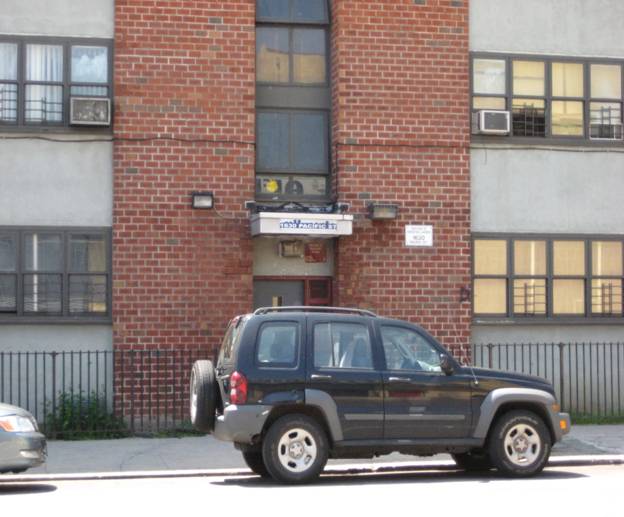
One of the entrances to the apartments bore the address 1630 Pacific
Street. The Felbingers had lived at 1632. This was as close as we were going to
get to Dad's past here. At Troy Avenue we headed south again to Bergen Street
where there is a school, P.S. 243. Whether Dad actually went to school there
isn't known, but there is a reference to Dad having attended school on Bergen
Street in the draft of a letter, in Dad's own hand, to Dorothy Felbinger who
lived in California. Dorothy must be held responsible for beginning this mania
for family research. She wrote a letter to our Aunt May, wondering if they
might be related. Aunt May passed the letter on to her brother, our father, and
so it began. In Dad's letter, he tells Dorothy of a fearfully icy day on which
his mother insisted he head off to his school on Bergen Street. The going was
particularly treacherous. Dad barely made it down the front steps, it was so
slippery. He clung desperately to the railing and looked back at his mother,
hoping for reprieve, but Cenie shooed him along. He slowly and carefully made
his way to school, only to discover that few others would make it that day. He
was irritable and disappointed as, without his classmates, the day was dull.
When he finally returned home, however, his mother, by now deeply concerned for
his safety, gave him the biggest hug, and he was greatly warmed by it.
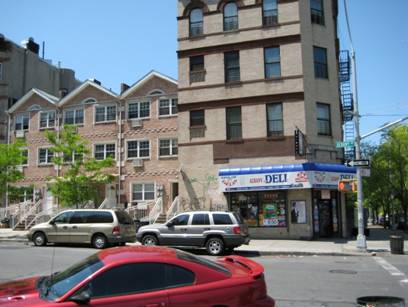
My brother and I continued our walk along Bergen Street to 154 Albany
Avenue where Aunt May was born in 1905. She was the youngest of the four
Felbinger children, who included our Aunt Gene (Georgine), Dad, and Aunt Etta
(Henrietta). Unlike 1632 Pacific Street, which no longer exists, there is still
a 154 Albany Avenue just off the southwest corner. Sadly, the building was
clearly not 1905 vintage. Much of the rest of the street may date to that time,
however, including the corner building which houses the Albany Avenue Deli at
street level.
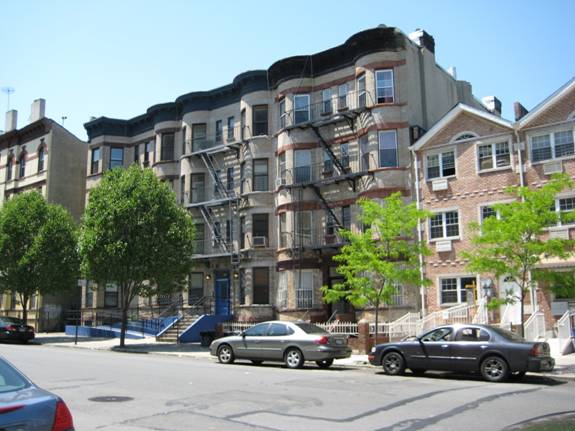
A young woman of color stood on the steps just outside the open doorway
to No. 154. She displayed no curiosity about us, and perhaps had not registered
that we were taking photos of her home from across the street. She was talking
on a cell phone and was no doubt more engrossed in her conversation. We crossed
the street, and when she had finished her call, John engaged her in
conversation. He explained about our Aunt May having been born at this location
one hundred and three years ago almost to the day, since her birthday had been
May 10th and today May 17th. "Wow!" she replied
and looking thoughtful, sat down on her steps. We asked her how old the current
building was, and she told us it might only be about five years old. It's a
pity to think we might have missed out on the original building by only five
years, but then one starts to wonder whether we would really have wandered into
this neighborhood five or ten years ago. In 1991 the racially motivated riots
in the Crown Heights neighborhood just a few blocks south made the area so
volatile it would have been worth our lives to have ventured here. But on May
17, 2008 we stood calmly talking to a young woman of a different race as she
sat on her doorstep, and all of us marveled at the history of the location
which had brought us briefly together.
North of No. 154, Albany Avenue leads to the Long Island Railroad el that
runs along Atlantic Avenue. This stretch still appears to have mostly original
buildings and gave us some feel for what Grandpa Felbinger's daily walk to work
was like, though in those days the railroad was at ground level.
It seemed a very pleasant neighborhood, but north of
the el, the neighborhood quickly deteriorates. We were looking for No. 42 Albany Avenue,
the address at which our grandfather had his bicycle business. Once again, we found
the address but the building was no longer original. The entire 2-block stretch
on the west side of Albany Avenue, north of Atlantic Avenue is a row of old
garages with metal doors, all virtually crumbling and occupied by rough-looking
black men that would give me pause to be there without my brother, ultimately
no threat but over six feet tall, just as his grandfather had been.
By the early 1920s, our grandfather was into automotive repair as well
as bicycles, and it was stunning to realize that such business was still taking
place in this locale more than 80 years later. Especially eerie, was that next
to 42 Albany Avenue was a lot filled with bicycles and parts of bicycles,
frames and tires, how many stolen is anyone's guess. A sign on the corrugated
metal of a garage just south of the lot stated in scrawled spray-can red paint:
BIKES 4 SALE-N-REPAIRS. Oh Grandpa, would you believe? There's still a bicycle
business here, though a far cry from your beautiful shop, the Albany Cycle
Company.
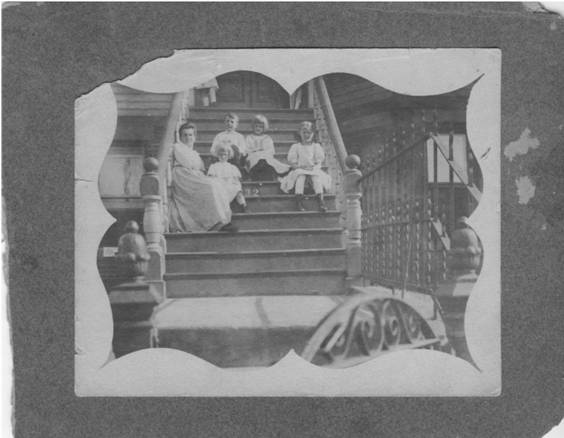
Family research is an ongoing work, and new surprises are around every
corner. This past year, our Vermont cousins, granddaughters of our Aunt Etta,
invited my brother John up to Burlington for Thanksgiving dinner 2009. There he
was shown one of Aunt Etta's photo albums, which included the photo below of
her mother and siblings seated on the steps of 1632 Pacific Street. You can
just make out the 32 on the steps. Mother Cenie Felbinger is at left with
youngest daughter May beside her. Behind May, from left to right, is our father
William, Etta, and older sister Georgine. So now we have a little more idea of
what the building looked like, and yes, Dad, those steps would have been
treacherous on an icy day.
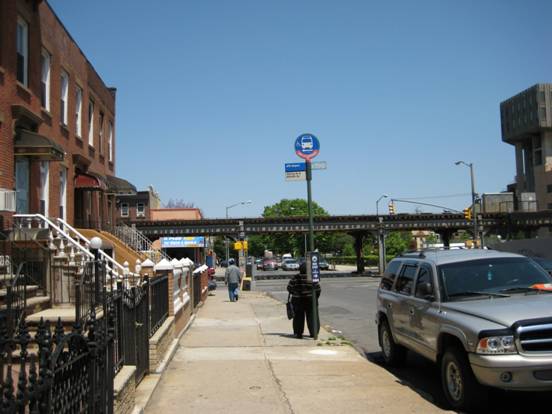
was our grandfather's daily walk to work.
He owned a bicycle business at 42 Albany Avenue.
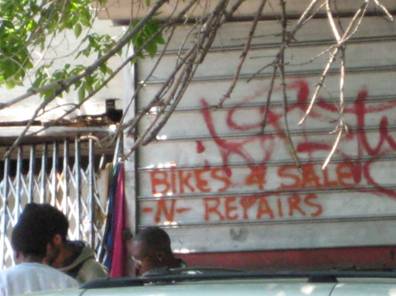
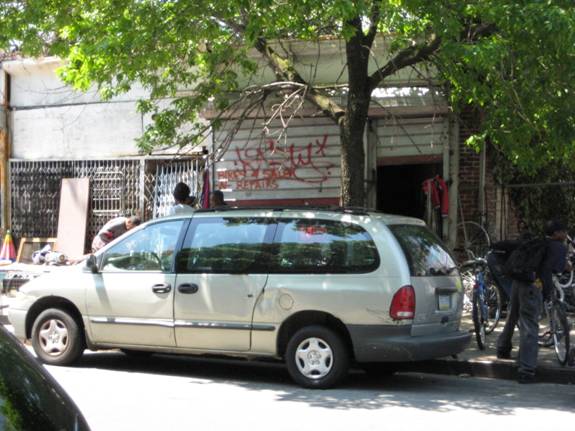
immediately south of the original
Albany Cycle Company
operated by our grandfather, John George Felbinger Jr. at 42 Albany Avenue.
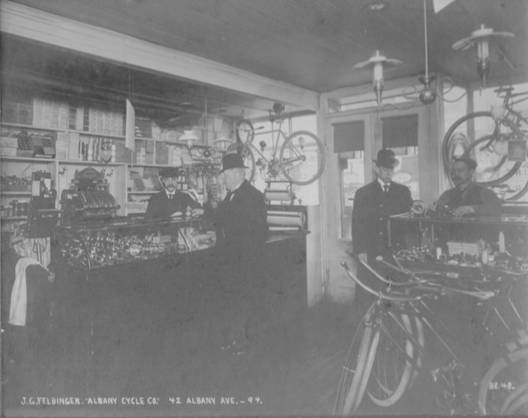
This photo (original in sepia) hung for years in our childhood home.
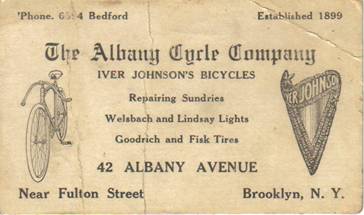
in a cherry wood box handcrafted by John George's father
Johann Georg Felbinger, who had been a cabinet-maker.
It was now time for lunch and to ponder all we had seen. We retreated
to a McDonald's for salads before leaving Brooklyn on the C train from Throop
Street for more familiar Manhattan. We had experienced many wonderful surprises
throughout the morning, and while the first had shrunk our childhood imaginings
to adult realities, there is no doubt that this part of Brooklyn has grown
larger in our understanding and in our hearts.
POSTSCRIPT - January 2010