DAY 1 : RESEARCH FIRST !
May 16, 2008
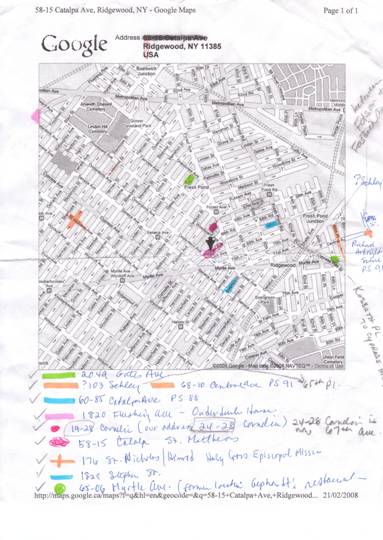
Everyone says that Queens is a mess. Everyone gets lost in Queens. The little bit of research that I had done via the Internet certainly hinted at the problem. I had spent a few months organizing what was to be a tour of Prahl Family addresses spanning the years 1910 to 1940. In 1910 my maternal grandparents, Edward and Christina Prahl, married and moved from Manhattan to Ridgewood, Queens. Plenty of German families were making the same move. Ridgewood was fast becoming the latest version of Kleindeutschland (Little Germany), an immigrant neighborhood that began its existence in Manhattan as early as the 1840s. A couple decades later, large numbers of German immigrants moved east to Brooklyn, and by 1910 they were moving east again to the borough of Queens. A year after my grandparents arrived in Ridgewood, their first child, my mother Constance Prahl, was born at 20-49 Gates Avenue. Eight years later, her sister, Christine, was born at 103 Schley Street in neighboring Glendale. Google Maps showed that 20-49 Gates Avenue was still a valid address. Schley Street, however, was not to be found. Friends of the family, who still live in the area, told me that many street names and numbers had been changed, but they had no idea what Schley Street had become or where it had been located. There was the added problem that, assuming I could figure out the new name for Schley Street, I would still have to determine how the old house number correlated with today's house numbers. All of this was confusing, but I was not without hope. I knew that some parts of Ridgewood had received heritage status. This meant that, unlike the Brooklyn addresses of my father, which had long since been torn down, I might yet discover the original buildings in which the Prahls had lived. All I had to do was determine the new street names and house numbers for the addresses I had.
I continued to search on the Internet. Living in Western Canada left me few better options except to plague my brother, who resides in New York City, with research problems. I found a website concerning Hildegard Elizabeth Wallner who was living at 119 Schley Street in October 1919, just six months after my aunt was born. The site mentioned that Schley Street was now 65th Place. This was great news. The question remained: which part of 65th Place? There are bits and pieces of it starting and stopping all over Ridgewood and Glendale. I thought it might be a two-block portion that intersected Central Avenue in Glendale. Aunt Chris claimed to have been born on a short street in Glendale. Also, according to Schlegel's German-American Families in the United States, big sister Connie was attending school at P.S. 91 on Central Avenue in 1917. The school still exists, not too far from this two block stretch of 65th Place. I was feeling confident that I had found Schley Street until I came up with other websites that told me 65th Place in the same vicinity had been variously Epsilon Street or Sherman Street or Sheridan Street. This was not going to be so easy.
Schley Street was not my only problem. I had other addresses
I wanted to find. The Prahls had moved frequently around the
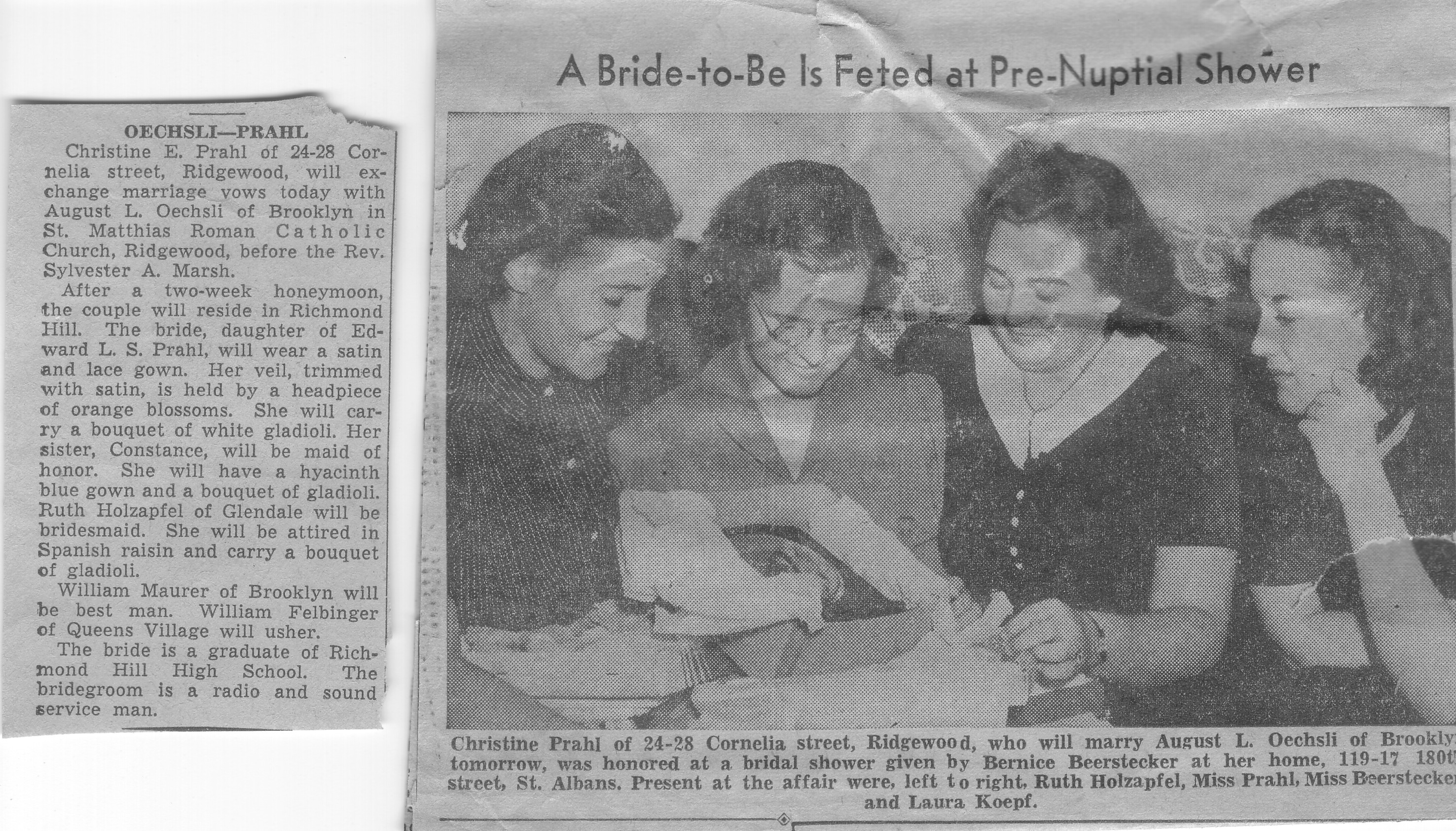
neighborhood. In 1939, they were living at 24-28 Cornelia
Street in Ridgewood. I have an old newspaper clipping,
concerning the 1939 bridal shower given to our aunt, which
gives this address. Once again I consulted Google Maps only
to discover that while Cornelia Street still exists, there
is no longer a number 24-28. "Do you mean 19-something" Google asked me.
No, I meant what I said. So, what had become of 24-28 Cornelia?
Had it been renumbered? Had it been demolished? Or was
something else at work? By today's numbering system, a
close-by address on Cornelia would be in Brooklyn rather
than Ridgewood. I felt utterly lost.
Obviously, Internet research was only going to get me so far.
In May 2008, I arrived in New York for my annual visit with Mom.
I had a long address list in hand, as during these visits my
brother and I work together on family research. We've spent days
in the Municipal Archives, toured cemeteries, and visited neighborhoods.
I was anxious to get out to Queens, but my brother insisted
that to head out to Ridgewood without more information would
prove frustrating and unproductive. What we needed were maps
dating back to 1911 when our mother was born,
1919 when our aunt was born, the early 30s when the Prahls
lived on Stephen Street, and one for the late 30s when
they lived on Cornelia. We planned an afternoon at the
Map Room of the New York Public Library. The weather was dreary,
far too wet for a neighborhood tour but perfect for indoor research.
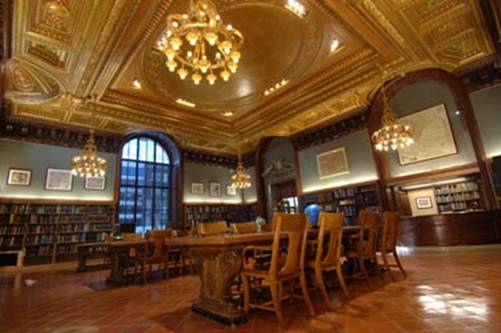
The Map Room at NYPL is stunning, ornate, crystal chandeliered, with huge polished wood tables ideal for browsing extra large atlases. The friendly staff person took possession of the list of addresses we hoped to find and promptly warned us, "Queens is a mess." He told us that to cover our dates the best they could offer was the Belcher-Hyde atlases for 1908, 1915, and 1929. The "help" would bring us the books shortly, and we should select our table area.
The first atlas arrived promptly. It was larger than 2 by 3 feet,
a half foot deep, and caused the "help" to rub her arm from the
strain of carrying it to our table. This was the 1908 Vol. 2 of
E. Belcher Hyde Atlas of the Borough of Queens. To be chronological
about our research, we should have begun with Gates Avenue, but
we were eager to confront the more difficult problem of Schley
Street. Immediately, we turned to Map 37 in Glendale. We soon
discovered that in 1908, two years before our grandparents
moved from Manhattan, most of Glendale was a blank on the map.
Schley Street did not exist. Back to Map 34 in Ridgewood
we discovered that while Gates Avenue existed in 1908,
the house numbers ran only to 18-42. Number 20-49 was
still just a plan waiting to be developed. It would
eventually be constructed on the north side of the
street between Fairview and Grandview.
In 1908 Ridgewood was mostly under construction. Later in the afternoon we learned that the old farms that comprised the area gradually disappeared between 1900 and 1912 as the German immigrant population expanded eastward from its earliest foothold on the Lower East Side of Manhattan. Map 34 told us that the immediate area surrounding Gates Avenue was being developed by the Germania Real Estate Improvement Co. The same map noted the location of P.S. 88 at which our mother would eventually complete her primary education. It was located between Elm Street on the south and Halsey Street on the north. Shortly after 1908, Elm Street had its name changed to Catalpa Avenue, a name which was far more familiar to us because it was the name by which our mother and aunt knew the street. Queens was barely in development before the names of most its streets underwent name and number changes. No wonder everyone in Queens was lost.
The "help" had, by now, delivered our next and even heavier atlas, Volume IIA of E. Belcher-Hyde, 1915. An index to NEW STREET NAMES appeared at the beginning of this atlas, and it was apparent that the renaming of streets and renumbering of houses was well underway. Old Elm Avenue became Catalpa Avenue. Schley Street now existed but had already been either Sherman Street or Sheridan Street not long before and depending on whether you were looking at the index or an actual map. Part of Gates Avenue had been Magnolia Street. Stephen Street had been Covert Street. Happily, we were now able to locate 20-49 Gates Avenue on the north side of the street. The NE corner of Fairview/Gates was 20-27. The NW corner of Grandview/Gates was 20-61. That set the boundaries for the block we were interested in, and houses ran by sequential odd numbers. This made 20-49 the 12th building from Fairview or 7th building from the corner of Grandview. We believed that the house numbers had not changed since 1915, since you can still find 20-49 on a Google map, but just in case, we could count off the houses to find the location of our mother's birth.
Schley Street was still proving difficult. We were now working with Map 38/39, and it was evident that Glendale was somewhat behind Ridgewood in terms of its development. The layout for Schley Street existed by 1915 (and already they were double labeling it as 65th Place), but no houses existed as yet. It was clear that Schley Street was indeed the two-block street bisected by Central Avenue. Elsewhere 65th Place had other names, including Epsilon and Shaler to name a couple, but we were now certain which portion of today's 65th Place had been Schley Street. We were hopeful that when we received our next atlas, we would easily work out which house had been number 103.
Meanwhile, we decided to tackle Cornelia Street again. Here we got lucky. The 1915 map revealed that Cornelia Street (formerly Jefferson Street) once continued in a series of jogs beyond Forest Avenue onto what is today 67th Avenue. Number 24-28 appeared to be the 14th building from the corner of what was Buchman Street (now 60th Lane) heading toward Fresh Pond Road, one street name that survived without change. We already figured that the house would no longer bear the number 24-28, but even without its 21st century house number we would be able to determine which building had been the Prahl home in 1939. All we had to do was count the houses from the corner of 60th Lane once we were in Ridgewood.
Our final atlas arrived, the E. Belcher Hyde 1929. On the Ridgewood map the section of Cornelia Street on which the Prahls had lived was already supposed to be 67th Place. Obviously the residents of Ridgewood who lived there at the time didn't know that. From our newspaper clipping we know that they were still using the name Cornelia Street as late as 1939 for the portion of street which is now called 67th Place. The new house number looked to be 60-78, but it wasn't easy to tell from the map. Again, if all else failed, we would count buildings from the corner of 60th Lane to determine the house we wanted.
We turned to the Glendale map once again and zeroed in on Schley Street. The hopes we had of easily locating number 103, Auntie's birthplace, soon disappeared. The glorious renumbering scheme that overtook Ridgewood and Glendale between 1915 and 1929 had taken 103 with it. The houses that appeared on the 1929 Glendale map were numbered from 70-03 in the first block and 71-01 in the second block. We could not be sure how these numbers correlated with 103 Schley Street in the year 1919.
By now my head was killing me. My eyes were blurring, and my gut was still complaining of jet lag and irregular eating habits. We'd been at our research over three hours, and the maps could no longer help us. It was time to leave the Map Room and head down the hall to the Genealogical Division. It was time to check on my brother's assumption that everyone who lived in Ridgewood and Glendale must have been as confused as we were by all these name and number changes. Queens was indeed a mess, but someone must have sought to rectify the situation. And someone had.
Norwood's Guide, 1st and 2nd Wards, Queens, Best Street Directory, Flushing (New York; C.W. Norwood, 1931) was an answer to our confusion, though I think it might just have left residents of the time period as confused as before. Though not nearly as large as the atlases we'd been handling, this little book was still something of a tome, due to the massive changes that had taken place in the community of Ridgewood/Glendale. The directory confirmed that Schley Street had become 65th Place, but more important, on page 271 it noted that the new numbers ran from 70-00 to 71-00 and that 70-01 corresponded with old 101 which was on the corner of 70th Street, formerly Edsall Avenue. Therefore, 103 Schley Street, Aunt Chris' birthplace, was now 70-03 and would be a cinch to find. Likewise the directory confirmed that 24-28 Cornelia Street would be on what is now 67th Avenue between 60th Lane and Fresh Pond Road. Number 60-52 would correspond to 24-02 old Cornelia Street and therefore, old 24-48 Cornelia Street would now be number 60-78. Hurray!
It was a satisfying day of detective work, but we had yet to do the actual tour. It remained to be seen if we would still consider Queens a mess once we got there, and how lost we might yet be.
We looked at one last book before leaving New York Public Library. History of Ridgewood 1912, by George Schubel, noted that in 1905 a 5-6 room apartment rented for $12.00 a month. A glass of beer was 5 cents, and a shave and a hair cut were 25 cents, two bits! Sing it with us.
DAY 2 : THE TOUR
May 19, 2008
Danger on the subway! The long-awaited day for our tour of the Queens neighborhood in which our mother and aunt had grown up, was off to a bad start. Early in the morning, my brother and I left the Upper West Side of Manhattan by subway and transferred to the L train at 14th Street. Some stations later, and well into Brooklyn, idiot teenage boys held up the train for many minutes by ignoring the repeated injunction to "STAND CLEAR OF THE CLOSING DOORS!" They hopped on and off and on again, yelling at each other all the while. A dozen strong, they continued their "high spirits" inside the subway car by confronting an equal idiot who was butting out an illegal cigarette. "You can't smoke on the train!" they challenged and advanced on him with all the arrogance of vigilante justice. The smoker idiot, a hefty adult, whipped off his belt, not just in self-defense, but to retaliate. He advanced on the kids who backed off long enough to whip off their belts and start swinging. We, and other passengers, were caught in the middle. Bravely or stupidly, the guy's girlfriend stepped between him and the boys and attempted to shove him back. You could see she wouldn't succeed. There was more yelling and posturing and waving of belts. Just as soon as the train pulled into the next station, John commanded me to head for the doors. We weren't alone. An elderly woman cursed an uncaring transit employee who was seated by the window of the preceding car. "Damn train nearly got me killed!"
Unbelievably, the train sat in the station for another 10 minutes -- waiting for a transit cop? Waiting for any cop? The transit employee made no move to investigate whatever continued to transpire in the car we had vacated. Finally the train took off, and shortly, another train arrived. The rest of the ride to Ridgewood was uneventful. We had to change trains again, this time for the elevated M line. It felt good to be above ground with a blustery spring wind whipping my face and clearing away any last anxious thoughts of our ride on the L. As we rode to the Fresh Pond Road station, I caught sight of a steeple which I felt sure must be St. Matthias Roman Catholic Church. Our aunt and uncle had been married there in September 1939.
Ridgewood should have been somewhat familiar to us. John and I had visited family friends there as children, but as far as I was concerned we had arrived in unknown territory. We exited the transit system from the front end of the train and were promptly lost. This rarely happens to John, and we had to work our way back to Fresh Pond Road from a neighboring street. Usually John recalls places from our childhood better than I do, mostly because he is five years older than I am. This day, I think, he was as glad as I was to have a map in hand.
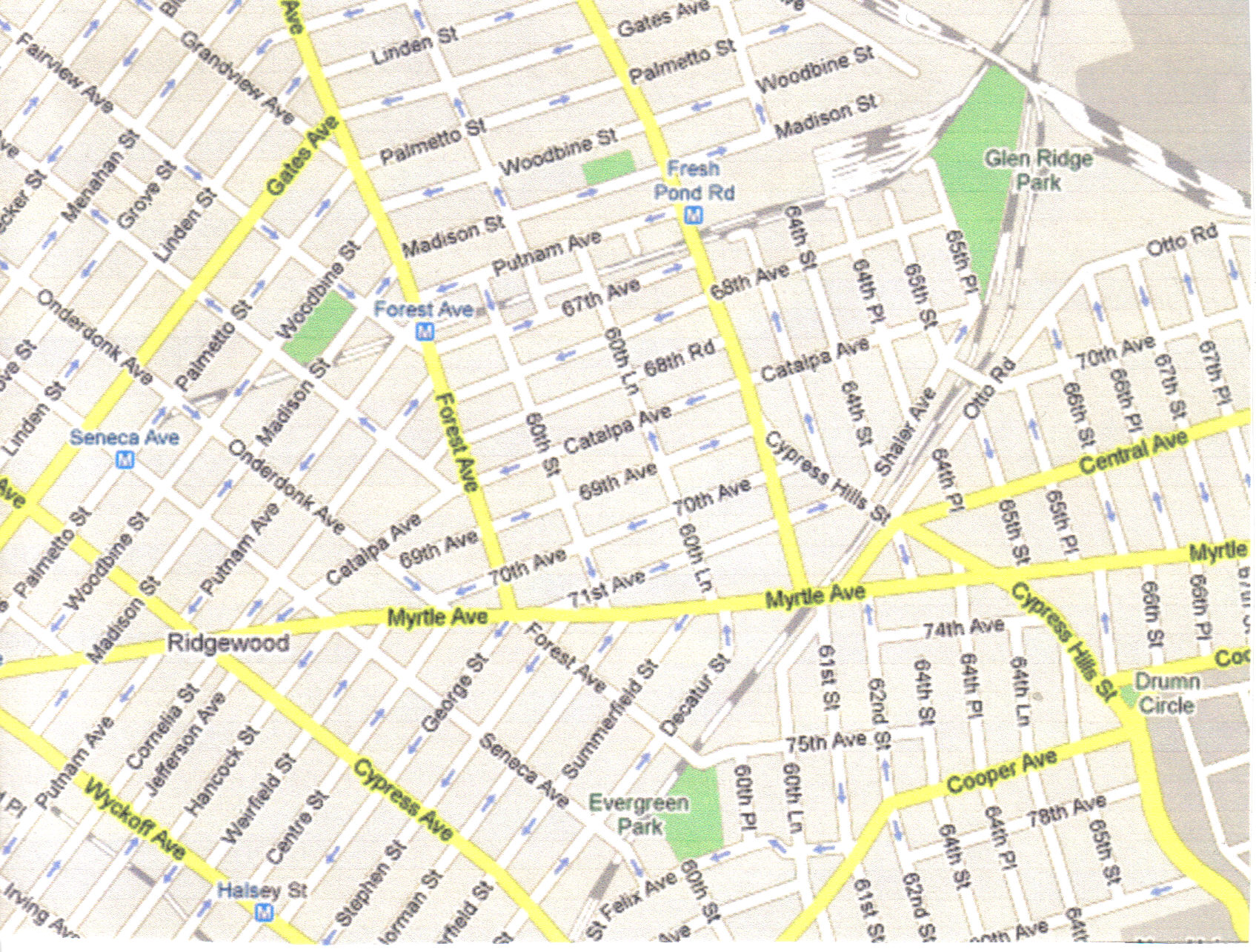
We used Fresh Pond Road to orient ourselves throughout
the day's exploration of Ridgewood and Glendale. It is
something of a main drag through the neighborhood. It
leads away from Myrtle Avenue toward Metropolitan Avenue,
both even bigger drags. In search of our first address,
we walked along Fresh Pond Road as it heads away from
Myrtle Avenue, looking for what had been 24-28 Cornelia
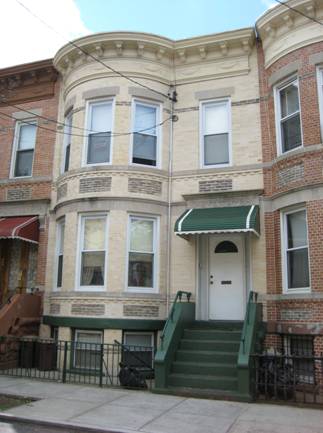
Street in 1939. Now, in 2008, it should be 60-78 67th
Avenue, as determined from the atlases we had perused
at the New York Public Library. It was wonderful to
have our research borne out. The address was exactly 14 doors
from the corner of 60th Lane. The woman who currently
lives there soon came to her bow window out of concern
for strangers who were busy photographing her home.
We tried to explain that members of our family had once
lived here, but I'm not sure she completely understood
what we were telling her. Ultimately, she was OK with us
taking photos, however. She may have thought we had
something to do with the fact that various sections
of the neighborhood are still being considered for landmark status.
After taking numerous photos, we returned to Fresh Pond Road
and resumed our former heading. We were now searching
for 20-49 Gates Avenue, where our mother was born in 1911.
The first few blocks of Gates Avenue disappointed us.
It was obvious the housing was not original as it had
been on 67th Avenue. Once we crossed Forest Avenue, however,
where Gates takes a bit of a turn, we again found brick
row housing that dated back to 1910, the year our
grandparents moved to Ridgewood from Manhattan.
We easily located number 20-49.
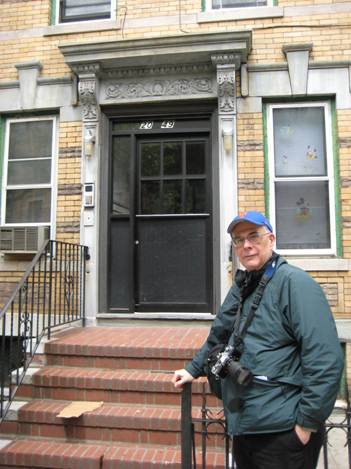
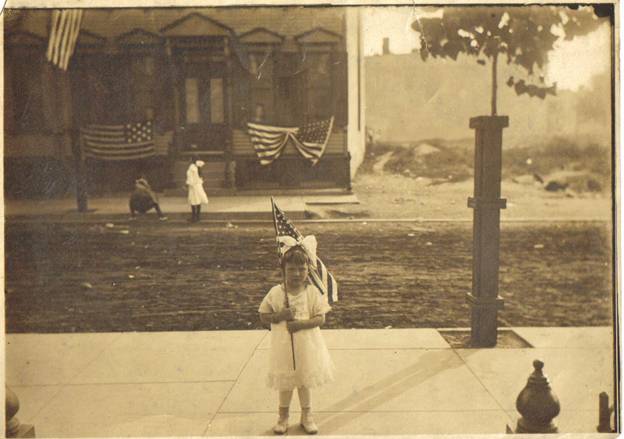
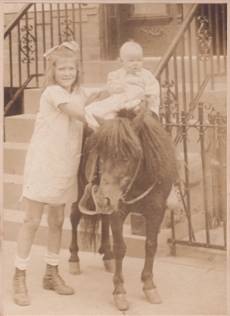
We have a few early photos of Mom. One was taken on July 4, 1914;
another was taken a year or two later. We compared the house
before us with these photos, but the window moldings and
railings did not match those in either photo. Each street
in Ridgewood seems to have its own particular characteristics.
I suspected that we would have better luck around the corner
on Palmetto Street. One of my Internet searches had turned
up the website for the Ridgewood Times newspaper. In their
archives was a photo of Palmetto draped in patriotic bunting
for a July 4th celebration in 1914. Indeed, the house moldings
that we saw on Palmetto Street exactly matched those in our
photo of three-year-old Connie holding an American flag. The
detail of some of the wrought iron railings were also a
better match for the later photo of Mom, age five,
holding a doll. In 1914 Palmetto Street was still unpaved,
and the tree in the photo was a mere sapling. The trees on
today's Palmetto Street are tall with thick trunks and
offer considerable shade.
Had the Prahls moved to Palmetto Street a few years after Mom was born? It's possible. As far as we know, the family rented all of their residences in the neighborhood, and like so many tenants, they may have moved as often as every two years. Perhaps in 1914 they lived on Palmetto Street.
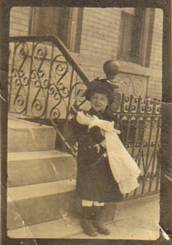
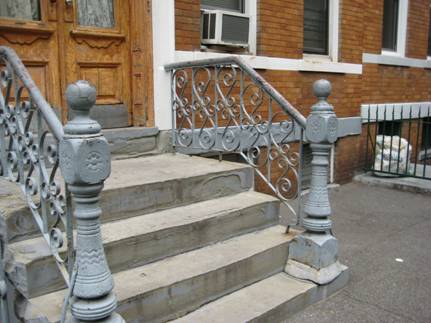
The wrought iron railings in the photo right are on Palmetto
Street.Notice how the detail more resembles that of the railings in the photo of
five-year-old Connie above.
We should have explored Palmetto Street further and taken more
time for photos, but we were sidetracked by a woman out sweeping
her sidewalk. She was in the mood to talk. Probably in her
seventies, she had lived in her house on Palmetto Street since 1958.
She told us that she had been born in Manhattan in the old
German neighborhood of Yorkville. Her parents moved out to
Ridgewood when she was a child, and they originally lived on
Gates Avenue at number 20-54, across the street from Mom's
birthplace. She may well have been living on Gates Avenue
about the time the Prahls were living on Cornelia Street.
According to her, Palmetto Street was under consideration
for landmark status. She was very proud of how well, overall,
the neighborhood had been maintained, but she had considerable
disdain for neighbors who had not kept their homes up to standard.
She was dismayed when I took the photo of the railings above.
"Don't take a picture of that! Those people don't care
anything about the neighborhood!" True enough, the
painted-over iron work was not as fine as that in front
of other homes, but I wanted an example of a railing which
resembled the iron work in our photo of Mom.
Once again we returned to Fresh Pond Road, this time retracing our steps toward the subway station. During the planning stage of the tour, I had thought it would be appropriate to find a nice restaurant for lunch, something authentically German, even a deli. I already knew that Gebhardt's, Ridgewood's most famous German restaurant and the location of my parents' wedding reception, had moved out of the neighborhood. We stopped, instead, for the proverbial New York quick lunch, a slice of pizza and a soda. Soon we were back on the street, heading toward Myrtle Avenue. Along the way we stopped at the corner of Catalpa Avenue and Fresh Pond Road where Public School 88, now called Seneca School, still provides primary education for local children. Although Mom had also attended P.S. 91 in Glendale, P.S. 88 was the only school she ever spoke of aside from Newtown High School over in Elmhurst. We still have an autograph album with the poems and signatures of her classmates at P.S. 88. It was a memento that she treasured, filled with memories from days she greatly enjoyed. "Roses are red, violets are blue; always paddle your own canoe."
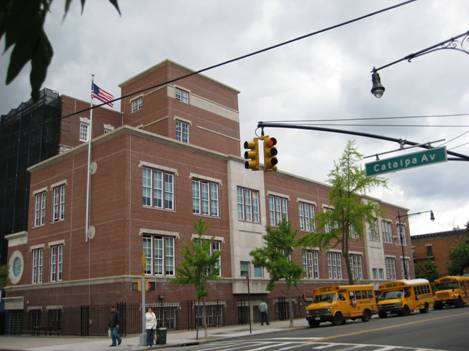
John and I now headed in the direction of our own past.
Just beyond Myrtle Avenue, on the other side of the elevated
railroad line, was 72-38 61st Street. Friends of the family,
Walter and Ruth Hebel and their son Marc, lived at this
address when we were children. Ruth had been very close to our
Aunt Chris, had been maid-of-honor at the 1939 wedding, and
was called Aunt Ruth by us, even though she was no actual
relation to us. Here, for the first time this day, we both
experienced familiarity with the neighborhood. John
remembered walking toward the el from the Hebel home when
he was, perhaps, five years old. At the time he thought
this a very long walk, but maturity shrinks distance and
it wasn't far at all. The street, however, formerly called
Dill Place, was just as dark as I remembered. This was
either because of the trees or the sky starting to cloud over
or the shadow of the el itself, which always generated
a degree of gloom. I think the last time I was there
I had been eight years old. It was two years after
Ruth had died, I believe from Hodgkin's disease. On this
particular visit, Marc showed me his incredible set of
model trains which occupied much of the basement of
the building. John doesn't remember the trains at all,
and so, perhaps, he had not been along on this particular
occasion. I also recalled looking out of the upper storey
bow window from what had been the master bedroom. The
Hebels had lived upstairs. I believe another family
lived on the ground floor. Perhaps the basement was
intended to be communal, but the space was completely
taken over by Marc's trains.
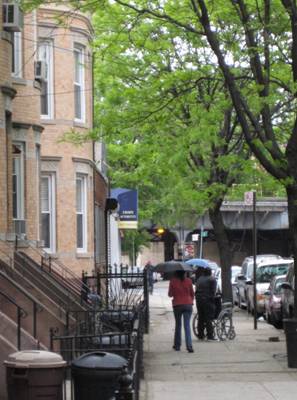
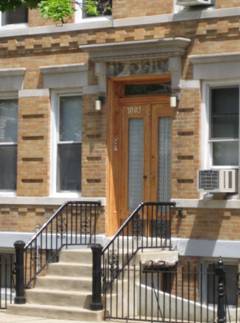
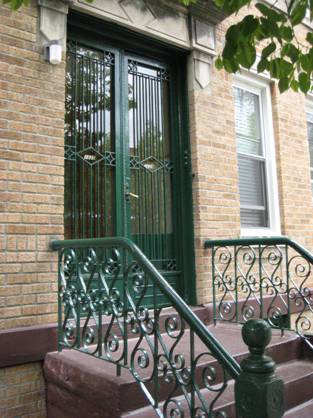
At last we were off to find Aunt Chris' birthplace,
103 Schley Street, or 70-03 65th Place as the location is
now numbered and named. Armed with the hard-won information from
New York Public Library, we confidently turned right
at the el, headed up Central Avenue several blocks,
and then left onto 65th Place. Near the end of this
lovely tree-lined street we found the Prahl's former home.
John and I now backtracked to Myrtle Avenue. The wind that
I had enjoyed up on the el in the morning was now kicking
up so much dust and pollen that my eyes were in pain.
I needed relief from the wind. We also needed that
hard-to-come-by-in-New York amenity, a public rest room.
We found our next Prahl address first. During the early
1930s the family had lived at 1829 Stephen Street.
According to my Internet research the address currently
houses AmVets Post #34, and because of this, we were
expecting an ugly, unimaginative square brick building
dating from the 1950s such as the AmVets eyesore,
different post number, that we found on Catalpa
Avenue some minutes later. We were thrilled to find
original Ridgewood architecture instead.
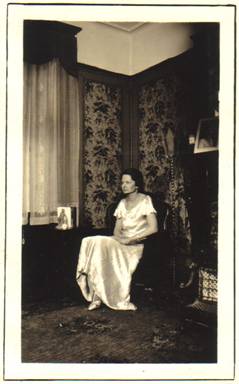
This is the only Prahl address for which we have photos of the
interior rooms. It would be wonderful to get inside 1829
Stephen Street, but it's doubtful that any of it would
appear as it had in the early 30s.
The last stop on our tour was St. Matthias Roman Catholic Church
on Catalpa Avenue. Indeed, the spire that I'd seen from the M train
belonged to this church, where our Aunt Chris wedded August Oechsli
on September 9, 1939.
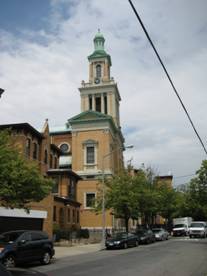
St. Matthias Church on Catalpa Avenue
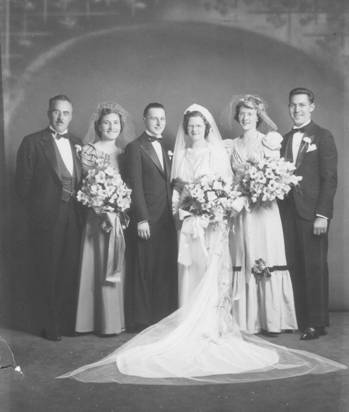
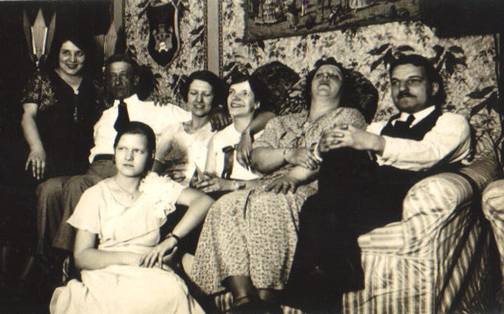
Left to right: Our father William Felbinger, Ruth Holzapfel
(who later married Walter Hebel,) our uncle August Oechsli,
our Aunt Christine Prahl, our mother Constance Prahl,
and best man William Maurer, of whom we know nothing except his name.
We returned to Fresh Pond Road one last time and there found respite from
the wind, a rest room, and refreshment in a small cafe. The Hispanic soap
opera blaring from a TV on the back wall was hardly evocative of the
German neighborhood that Ridgewood had once been. Change occurs.
The latte I ordered was very 2008, but the rugelach I selected
to accompany it and the Linzer danish that John chose were small
slices of a neighborhood the Prahls would have known.
On our way home we opted to ignore the infamous underground L train and stayed aboard the elevated M all the way across the Williamsburg Bridge to Manhattan. The view of the Empire State and Chrysler buildings and of the United Nations building further up the East River was stunning. And then it occurred to us why the newly married Edward and Christina had moved out to Ridgewood in 1910. They were looking for a home in the suburbs, cheaper rent than in Manhattan, new and lovely apartments with an easy commute into lower Manhattan for work. The Williamsburg Bridge, which opened in 1908, provided a rail line as well as a road for easy access to Manhattan from Queens. The toll on the bridge was removed in 1910.
Late in the afternoon, we changed trains at Canal Street and returned to the Upper West Side and the Columbia University neighborhood where John lives. The Prahl family, from its Manhattan days, has more than a few addresses to be explored up that way. I feel another tour coming on.