Report for the year 2010
This report covers calendar year 2010. Actually, I am rather proud
of myself: I begin to write this report in January 2011 rather than
in mid-year, my custom of late. But perhaps I should not
pat myself on the back too readily, because this seeming diligence is as
much the result of recent events as anything else.
But I am getting ahead of events. The work of 2010 went smoothly enough:
I finished some projects, corrected others, and wrote additional papers
to explore and report certain topics in detail. Again as in past years,
reporting the work does not fall into a neat division of "Felbinger" on
the one hand and "Prahl" on the other; I worked on both families at the
same time. Unlike prior years, however, the division may be somewhat
easier to maintain in the reportage. Once again, I will report my
activity chronologicallly.
******
January began pleasantly enough. I was still in Vancouver, British
Columbia, visiting Alice and Bob. I took the opportunity to see on-site
what Alice is doing for the family projects. Alice is creating dossiers
on every family member: in effect, a "mini-biography" for each individual,
listing all the information we might actually know about them and how they
related and interacted with one another. This work can be even more
labor-intensive than what I am doing. I like Alice's approach: it is
very holistic. My approach has been to extract information from primary
source material (vital registers, lists, record books and other documents),
and to arrange the information in the same order that I find it, usually
chronological. Of course, transcribing handwritten German records
(with occasional Latin) can be quite the job in itself, getting the
material into a legible form that anyone can use them. So we're both
putting a lot of time and effort into these projects. And our division
of the world works well: Alice does Canadian and American material
(family material for husband Bob's side of the family, and the greater
New York metropolitan area for us), with some occasional German while
living in Vancouver. I live in Manhattan (with occasional travel
off-island to the "outer" boroughs) and get the "hard" job of going
to Germany and researching material there (Yeah, right! Pour more
beer into my stein ... ). Alice and I laugh together occasionally
about our three thousand mile "geographic shift". Seriously: at some
point we will have to arrange all the material into one gigantic
collection.
Back in New York the first full week of the month, I spent much time
downloading Vancouver souvenir pictures sent by Alice. This might
seem a simple task. Truth to tell, the memory stick I used as a
backup simply ran out of space and I had to buy a new one with more
capacity. Not being a "computer techie", I get nervous when I must
do these routine maintenance chores, so I try to slow down in order
not to lose anything. In any event, research went forward. Playing
with the computer one night, I discovered there are actually two genealogy
groups for Schleswig-Holstein. I may need to be in touch with (or
actually obtain membership in)both of them:
Arbeitsgemeinschaft Genealogie-Schleswig-Holstein e.V.
/ Genealogy Work Group Schleswig-Holstein / AGGSH
Meisenweg 3
24534 Neumünster
Schleswig-Holsteinische Familienforschung e.V.
Landesarchiv Schleswig-Holstein / Prinzenpalais
24837 Schleswig
Mid-January I got more active. I made a telephone call
to cousin Sherry Campbell in Ohio. First, to catch up with her and
all the children/grandchildren; second, to obtain the address and
telephone number of her son Douglas. I have a book to send to Douglas,
a copy of the Memoirs of U.S. Grant. My possession of the
book gives me the opportunity to relate another family story here.
As told to me by Douglas's aunt Georgine (Cousin Sis), Douglas's
great-grandfather, Samuel Campbell was a "runner" (these days we
would say "go-for") for Grant after his presidency. Campbell was
quite an admirer of Grant, so much so that when Grant was
finishing his memoirs while simultaneously dying of throat cancer
in 1885, Campbell traveled from New York City to Mount McGregor
to see Grant. He was at first refused visitation by the Grant
family, they claiming Grant was too ill to have visitors, until
Grant himself called out from the adjoining room, "If that's Sam
Campbell, I want to see him", so Campbell was able to pay his
respects. As token of his admiration and loyalty to Grant,
the family presented him later with a copy of Grant's memoirs.
And how did I get the book? This question has entertained
both cousins Lorraine and Georgine for many years. Ah, another
case of being in the right place at the right time.
When Douglas's grandmother, Georgine (Felbinger) Campbell was
moving from her house in Hollis, N.Y. to her condominium in
Jamaica Estates, I happened to be in the house at the time.
Aunt Gene was packing books and when she got to the Grant volume,
she said "What am I going to do with this?" She thought it should
rightly go to her son Donald, and I agreed. But Donald was in Ohio
and I was physically present, more than amenable. Aunt Gene was
a bit reluctant, but made me promise I would pass on the volume at
the earliest convenience to her granddaughter Donna (why not her
grandson Douglas I had no idea, not even at the time). Well,
we are many years along
now and I still have the volume. But it is time to pass it along,
as we rapidly approach the 150th anniversary of the Civil War.
But in one respect I will break my promise to Aunt Gene.
Both Lorraine and Sis have suggested strongly that the volume
would best go to Douglas, because it would be kept on the male,
Campbell side of the family. Again, I agree, and so it has
been necessary for me to find where Douglas is living.
In the same week I had time to go to the regional office of the
National Archives and Records Administration on Varick Street.
While there I continued my search forthe death records of GGP
Carl Blaicher and his second wife Johanna in the New York
State vital records indexes held by NARA. Him I found quickly:
died September 15, 1932 (70 years, 7 months short 2 days).
Certificate was issued in Mount Vernon, no. 54302. I went
looking for Johanna. I reasoned that as she was fifty-three
in 1930 she could easily have lived at least another thirty
years, and so I might not find her because that would put her
in the 1960s, and there is the fifty year statute of limitation
for obtaining death certificates. I bravely began with the 1930
death index and worked forward. I did find a couple other
Blaichers in Buffalo, but not Johanna ... until I got to
the end: 1960. Found her there: died June 6, 1960, age 83,
certificate no. 45502, also issued in Mount Vernon. If I
had searched for her the previous month of December, I would
not have found her, because the 1960 index was released only
at the beginning of January. For all I might know, she
might have remarried or moved out of state. Come back
each January for the new year's release.
Sadly, I checked again for sister Christine Felbinger (or
a listing for "Felbinger, female") with no success. This
lack of a listing makes me deeply suspicious about what
may have happened at the time. The pregnancy was well
attested by Mom and other family members (Aunt Chris,
and Lorraine and Sis), so I have no problem there. What
troubles me is the lack of documentation. Allegedly
Mom brought the fetus to term, and yet it was a fetal
death. So, what records of the body? I'm very clear
that there are records in the indexes for these situations,
but none here. Variant spellings of "Felbinger" have not
worked because the records are indexed by soundex system.
Additionally, where might the child be buried? In that
matter, Mom never really said: in Brooklyn, in Queens,
in Nassau? Bit of a mystery here.
Another surprise came this particular day: Grampa
Prahl's death certificate from the town of Islip finally
arrived in the mail. Only discrepency: according to the
certificate, Grampa died in Bayport, not Bay Shore. I
may be forgiven some vagueness of memory after forty-four
years.
January 25th I was off to Staten Island for a meeting of the
Woodland Cemetery Association. Main order of business this
night was to sign a letter of intent to sign a ground lease
in order to develop a portion of the property for commercial
purpose, that the Cemetery might have an income. On the way
home I realized that the reason why I am a trustee is because
the first two generations of Prahls are buried in the Cemetery.
And the first Prahl family member in the Cemetery is 2GGM
Friedrike Prahl, buried there January 26, 1880. Exactly one
hundred-thirty years less a day later, I, her great-great-grandson,
signed off to improve the physical condition of her final resting
place. Another instance of familial seredipity one can't make up.
My log book for February is filled with entries regarding
my preparation of the first biennial report I have ever written.
The report covers the family project work for 2008-2009. The very
simple reason for this combination is that so many things happened
in these two years and my energies were so taken up dealing with
several matters, that writing a report was nothing I might accomplish.
The actual log book entries are filled with the technical details
of preparation. I will not bore the reader here with these details:
they are tedious enough. Sufficent to write here that the principal
difficulty was writing reports as a Word document, and then
attempting correction after transfering the document to the website.
My own inclination is to correct the uploaded version, but no, such
correction messes up (polite term) the underlying coding that Word
processing puts into the document, and then displays the skewed
version on the website. The tedium and frustration of deleting
the file, going back to the original Word document, make the
corrections, re-upload the document only to find other errors
needing correction is unimaginable, and in the end became
intolerable. Finally I stripped the report of the coding
(which cuts the actual number of bytes utilized by roughly
50%, saving disk space), and took to writing it directly on
the web site. I did the same for two reports Alice sent to me.
The reports Alice sent relate our travels through New York in
2008. Again my logbooks are filled with the details of preparing
those reports; in that sense the reports also come under the
conditions stated above. I tinkered stylistically with the
texts of the reports, went through them for factual errors,
and consulted with Alice about any changes I made either in
format and content. I am very proud to have my sister's work
on my website for the first time. Her efforts to deal with
the New York material has saved me so much time, and creates
much collaborative teamwork.
The first report, "Felbinger family tour in Brooklyn: May 17,
2008" tells of our visit to the Bedford-Stuyvesant neighborhood
of Brooklyn to look at the Albany Avenue and near-by addresses
that were so often the focus of our father William's stories
of his youth. As the Wikipedia article on Bed-Stuy notes: "In
the last decades of the 19th century, with the advent of
electric trolleys and the Fulton Street Elevated, Bedford
Stuyvesant became a working class and middle class bedroom
community for those working in downtown Brooklyn and Manhattan
in New York City. At that time, most of the pre-existing wooden
homes were destroyed and replaced with brownstone rowhouses.
These are highly sought after in the neighborhood's contemporary
renaissance". It was into this neighborhood that the
Felbingers moved, both to live and work. Their residence was
at 154 Albany Avenue, later 1632 Pacific Street; GF Felbinger
had his bicycle shop at 42 Albany Avenue. Never having visited
this fabled part of Brooklyn, Alice and I did not know what
to expect and were quite suprised, delightfully so, at what
we found.
The second report, "The Prahl family tour in Ridgewood/Glendale,
2008" relates our researches and visit to that part of Queens.
As a story-teller, our mother Constance was not always as focused on
places as our father (except for "The Bungalow", which see below),
and because of family friends Alice and I often visited
Ridgewood-Glendale in our youth. But again, sites relating
specifically to Mom, her sister Chris and our grandparents
Edward and Christina Prahl were as much a mystery to us as
was Brooklyn for Dad's sites. For full details, I commend both
tour reports to the reader of this report.
In my logbook, I note two entries concerning websites of research
value. Cruising the Web one day for information on the 45th New York
Infantry Regiment, I found a listing for the
"Gettysburg Daily",
an online website dedicated to presenting material on the Battle of
Gettysburg. In the reference I found, there was listed a
presentation by battlefield guide Stuart Dempsey on the role of
the 11th Corps of the Army of the Potomac, in which the 45th New York
was the lead regiment of the Corps' Third Division, First Brigade
on the first day of the battle, July 1, 1863. Looking at all the
segments, I found Dempsey's presentation with maps, still photos
and video commentary particularly fascinating because they
actually show the terrain on which the 45th had its most
significant participation in the battle.
As I write these lines in February 2011, I will pause briefly
to note that while verifying the URL of the "Gettysburg Daily" to
include it here, I found an additional URL for a *German*
re-enactment group of the 45th New York. Their website is
located at "45th Reg. of Inf.
N.Y.S.V. 5th German Rifles". A quick look at the site
indicates the usual German thoroughness for detail. In a quiet
moment, I will explore it more fully.
Back to report 2010 activities. The other website of interest
is that of Stephen P. Morse, who was the creator of the Intel
8086 computer chip that has made so much computer technology
possible. In recent years Morse has spent much of his time
applying his technological skills to creating web-based
genealogy search tools. His web site
"Obtaining AD/ED
for the 1890-1925 New York Census in one step" particularly
caught my eye. Through this index and two hours of search I was
able to find the 1905 New York State census record for GP John G.
and Cenie Felbinger, and the four children Georgine, William,
Henrietta and May at 154 Albany Avenue in Brooklyn: 18 AD,
17 ED, Block D, p. 13, lines 10-15 (image no. 9 on the microfilm
reel). The date on the census report is June 1, 1905: Aunt May
is listed as 1/12 old. Dad is listed as William G. (for George,
not H. for Henry). Looking at website more closely, sadly only
the 1905 census is "up". The site shows only what FHC microfilms
to obtain if one wants to see the 1915/1925 censuses. Additionally,
it's not entirely clear that 1632 Pacific Street to where the
Felbingers moved around the corner from Albany Avenue is available
on the 1915 census. Order the films and see. Nevertheless,
I would commend the Morse tools to anyone in searching for material,
being aware they may be no better or worse than several of the
other tools available: Morse's advantage is that several tools
are available altogether through one website.
For the month of March I have pages and pages of notes
about my activity in the logbook. I can summarize all these
pages in one sentence: I continued work on the biennial report
for 2008/2009, finished and proofed it. 'Nuff said.
That the report was finished by the end of March: good thing.
Easter came April 4th, early this year. In addition
to the usual Holy Week activities, my travel plan of leaving
for Germany Thursday the 8th left little time to pull together
my research papers and to consider what work I wanted to
accomplish. Happily I had enough of a game plan to occupy
me while in Nuremberg.
In this report I will concentrate on work accomplished.
For the human interest part of the trip, I commend two reports
to the reader: "Travels with my ancestors: a journey through
Franconia", written for the German Genealogy Group newsletter.
URL FOR REPORTS HERE.
There is little to tell about actually writing the reports;
I will mention them in the proper sequence of events.
This year I landed in Munich for a long weekend rather
than make the arduous trek from Frankfurt to Nuremberg.
Apart from the usual things I do in Munich, I
spent time taking pictures with the new digital
camera purchased for the trip. My 30-year-old Minolta
still works, but photographic technology has moved on,
and therefore the camera is effectively an antique: time
to upgrade. Taking photos of familiar sights allowed me
to familiarize myself with the camera, without the worry
about the quality of the shots.
I arrived in Nuremberg Sunday, April 11th. The next day
Monday I went to the Landeskirchliches Archiv der
evangelisch-lutherischen Kirche in Bayern (LAELKB)
in the Veilhofstrasse at my usual time of 8:30.
I had several projects planned. First project was to
go back and enlarge my transcription of the Ickelheim
school records (my Document no. 10) to include any Kett
children I might find. One might think this an easy
task, yet the editing my previous transcription
proved more difficult than I first imagined. I found
six entries of Kett children to add, but as usual I also
discovered errors requiring corrections to a document
I thought completed 5-7 years ago and finished for
all time. Additionally, dealing with residual jet lag,
the floaters in my eyes and a mild case of the sniffles
from the tremendous change in temperature from the 90s
in New York to the 50s in Nuremberg made progress slow,
and took about two hours before I could determine that I
got it all squared away. Moving on the the Pfarrbuch,
I corrected the mistakes in my previous transcriptions
of the text. After lunch, I started further transcription
of the Pfarrbuch, completing pages 24 to 29 of Teil II by
the end of the day.
Tuesday the 13th was a good day. Back in the
Veilhofstrasse archive, I completed transcription of Teil
II from page 30 to the first few lines of page 47.
If yesterday was a good day, Wednesday the 14th was
not the best. When I notified the archive of my arrival,
I was rather vague about what I wanted to accomplish, so
they signed me up to go to the Kirchenbuch center at
the Lorenzerplatz for every day of my two week visit.
I was not really ready to go this day. I had
the bit in my teeth to finish the Pfarrbuch and the
Armenkasse. Second, I had not looked at my church book
transcriptions since 2007. And third, being tired last
night I did not look at anything anyway. First order
of business was to write a list of what to do:
- Helmbrechts: Baier records;
- Burgbernheim: its Felbingers;
- Kommunikanten lists: all parishes;
- Felbingers previously done that need checking: once again;
- Death record for Georg Sturm (Weihenzell); his marriage;
his children (other than Johann Sturm, b. 1748)
I started with the Baiers in Helmbrechts. Big mistake: not
having touched the records since 2007, I had no sense of them
anymore, except for GGM Heinrietta Baier (Bayer), born 1863.
Reading through them did not help particularly, so I took up
work on the Oberdachstetten and the Westheim Johann Michael
Felbinger (1841-1842) records, as these records present a
significant challenge.
In the afternoon I went off to the Gesellschaft für
Familienforschung in Franken, to pay my annual dues, purchase
a book on scripts, and try to make headway with their records.
A few tidbits of information: Dedic, Paul. Kärntner
Exsulanten des 17. Jahrhunderts. One mention of Schuri,
though not mine, of course. Also: Genealogischer Handbuch
bürgerlicher Familien, Bd. 15, p. 119-120. Elisabeth
Engelbrecht, June 22, 1620-November 10, 1697, married
Jeremias Felbinger, April 27, 1616-March 10, 1644, Brieg
in Schlesian, rector of the school in Röslin: also the
author of several religious books, if I remember correctly,
but should check.
Thursday the 15th I returned to the Veilhofstrasse to finish
the transcription of the Pfarrbuch, from page 47 of Teil II
to its end. Even had some time at the end of the day to
actually read through the transcriptions, that I would
not be frustrated when I got home. The big event of the
day came in the evening. GFF had arranged with Annamaria
Müller of the Archives for an evening of reading
through manuscripts. Format of the program was for each
GFF member to read a portion of a manuscript while other
members read along. Fifteen Germans and one American:
with a little modesty I can write I acquitted myself well
enough, reading better than some, not as well as others.
A paranthetical tourist note: the program took place
at the St. Anton Pfarrzentrum, Fürtherstrasse 94
(subway stop: Bärenschanze), and right around the
corner from the Pfarrzentrum is the Justizpalast where
the Nuremberg war trials were held in 1945-1946.
Friday the 16th I continued to read through my
transcriptions of the previous days, finding few errors:
hurray! Friday is also the short day in the archives,
so I went off in the afternoon to do the tourist thing.
On the way back to the Hauptbahnhof at the end of my junket
I saw an announcement on the electronic sign board at the
tram stop that the air space over Nuremberg was closed.
The words were clear, the meaning was not. When reading
my e-mail later in the Internet shop in the train station,
I found a message from Alice telling me a volcano had
erupted in Iceland, and the European governments were
shutting down the airspace all over the continent.
No one was going anywhere. A quick telephone call to
Alice reassured her I was OK, but this information and
events of the next week made for ongoing anxiety
for the rest of my trip.
As I was not scheduled to fly for another week, however,
there was no point to change my plans for this immediate
weekend. Saturday morning the 17th I left Nuremberg
to take the train to Bad Windsheim, ninety minutes away.
By now spring was in its first flush of sunny warmth,
and I spent the day visiting several exhibits of the
Freiland Museum in Bad Windsheim.
I had planned Sunday the 18th to be the big day of the
Bad Windsheim/Ickelheim trip. Before my departure for
Germany I had contacted the deanery of Bad Windsheim,
to learn when services would be held in the Ickelheim
church. Nine-thirty AM was the appointed time. I was
prepared to walk to Ickelheim via the road that connects
it to Bad Windsehim (having walked it in 2003), but was
not eager to do so because traffic on the road travels
so fast. In my Bad Windsheim hotel I found two maps
that showed both the streets of the city, and more
to my purpose, a Wanderweg (hiking trail) between
Bad Windsheim and Ickelheim that avoided all the
traffic. Eager to arrive at the church in time,
I had a moment's hesitation before setting out
(for I know the road, the Wanderweg I do not),
but ultimately chose the Wanderweg, reasoning that
I routinely walk the distance of 4 kilometers
(2.5 miles) in approximately fifty minutes.
(Note: the maps below are best viewed online.
If printed to paper, a separate copy of the maps should
be made. -- JEF)
 Map of the southern section of Bad Windsheim. My journey
along the Wanderweg began at my hotel "Zum Goldenen Schwann" at the
southeast corner of the Schwalbengasse and the Holzmarkt, west along the
Rothenburger Strasse to the outskirts of town, cutting across the little
park north of the Cemetery and then south on the Westheimer Strasse to the
pass under the highway, and beyond.
Map of the southern section of Bad Windsheim. My journey
along the Wanderweg began at my hotel "Zum Goldenen Schwann" at the
southeast corner of the Schwalbengasse and the Holzmarkt, west along the
Rothenburger Strasse to the outskirts of town, cutting across the little
park north of the Cemetery and then south on the Westheimer Strasse to the
pass under the highway, and beyond.
 Map of the Wanderweg from Bad Windsheim
to Ickelheim, showing also the villages of
Sontheim and Westheim, both important in
the history of the Felbingers in this
immediate area.
Map of the Wanderweg from Bad Windsheim
to Ickelheim, showing also the villages of
Sontheim and Westheim, both important in
the history of the Felbingers in this
immediate area.
The Wanderweg proved a fortuitous and happy choice.
Heading south from the west end of town, I passed
the Windsheim cemetery, continued along the trail
that led me to an underpass at the east-west highway and
out into the hazy, spring morning sunshine of the
Franconian countryside. As I walked, I stopped to take
several photos of Bad Windsheim, and of Ickelheim as
I approached it. I arrived at the Untertor (Lower Gate)
on the north side of Ickelheim by 9 AM, plenty of time
to prepare myself for the church service.
As I have written extensively of my time in Ickelheim
in the two-part article I wrote later this year for
the Ahnenforscher, the German Genealogy Group
newsletter, I will not duplicate the reportage
of those articles here.
LINKS TO ARTICLES HERE.
Sufficient to write here that attending the church
service allowed me to meet Mr. Friedrich
Thürauf, whose family has been long resident
in Ickelheim, and through him I have been in contact
with Mrs. Christa Binder, daughter of a former
Bürgermeister of Ickelheim. These contacts
have proven most fruitful, but more of this later
in this annual report. I spent the afternoon in
Ickelheim with a copy of the 1828 map in hand,
taking photographs to mark the locations
of several places where the Felbingers (certainly
the Illinois-California branch of the family) had lived
within the village.
LINKS to PICTURES and MAP
About 3 PM I set out to go back to Bad Windsheim by
the Wanderweg I had come, and arrived back in my hotel
about 4:30 PM. Boy, was I tired, but happy for what
I had accomplished.
Now, however, the issues confronting me about travel
home preyed on my mind in ernest. I awoke in the middle
of Sunday/Monday night with a panic attack: curse of
never being panicked in a crisis. The only way I could
deal with it was to sit a while and write out all the
things I needed to do, both for my research and to
make necessary arrangements if I could not fly home
on the coming Saturday.
Off and away early Monday the 19th, back to Nuremberg
on the 8 AM train, and arrived there shortly after 9.
In the Veilhofstrasse archives this day, I read
through the Nachträge pages of Teil
II of the Pfarrbuch, noticing things I had missed
on Friday and making the necessary corrections.
I turned in the Pfarrbuch to the archivists,
so that they could make for me a CD of the
title-page of the document, plus the caption
title-pages of the three sections. I also made
(yet again, sigh!) several corrections to the
Armenkasse records. For this document there is
no end to this, but at some point I will simply
declare myself finished. In the early evening
I called Alice and the office to let them know
I was still OK. Also, looking at e-mail in the
early evening and cruising Lufthansa's website, I
could see they were starting international flights
again, if on a limited basis.
Tuesday April 20th I was back in the Kirchenbucharchiv
at the Lorenzerplatz. Thought to do a short job: check
the Weihenzell registers to see whether there is any further
mention of Georg and Maria Sybilla Sturm. This job
turned into an all-day project. It's clear there are
several Sturms in the Weihenzell area; from their
occupations it's at least a good guess they are not
related, though if I get back far enough ... Checked
the birth register from 1748 when Johann Sturm is born
back to 1740, because he is described in the
Westheim registers as "youngest son". So clearly
there must be older children (including sons), but I
found no mention of George and Maria Sybilla. I
checked the marriage records from 1740 to 1750: there
are a few Sturm marriages, but again: not *my* Sturms.
The first Johann Sturm entry is 1781 in Westheim, and
his father Georg is mentioned as being deceased: this
means a search of 34 years of death records (1748-1781)
to determine a death date. Up to 1757 there are Sturm
entries, but again not *my* Sturms, neither Georg nor
Maria Sybilla. I think to go through the death entries
from '57 to '81 quickly to see who's there and then move
on to the Baiers in Helmbrechts.
Wednesday the 21st I continued the Sturm search. Looking
through the Weihenzell records for the years between
1757-1781, I again found Sturms, but not *my* Sturms.
I do not consider the Westheim register *wrong* per se,
I can guess that Johann Sturm told the Westheim clergyman
what he believed was correct at the time his first
marriage was registered. Whether his father Georg and
his mother Maria Sybilla actually died in the Weihenzell
parish, or went elsewhere following the sheep will just
remain unknown unless I find some evidence. While
continuing this work, it occurred to me that a search
for Georg's birth record is a good thing to do, but with
limited time in the Kirchenbucharchiv, the necessity of
going through 40-odd years of records on a hunch is the
proverbial needle. Georg's wife is almost an impossibility
without her maiden name. Effectively this is the end
of the line.
Moving on to the Helmbrechts records of the Baiers, I
began with the births. I find the Baiers as equally
confusing as I find the Meyers and Doppmanns, so I quickly
drew a family tree to cope with all the names.

Baier family tree, starting with Marie Heinrietta Baier.
My original tree simply indicated ancestral persons,
in order
to keep them straight.
This revised chart shows the most complete
information available
after researching the families in April 2010.
Right-click on the image for a larger version.
I can get back to 4GGF Jakob Ordnung, listed in the records
as a farmer. Son Johann (3GGF Ordnung) fared better
by becoming a Zimmergeselle (journeyman carpenter).
That might still be considered an agricultural trade
in some way, but definitely a step up the ladder. More
interesting on the Baier side (if the birth registers
are to be believed) is that 3GGF Johann Baier left
for America sometime before 1848 and is so listed in
the baptismal record of his first grandchild Johann Georg
Baier by his son Johann Georg Baier (2GGF) and his wife
Katharina Margaretha Ordnung (2GGM). If this is indeed
so, then 3GGF Johann Georg Baier would be the first family
member to have left for America (North or South?).
Tracking him down, however, would be another almost
impossible job because the Germans to America records
will cover the 1840s, but again the name is common,
and if he left earlier, how detailed are the records?
Worth a look when I get home.
Going through the baptismal records and drawing the family
tree, I am clear I found all of the siblings of Heinrietta
Baier (Blaicher) in 2007. But then I got crazy and started
searching every Baier (Bayer) I could find in Helmbrechts. I
can only say "I was tired" and not thinking too clear. Now
I need to go back and check for all the children of 3GGP
Johann Baier/Margaretha Barbara (Heerdegen) Baier and 3GGP
Johann/Katharina Margaretha (Greim) Ordnung. If I can find
the 4GGPs including Jakob Ordnung this would be wonderful.
The situation does get complicated because 3GGM K.M. Ordnung
was previously married to (and divorced from!) Johann Daniel
Merkel.
I continued to go through the records to correct anything I
found amiss. Again, I am not too surprised how much I misread,
but my reading skills have also improved in three years. One
wretched example: Johann Heinrich Baier (1853-1856), died of ... ?
Couldn't read it three years ago because the scribe had a truly
tiny handwriting and bad characters. Couldn't read it this
time either, but thought to try reading it backwards and came
up with "Convulsionen". The initial "C" is written like a
vertical manuscript "l". Who might guess?
Thursday the 22nd I was back in the Kirchenbucharchiv, working
on the Helmbrechts records. This day I accomplished a number
of things:
- I checked all death records: looked for 2 GGP JG/KM Baier,
and their daughter Elisabetha and son Johann Nikol. *No* records.
I am also clear that Christiana the youngest child was born in
Münchberg, so they all were already on the move, and if
Henry's immigration record is correct, they wound up in Saxony;
- No record of marriage for either Elisabetha or Johann Nikol
Baier;
- I need to go through the records for the Daniel Merkel/KM Greim
(3GGM Baier) children;
- In preparation for the children search, made a list of all the
Baier / Ordnung baptisms from 1800 to 1848;
- I have the marriage and death records for 3GGP Ordnung;
- *No* death records for 3GGP Baier. There is the one mention that
he (Johann Baier) is in America (baptismal record of Georg Heinrich
Baier, b. April 17, 1848, bapt. the next day). Best guess that 3GGM
would have emigrated with him;
- *No* marriage record for 3GGP Baier either. There are a couple
Johann Baier marriage records, but always to a woman different than
3GGM Margaretha Barbara Baier (Heerdegen). It is as if they appear
out of nowhere, have a few children and then disappear;
- For this purpose, I need the baptismal record of Georg Heinrich
Baier, but I don't remember seeing his name in the list of baptized
I compiled. Will have to check;
- I must pursue the Ordnungs further, as they seem better documented.
In any event, all this started to become confusing, so I decided
to stop and work with the material I have collected.
Last research for the day: I checked the Johann Hoffmann 1873
marriage record in the Ickelheim records for his mother's name.
Yes, the name is "Sooss", but on the microfilm this is hard to
see, so my original misreading is understandable. But these
are the kinds of errors that make genealogy an exacting task.
I took the rest of the afternoon off, to go visit the Melanchthon
exhibit in the St. Egidienkirche. A very small exhibit, to
commemorate the five times Melanchthon passed through Nuremberg
during his life, in commemoration of the 450th anniversary of
his death (April 19th).
The above are the last entries in my logbook for the work in the
German archives this year. The following day Friday I returned
to the Veilhofstrasse to pay my bill, bid the archives farewell,
and head for the train station. In planning the trip I had been
unable to make a reservation in Munich for the final night
because of a large trade exhibition there, so I made a reservation
to spend the night in Augsburg, to be able to make an easy
train ride to Munich to catch the 11 AM plane. Of course,
the Iceland volcano disrupted everyone's plans, and it never
occurred to me that if sufficient people had canceled I might
actually have been able to change my own plans. So after a
pleasant ride on the regional train from Nuremberg to Augsburg,
I spent the night in the latter place, to be up very early in the
morning to get to Munich. In the event, I did not need to worry.
The airlines, Lufthansa included, had taken up flying again,
and I did the usual routines of check-in, customs and
head for the gate. Of course, I was also obliged to listen
to the stories of my fellow American tourists who had more
prosaic stories to tell: price enough for peace of mind.
The flight was uneventful, except for the end: we flew over
Belmont Race Track on the approach to Kennedy, first time
I've ever come that way home.
I spent Sunday the 25th picking up the threads of my New
York life, always a necessary task after returning from a
trip. Thereafter I spent the rest of the month making the
corrections brought home from Nuremberg, most of them anyway.
I note here one particularly fortuitous result of my trip to
Ickelheim. While still in Nuremberg I received two emails
from Friedrich Thürauf, whom I met in Ickelheim. One
of the notes included a picture of the former Hirtenhaus
(Herder's house) in Ickelheim that he had received from
Christa Binder.
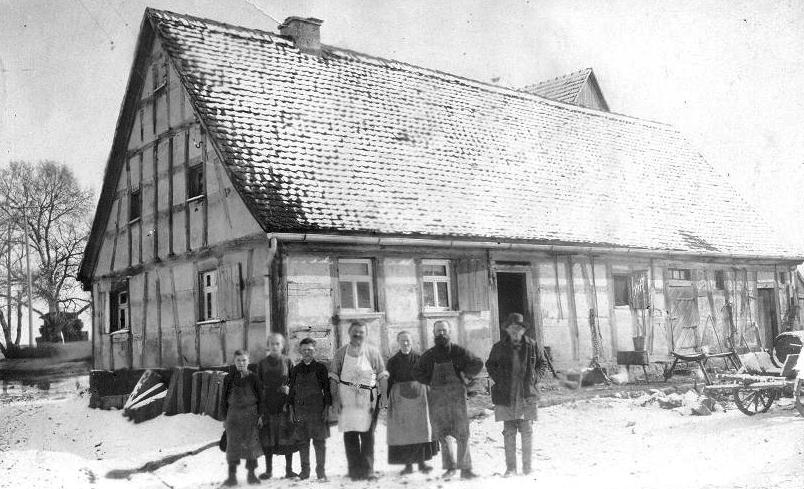
Photo taken in 1916. From left to right: Katharina Rückert,
b. 11/25/1910; two unknown boys standing one on either side of her;
the man with the apron most likely the father of the two boys,
the inkeeper and butcher of the guest house "Zum Hirsch" that was
torn down in the late 1980s; the two old people are the parents of
Katharina Rückert; the man at the far right is unidentified.
The Felbinger family was related to the Rückert family by the
marriage of Anna Margaretha Felbinger, daughter of Martin Felbinger,
to Johann Leonhard Rückert, 2/4/1866; she was widowed in 1869 and
married Georg Manfred Reinhard the same year.
I include here the attached note from Christa Binder, with English
translation:
	"Hallo Frieder
	"Im Anhang das gewünschte Foto.
	Das einstige Hirtenhaus hatte die Hausnr. 37, die Schafscheune
	die Nr. 38.  Von der Schafscheune konnte kein Foto gefunden werden.
	Beide Gebäude sind am 14. April 1945 abgebrannt, als die Amerikaner
	nach Gegenwehr Ickelheim beschossen.
	"Als einstige Bewohner der Nr. 37 sind bekannt: Felbinger, Rückert,
	Popp und Beyer.
	"Johann Felbinger was Gemeindehirte und Taglöhner.  Er
	heiratete 1862 die Anna Margarete Sturm.  Sie war die Tochter
	des Gemeindedieners.  Auf Nr. 5, heute die Aschenneller werden
	auch Felbinger genannt.  Auch auf Nr. 25, heute Herbert Stahl,
	sowie auf Nr. 35."

	******
	"Hello Friedrich
	"Attached the desired photo.
	"The former herder's house was Number 37, the sheep barn Number 38.
	No photograph of the sheep barn could be found.  Both buildings burned
	down on April 14, 1945, when after resistance the Americans fired on
	Ickelheim.
	"Former residents of Number 37 are known: Felbinger, Rückert, Popp
	and Beyer.
	"Johann Felbinger was the communal herder and day laborer.
	He married Anna Margarete Sturm in 1862.  She was the daughter
	of the communal beadle.
	"Also Number 5, today the Aschenneller was also named Felbinger.
	Also Number 25, today Herbert Stahl, as well as Number 35."
From the note it is easy to learn that, though there are no longer any
of my Felbingers in the village, yet there is still a dim memory among
the natives that the Felbingers lived there once. And, as usual, there
is another one of those ironies that crop up: a little research
illuminated the matter. There is a book: Fritz, Stephen G. Endkampf :
soldiers, civilians and the death of the Third Reich. Lexington :
University of Kentucky Press, 2004, which relates the history of American
military action in Franconia in the closing days of World War II. A
quick read of the book reveals advance of American forces in mid-April,
that though the war was effectively lost for the Germans, yet there
continued to be sporatic resistance. When the Americans advanced
through Bad Windsheim and approached Ickelheim, they came under fire
from some German soldiers still remaining. The Americans did not consider
it necessary to clear out the resistance by infantry assault, but chose
rather to withdraw and bring Ickelheim under artillery fire. The
bombardment set several buildings on fire, one civilian was killed. Among
the buildings lost was the Hirtenhaus on the northern outskirts of the village.
Exactly sixty-five years plus four days later, I show up looking for the
house.
Subsequent communication with Frau Binder has dramatically illuminated
my understanding of Ickelheim. To my inquiry about the photograph
of the Hirtenhaus (above), she responded by supplying me with the date
of the picture (ca. 1916, by a traveling photographer who took several
photographs of the village at that time), the people in the photograph,
whom I have inscribed in the caption below the picture, and the exact
location of the building. By my initial reading of the old 1828 map,
I had guessed house number 37 to be on the northern edge of the village,
immediately to the west of the Untertor. This opinion did not hold up
after looking at the photograph, because the background of the photo
shows open spaces, not more village, as one might expect
if the angle of the photo is from the north looking south.
According to Frau Binder, the Hirtenhaus was actually located on the
road to Bad Windsheim, north of the Untertor, the present address being
Hauptstrasse 3. A closer examination of the map shows also a couple
lots numbered 37 and 38 (with which a view from the west looking east
would certainly correspond), and on the map immediately north of
these lots is written in large letters "Hirtenfeld", "Herd
Field".
Upon another inquiry about a sand pit in the vicinity of Ickelheim, in
which Anna Margaretha Felbinger perished in 1844, she sent the following reply
(my English translation below the photograph):
"Zu Ihrer Frage nach den Sandgruben in Ickelheim. Hans, mein Mann hat mir
diese gezeigt. Nur viel sieht man davon nicht mehr. Das anhängende Bild
zeigt, es ist nur noch Wald vorhanden. Aber eine kleine Geschichte dazu, die mir
Reinhard Brand erzählte. Er ist 1939 in Ickelheim geboren. Sein Vater hat
1948 einen Stall gebaut. So musste er am frühen Morgen mit ihm per
Kuhgespann zu dieser Sandgrube gehen. Es gab dort eine Grube mit weißen
und eine mit roten Sand. Der weiße Sand war der bessere und wurde für
den Gebäudebau genutzt. Der rote Sand zu minderwertigeren Arbeiten
verwendet. Die Sandgrube mit dem weißen Sand war sehr tief. Man musste
nach unten klettern und den Sand in die erste Etage schaufeln. Dann in die
zweite und dann noch einmal, bis der Sand dann auf den Wagen geschaufelt
werden konnte. Die Kühe mussten so lange warten, deshalb ist man
bei Sonnenaufgang losgezogen. Sonst wären die Tiere von
Schnacken und Steckmücken so geplagt worden, dass sie nicht stehen
geblieben wären. Am kühlen Morgen war diese schweißtreibende
Arbeit auch für die Menschen angenehmer. Reinhard Brand erzählt
weiter, dass er nach dieser Arbeit noch zur Schule musste, die da meist
im Sommer um 7 Uhr begann. Es sind bis zu diesen Sandgruben ca. 3 bis 4
km mit 2 Steigen. Die Wald wege waren nicht ausgebaut und die Rote Steige
im Wald musste auch überwunden werden. Diese Art von Arbeit ist heute
nicht vorstellbar. ... Was ich mich nicht vorstellen konnte, dass Ihre
Anverwandte in dieser Sandgrube verschüttet wurde, ist mir dadurch
plausibel geworden. Es ist sicher, wie in dieser Chronik vermerkt, so
gewesen."
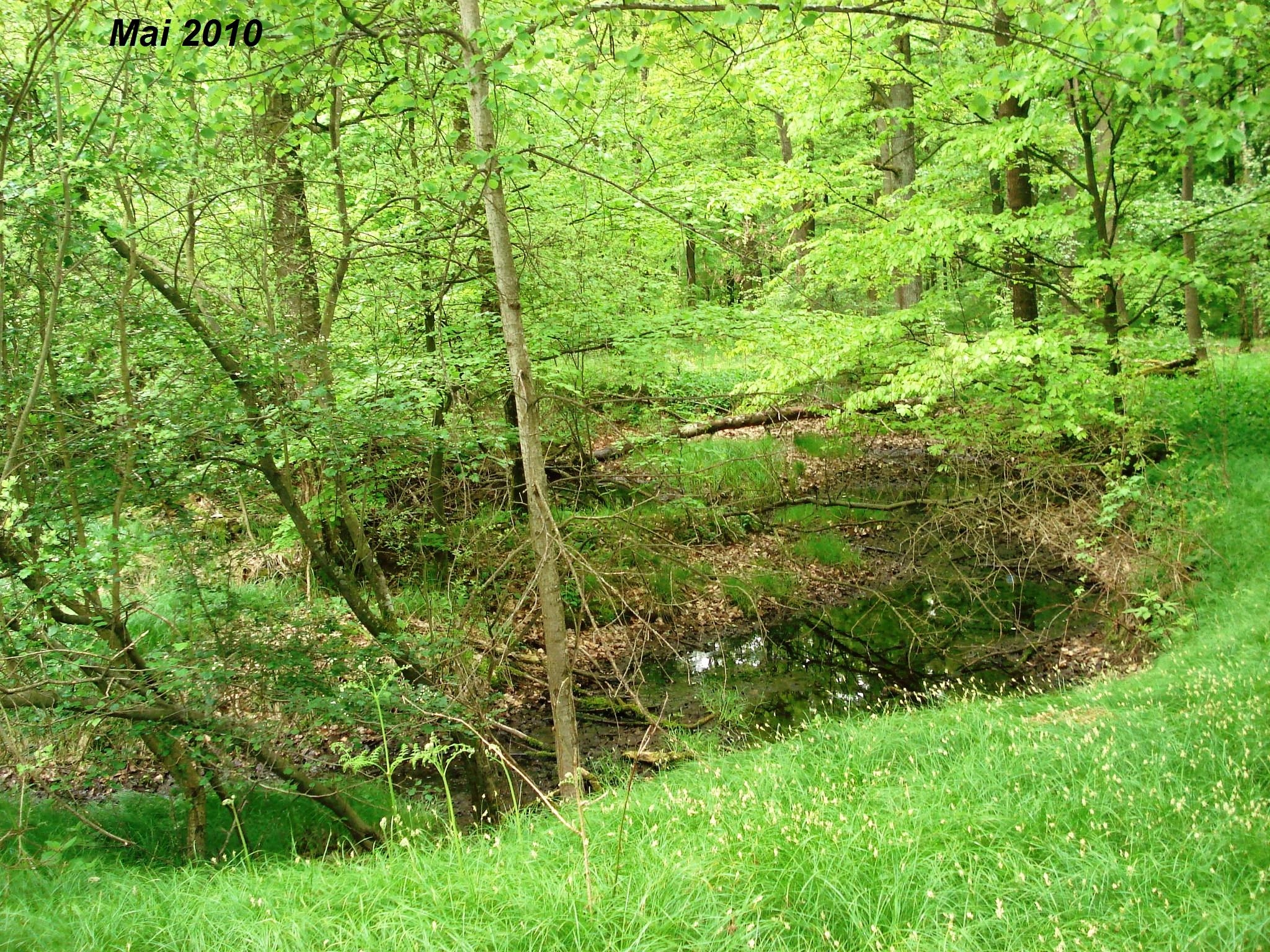
"Concerning your question about the sand pits in Ickelheim. My husband
Hans showed me this [picture]. One cannot see much any more. The attached
picture shows that there is now only woodland present. But to this a short
story that Reinhard Brand related to me. He was born in 1939 in
Ickelheim. In
1948 his father was building a stall. So he had to go with him [his father]
with a team of cows to this sand pit. There was a pit with white and one
with red sand. The white sand was better and used for building construction.
The red sand was used for less important jobs. The pit with the white sand
was very deep. One had to climb down and shovel the sand to the first
level. Then to the second level, and once again until the sand could be
shoveled onto the wagen. The cows had to wait a long time, so one left for the job
at sunrise. Otherwise the animals would be so plaged by gnats and
mosquitoes that they would not stand still. In the cool morning this sweaty
work would also be more pleasant for the men. Reinhard Brand related further that
after this work he still had to go to school, which in the summer began at 7
o'clock. It's about 3 to 4 kilometers to these sand pits with two rises. The
paths were not improved and the Red Rise in the forest also had to be negotiated.
This kind of work is inconceivable these days ... What I could not imagine, that
your ancestor was buried in this sandpit, has become quite plausible to me by
this story. It is definitely so, as the Chronik notes." -- I note here that
the "Chronik" is: Ickelheim : eine Chronik, the festschrift written upon
the occason of Ickelheim's 1250th anniversary in 1992.
While I continued to process corrections brought home from Germany (I am
surprised at the remove of a year to realize that I actually got to them
that soon after my return!), I took a short trip to NYPL on April 30th to
look at telephone books. Strange thought after so much excitement in Germany,
but I was interested to see if might track down Grampa Edward Prahl in them,
to see if there were two separate listings for him and Gramma Christina,
as the deeds to the Mastic property indicate. I was so taken with the
directories I found, I went back the next day, May 1st. Tracking
down the books wasn't that easy: even the reference librarian in Local
History Division was surprised the Library has them back as far as I required.
On microfilm, of course. Difficulty: there were *one* annual telephone book
for all the five boroughs of Greater New York until 1929, when each borough
got its own directory (white and yellow). Of course, there was only one
carrier in those days: AT & T, American Telephone and Telegraph, aka
"Ma Bell"). The specific difficulty: for the time frame I need (1925),
only the Manhattan and Bronx portions of the directories are on the
microfilms, not Brooklyn and Queens. Whether Brooklyn and Queens were
ever issued is not clear from the copies in hand. OK, I went back a
year to 1924, and found two entries:
- Prahl, Edward LS
2329 VanCortland Ave
EVErgrn - 7798
- Felbinger, Henrietta
r Queens
HOLlis - 5592
Grampa's entry puts him at the address that Gramma used to purchase the
Mastic property in her own name. From the real estate deeds it is clear that
for some reason they purchased the properties using two separate addresses.
Perhaps Grampa used the 4 Martin Avenue address in Glendale as a business
address, but that is not evident in the directory. At the the distance of
eighty-five years, however, the reason is no longer apparant, and there
is no one to ask. The listing for Henrietta Felbinger (Aunt Etta) was
something of a surprise: it is the only listing for the Felbingers in
Queens in 1924, but this would also include Gramma Cenie, Dad, Aunt Gene
and Uncle Doc, and Aunt May as well as Aunt Etta. Why in Aunt Etta's name,
especially as Aunt May was working for the telephone company? Again,
who knows what family arrangements were made.
When I returned on Saturday the 1st, I found the Nassau County telephone
books as well. Thought I might look up the telephone books for when we
lived in Valley Stream. I found interesting entries:
- Felbinger John tlr
21a SPk Ave
Rock CEN 4376
501 Harrison AVE Oceans
RockCEN 3338-R
- Felbinger, Wm H 23 Gotham
Valy Strm-9877-W
The Rockville Center entry confirms Dad's story about finding another
Felbinger at the time I was born. Discharged from the Army, Dad
would go to South Nassau County Hospital (now South Nassau Communities
Hospital) in Oceanside to visit Mom at her lying-in. Dad never learned
to drive, and so was dependent on public transportation (one can imagine
the state of public transportation at the end of the War). According
to his account, he took several buses to Rockville Center, got
off near the hospital (paranthetically: this is a difficult part of
the story to comprehend, because South Park Avenue in Rockville Center
is a mile away from the hospital, but this is the way stories are told;
and indeed, Dad may have chosen to walk the distance), walked down
the street, and saw the sign of a tailor shop that said: "John Felbinger,
Proprietor". And Dad had never stopped to think there might be other
Felbingers in the world other than his own (well, the Felbingers are
a small tribe). He went in, inquired of the proprietor, who was
courteous but not very informative, and Dad went his way.
Over the years I too have been aware of this Felbinger family in
the Rockville Center/East Rockaway/Oceanside section of Long Island,
but have never attempted to make contact. In any event, I am pleased
to see the detail of Dad's story, that it was a tailor shop, born out
by the entry in the telephone directory. Of course, now I wonder
whether Dad checked the entry in the directory.
The entry for "Felbinger, Wm H" is, of course, self-evident. What
impressed me about the entry is that, very dimly, I recollect the
telephone number because in those days the telephones were party
lines, not the private lines of later years. Had to remind neighbors
from time to time to get off the phone.
Fast forward the telephone directories to 1950 and found the following
entries:
- VAly Strm 5-9877-W
- Oechsli August L.
229 Stuart Rd Gibson
VAly Strm VA5-9755-R
The first number was our number, only now the "5" was added to represent
the value of "L", but dimly I remember we did not receive a rotary phone until
years later. And then there was the telephone number I really do remember,
which was LOcust 1-2238 (even after all these years ...). The other
number that I found was the listing for Uncle Gus and Aunt Chris, who lived at
the eastern end of the Gibson section of Valley Stream on Stuart Road, until
they moved to Massapequa in 1953.
The GGG meeting on May 6th was essentially a lecture on German genealogy
in New York State:
- can search the Mormon Family Search web site for the 1892 NYS census;
- passports of dead people from the State Department: index on microfilm
at NYPL, also Stephen P. Morse site;
- Municipal Reference Library across the hall from the NYCMA;
- voter registration election enumeration districts change every two years.
Following up on some of the suggestions made at the GGG meeting, I ran
"Felbinger" and "Prahl" through the Family Search function. Nothing
particularly interesting for the Felbingers in the moment, but I did
find reference to 2GGF Charles Prahl and his patent. I decided to
postpone this search until I could get a better grip on the Pfarrbuch.
I spent a good portion of May working on typing up my transcription
notes for the Pfarrbuch and making sure everything is as correct as
I can make it. This work generated a search for the term "Decimalen"
through the German Wikipedia site. A substantial part of Teil II
of the Pfarrbuch discusses the land holdings of the Ickelheim parish,
and these holdings are often described in "Tagewerk" and "Decimalen"
(aka "Dezimalen"), which is equal to 1/100 of a "Tagewerk" (aka "Tagwerk").
These are old-fashioned measures for land: varies from place to place,
Bavaria had it own measurement.
From the German Wikipedia article for "Tagwerk":
	"Ein Tagewerk oder Tagwerk ... war eine früher übliche Bezeichnung
	für die Arbeit die an einem Tage geleistet werden konnte. Daraus entwickelte
	sich ein Maß für Flächen, vor allem in der Landwirtschaft, das als Tw oder Tagw.
	abgekürzt wurde. ... Ursprünglich stammt der Begriff aus der Landwirtschaft und
	bezeichnet jene Landfläche, die an einem Tag bestellt werden konnte, also von
	Sonnenaufgang bis Sonnenuntergang.  Dabei legte man im allgemeinen ein
	Ochsengespann zu Grunde, denn Pferde hatten in der Epoche der Grundherrschaft
	(etwa vom Frankenreich bis 1848) nur wenige der Bauern oder Halbbauern zur
	Verfügung.  Die so verstandene Arbeitsleistung bedeutet bei gleichmäßigen
	Boden und flachem Gelände ein genähertes Flächenmaß: Das Tagwerk
	umfasste in Baden, Bayern und Nassau zwischen 25-36 a [= Ar], also 2500 bis
	3600 m2, speziell in Bayern 3407.27 (nach anderen Angaben 3408) m2.
	Unterteilung in Bayern 1 Tagwerk = 100 Dezimal = 40 000 Quadratfuß."

  	"A Tagewerk or  Tagwerk was an early, traditional term for the work
	that could be performed in a day.  From this there developed a measurement for area,
	especially in agriculture, that was abbreviated Tw. or Tagw.  ... The term originally
	developed in agriculture and designated that area of land that could be tilled in a day,
	from sunrise to sunset.  For this a team of oxen was taken as the basis, as farmers and
	half-farmers rarely had horses for use 	in the period of the manorial system.  The work
	as understood meant a piece of land of measured ground and flat terrain: In Baden,
	Bavaria and Nassau, the Tagewerk comprised between 25-36 Ar, that is 2500 to 3600
	square meters, particularly in Bavaria 3407.27 (or from other sources 3408) square
	meters.  Subdivision in Bavaria: 1 Tagwerk = 100 Dezimal = 40 000 square feet."
Finishing the work on the Pfarrbuch, I returned to my little excursion of
2GGP Charles Prahl's patent activity. On Ancestry, I found he did not
hold a U.S. patent: he held *five* U.S. patents:
- Patent no. 140,945, July 15, 1873. Improvement of match-boxes. He was living in
Stapleton on Staten Island;
- Patent no. 235,808, December 21, 1880. Spring-fan. Living in Manhattan.
- Patent no. 297,446, April 22, 1884. Finger ring improvments. Living in Cranford,
NJ.
- Patent no. 560,926, May 26, 1896. Repeating clock. Living in Manhattan.
Another case of serendipity: I found this on May 26th.
- Patent no. 603,036, April 5, 1898. Repeating watch. Still in Manhattan.
Smart guy, 2 GGF Prahl.
The last days of May I started work on the Helmbrechts records, but once
again found two problems: not being able to read my notes I had
made in Nuremberg; more importantly, not quite remembering how to do tables
in Word. Were I working with the program all the time, it might be easier.
So I shifted to the Ickelheim Schulbuch records in the first week of June.
This work was not much easier, but as I had set up the original work in HTML
(as I am doing here), I could pull up the records on the Internet,
click the "Source" option and print out the tags I had used previously.
This made working on the formating of the Schulbuch very easy, and I
made significant progress.
The GGG meeting on June 3rd was a presentation by Wilhelmina Rhodes
Kelly about central Brooklyn (aka Bedford-Stuyvesant). My ears perked up
particularly when she mentioned the Howard Colored Orphanage near Pacific St.
I asked her about this after the meeting, but she was vague on the subject.
I checked Google maps and Wikipedia the next day. The Orphanage itself
was located at 1550 Dean Street, one block south of Pacific Street
and west of Troy Avenue. 1632 Pacific Street was just east of Troy.
My particular interest was that according to his stories, Dad had a colored
friend as a boy, but Alice has no more specific details about this except
that he had one. Wiki revealed that the boundary between Bed-Sty and
Crown Heights is Park Place, south of 154 Albany and Bergen
and Pacific, so this puts the Felbingers in Bedford-Stuyvesant,
just north of its southern border. One thing we missed on the
family tour in 2008 was the Brooklyn Children's Museum (also in
the neighborhood), of which Dad often spoke well.
On June 7th I came home for a coffee break in the morning to find the
electric power off in the apartment. When the electricans came in to
fix the problem, they exclaimed I have really old wiring. Guys, the
building is ninety-nine years old, built the same year my mother was
born. Mom died last year at 98; why shouldn't 99 year-old wiring die?
Duh. Happily, I have the luxury to go to the office to work on
material. Good thing: the electrical wiring continued to
plague me throughout the summer, finally giving up the ghost in
mid-September. The electricians jury-rigged a connection to the
electrical outlet in the hall. The problem was finally
resolved only in February 2011.
Power or not, I went to the Municipal Archives June 8th to use up my free
days, and attend a lecture at the regional National Archives office at
lunch time. I was looking for the list of names Alice had sent me May
1st, mostly Meyers, but also a Lily Fichtelman, d. June 26, 1878 and a
Lilly Fiebbinger, d. September 2, 1880, possibly the 10th child of GGP
Johann Georg and Maria Barbara Felbinger.
Before heading down, I checked the GGG NY death indexes to get the
certificate numbers. Fiebbinger: Kings, 1880, no. 8678; Fichtelman:
Kings, 1878, no. 4811. At the Archives, I looked for Fiebbinger first.
A mishmash of letters: "F" ... bad handwriting ... "b" or "t" ... inger.
Little and no information (strange). Verso of certificate: Greenwood
Cemetery, undertaker, date of burial. Well, could be. I decided
to have the copy made, now up to $11 each: gold in them there records.
While filling out the request form, I noticed something written on the
lower margin of the verso of the certificate, away from everything else:
a single word in a clear, 19th century script:
"Felbinger"
Yes !!! Once again to feel the thrill of finding what I was looking for.
I was giddy, and started to hyperventilate. When I calmed down, I decided
to look for a birth certificate as well. Using the old handwritten index
card microfilm, I did not find "Felbinger", but my eyes fell on a "Fellwig,
Lily". Variant of a previously seen variant: "Fellringer", "Fellwinger".
Got the certificate microfilm, and found bad copy: either "Fellwing" or
"Hellwing" (ornate initial letter). Read further and could just dimly make
out the name of the mother ("Marie Fichtlemann") and of the father ("Georg
Fellwing" or "Hellwing"). Found Lily again: born August 3, 1880: Kings,
no. 6975.
Also found Lilly Fichtelmann. Died June 26, 1878 of excessive vomiting,
cause unknown. Written in what appears to be a large grease pencil:
"Inf. asthenia". Also looked for a birth certificate; found none.
Did not have a copy made.
The photocopy of Lilly Felbinger's death certificate came back a positive,
revealing faint-handwriting, but could just make out the cause of death:
Cholera infantum. Old story.
I started working on the Meyers, but too soon it was time to go for the
lecture. I walked from Chambers Street up to Varick.
Over the next few days, the keyboard of the office computer started giving me
grief, so I was really shut down for a while until it seemed to correct itself.
June 12th, Saturday, off to Greenwood Cemetery to pick up maps and visit the
Felbinger family plot. I spent the following week doing clean up and
corrections, and compiling a thumbnail list of the children of GGP Johann
Georg Felbinger and Maria Barbara Fichtelmann that I include here:
Children of Johann Georg Felbinger and Maria Barbara Felbinger
(Fichtelmann)
- Anna Margaretha, b. Fichtelmann; Felbinger after
marriage of Johann Georg Felbinger and Maria Barbara Fichtelmann in Manh.
(registered in Bklyn), April 14, 1867
b. May 20, 1864 - Linden, bei Markt Erlbach, Bavaria
m. June 25, 1882 - Johann Zimmermann
d. April 14, 1945 - Brooklyn
- Anna Christina, b. Fichtelmann; Felbinger after marriage of
Johann Georg Felbinger and Maria Barbara Fichtelmann in Manh. (registered
in Bklyn, April 14, 1867
b. December 4, 1866 - Linden, bei Markt Erlbach, Bavaria
m. November 12, 1885 - Brooklyn, Klaus Hinrich Kleen (aka Klee)
d. January 17, 1944 - Plainfield, NJ (acc. to WH Felbinger)
- Maria Barbara
b. on/about July 1, 1869 - Brooklyn
d. December 17, 1871 - Brooklyn
- Lina
b. on/about April 28, 1871 - Brooklyn
d. February 28, 1872 - Brooklyn
- Lena
b. May 3, 1873 - Brooklyn
m. Winters (unconfirmed)
d. August 26, 1942 - Brooklyn (acc. to WH Felbinger)
- John George (Father of Georgine, William, Henrietta and May)
b. June 23, 1876 - Brooklyn
m. April 19, 1899 - Gesine (Cenie) Meyer
d. February 27, 1924 - Brooklyn
- Louise Henrietta
b. January 23, 1878
m. Thomson or Thomas (acc. to WH Felbinger; unconfirmed)
d. February 4, 1957 - Plainfield, NJ (acc. to WH Felbinger; unconfirmed)
- Lilly
b. August 3, 1880 - Brooklyn; listed as 7th child
d. September 3, 1880
- Johanna Theotor
b. September 27, 1881
m. Thompson or Leslie (acc. to WH Felbinger; unconfirmed)
d. August 18, 1928 - Brooklyn (unconfirmed)
- Alma
b. May 2, 1884 - Brooklyn
d. July 12, 1884 - Brooklyn
June 19th, Saturday, I was back to Greenwood Cemetery, this time for a
bus tour through the Cemetery. Not the standard tour of the "The rich
and the famous" (or "infamous"; gotta go back for that one, usually on
Wednesdays, inconvenient). Picked up a technicolor map for Alice to
go with the Greenwood book I had sent her. The tour, led by Jef Richman,
GW's historian and presented by Dr. Jocelyn Wills, professor of social
and economic history, Brooklyn College, her area of research on lives
of ordinary Brooklynites in the 19th century. The tour visited the
graves of six ordinary people: from all walks of life, what may be
known of their lives in the 19th century "boom-bust" U.S. economy
that also had no social safety net. People who were almost
prototypical Horatio Alger stories of a lot of pluck and a little luck,
and still didn't "make it" (or did, after a fashion). Will's several
theses: 1) not easy to trace the lives of these people because they
did not leave a lot of records behind (this is understandable: I
have just finished shredding the last of Mom's financial records);
2) many tried to start small businesses of their own; at least 85-90%
of these business failed; 3) the women often played a more significant
role in the business affairs of their husbands than the records would
indicate. Indeed, the phrase "keeps house" in the U.S. census records
was often a code phrase that the husband was doing well enough that
the wife did not have to be involved; 4) separations and "divorces" (for
all the usual reasons; in fact, many simply remarried without the
benefit of a divorce decree, given the fact that in New York adultery
was the only grounds for divorce, and remained so until 1971) were
actually more prevalent than the records would actually indicate;
5) tracing the lives of the "ordinary people" gives us insight into
the elaborate, complex social world in which they all functioned and
which has long since passed. In a passing remark, Richman noted that
the graves on the perimeters of GW are (as Alice surmised), the
"cheap lots", where people could be buried for $5-$10 the grave rather
than in the more expensive plots in the interior of the Cemetery.
But to spruce up the Cemetery, the management started putting family
plots in the perimeter as well (like the Felbinger plot). An
interesting source of Wills' research is credit reports written by
several reporting agencies about the men and their businesses
(written often by failed businessmen, who ought to know). This
is a source of research I hadn't considered, but of
course would be of particular interest for GGF and GF Felbinger.
In the meantime, Alice and I have been exchanging records back
and forth. June 20th I noted Alice requested information about
Claus Hinrich Kleen, the husband of Anna Christina Felbinger
(see list, above). A quick check of Ancestry brought up a
few interesting records of a Klaus Heinrich Kleen, a sailor
who jumped ship in New York in 1871. Further, a Federal
census record in 1880 in Brooklyn of Kleen, bachelor,
driving a pie wagon. Then there is the 1885 marriage, and a
death record in 1915. But except for the marriage and perhaps
the 1880 census record, there is no real indication that the
other records relate to "our" Kleen. The 1892 census might
actually reveal something. What is clear is that
Anna Christina was living with her son Oliver with GGP
Johann/Maria Barbara Felbinger, as indicated in the 1900
Federal census. What I find interesting in this is that
Klaus and Anna were married in 1885; Oliver is
three years old in the 1900 census, and increments ten
years in the censuses thereafter: 12 years between
a marriage and a child?
Thursday, June 24th, I was off to Washington, D.C., incidentially
for the annual American Library Association conference (the exhibits
and vendors are always fun), specifically to visit the National
Archives to work on the records of the 45th New York Infantry
Regiment. I brought with me a copy of the letter I received
from them in 2006 that related to my research. When I got there:
security's real tight. Good to know they try to keep the
records of the country safe, but it can be debilitating and
frustrating too. First business was to look for the pension
records of 2GGF Ignaz Merkel (time to do something for the
Prahl side of the family); thought I might find a service
record for him as well. I found his listing in microfilm
series M551, "Index to compiled service records for volunteer
Union soldiers", reel no. 96, New York. And his listing:
Merkel, Ignaz, 45th New York Infantry Co. C. Also found his
pension records listing in microfilm series T-288 "General
index to pension files". reel no. 323: Merkel, Ignatz. C,
45 New York Infantry, 1879 Oct 15. Invalid application 316160,
Certificate no. 220190. The Archives has a standard request
form that works for both military and pension records, as
well as bounty land requests. Then sit and wait a while as
the staff has regularly established times for a "pull of
records". Spent an hour waiting and went off to the cafeteria,
and from there found my way to the gift shop. National Archives
separates the researchers from the tourists who may be interested
only in seeing the Declaration of Independence and the Constitution.
Somehow I managed to bypass all of this, but no one complained in the
moment that I somehow slipped through the cafeteria. Off to
room 203, Central Research Room. This is a remarkable and
busy place, about a quarter to a fifth the size of the main
reading room in Butler Library, Columbia University ... and
the security even tighter, especially as researchers are
allowed to bring in all kinds of electronic and photographic
equipment to copy material. It's clear the room was set up
in the 1930s when the only way to make a copy was to sit
and laboriously write out the material by hand. Usual run of
helpful reference people and surly attendants, and still
had to wait a while for my material: though submitted for
the 2:30 "pull", the staff was backed up, so they didn't
get around to it until 3:30.
Two items finally showed up. First, Ignaz's military record,
with the notation: "We have been unable to locate a compiled
military service record for a soldier by the name you listed
in the organization that you cited. Please re-check the military
index". I was not too surprised at this. The microfilm
index suggested that whoever initially indexed the regimental
records to begin with may have recreated a listing for each
individual soldier, but whether service records *actually*
exist for each soldier is another matter. Considering that
I received from the New York State Archives only a record card
stating Ignaz was listed as a "wagoner" in April 1863 told me
that he was listed on the rolls for three years, and did basically
what may have been required of him and didn't get into trouble:
no one had anything to say of him one way or the other.
In any event, the acknowledgement of the Archives was also a step
forward, beause not too many know that such records exist in
distinction to the pension records.
Second item, pension file: immediate disappointment. The pack,
rather thick, was for a Thomas McNickell, App. 310459 1879
Sept 20, certificate 220.190, Pvt., H, 5-KY Infantry. Definitely
not Ignaz. And how did I get this? The attendant, clearly
the bureaucratic sort, overworked and feeling more than a
little put upon, pointed out that the jacket was for the
number requested: 220.190. Explains how they file them:
by certificate number, not name. Smart, but still not Ignaz.
Being diplomatic usually works: I took a brief look at the
file and said no, not the right file; but the error may be
mine and I will go back and look. Back to the microfilm indexes.
To hell with one reel at a time; can't work that way when need
to see multiple entries at the same time. Pulled the two microfilms,
both for Ignaz and McNickell. It's possible to read that number on
Ignaz's record card because of the handwriting; could also be
read as 220.100. So I called upon one of the reference
archivists. She suggested pulling the microfilm index,
series T289 -- "Organizational index to pensions for veterans
who served between 1861-1904", reel no. 322 New York,
Co. A, 42nd NY Infantry - Co. I, 45th NY
Infantry. The reel yielded:
Merkel, Ignatz
1909 Mar 12
1879 Oct 15 Application 316,160
d. 1909 j. Age Certificate 220,196
This appeared to be correct, not because of the number but because
of the notation: 1909 Mar 12. Among the papers at home I remember
a notation that there was some action on the pension, because
Ignaz had died the year before in December. And why the discrepency?
Because, the reference archivist, told me, is that the Veterans'
Administration took over the pension function in the
1920s (World War I) and decided to redo the entire system (not
clear whether individual to organization, or the reverse), but
the upshot is that in the 1940s in a space-saving move the VA had
all the index records microfilmed with bad microfilm (war-time,
of course), and then destroyed the original cards (dumb, but
librarians do the same thing all the time). At some point,
some clerk miscopied the certificate number, or at least
had an overly elaborate handwriting.
Here ended this day's research. Frustrated, I returned to my
motel, the Americana, a very 1960s retro establishment in Crystal
City on the far side of the Potomac.
The following day, June 25th, GF Felbinger's 134th birthday,
I went back to the Archives to make another run at Ignaz's
records, but also to attempt to pull the records of the 45th
New York Infantry itself. Request slip for Ignaz put in
right away. For the 45th records I had to go to the Archive
office for Old Army Records. The archivist there was quite
helpful and knew exactly what I was looking for, pulled a
box of index material right off the shelf:
NWCTB Reference Collection
RG94 E-111 to 115
Regimental Books, Mexican War, Civil War, Spanish American War, Philippine
Insurrection
(This gives me the thought that I might find John Meyer and Gramp Prahl, but that
will take more time)
To help myself ultimately, I photocopied the citations:
- 45th N.Y. Infantry - Regimental Descriptive Book 1 of 8 - 9W3/13/8/2
- ditto - Descriptive Book Co A to D 2 of 8 - 9W3/13/8/2
- ditto - Descriptive Book Co E to H 3 of 8 - 9W3/13/8/2
- ditto - Descriptive Book Co I and K 4 of 8 - 9W3/13/8/2
- ditto - Regimental Letter, Index, and Order Book 5 of 8 - 9W3/13/8/2
- ditto - Order Book, Cos A to K 6 of 8 - 9W3/13/8/2
- ditto - Morning Report Cos A to K 7 of 8 - 9W3/13/8/2
- ditto - Regimental Guard Report, Furlough, and Miscellaneous Absence Book
8 of 8 - 9W3/13/8/2
Note: the 45th New York was amalgamated with the 58th New York Infantry
in 1865 at the end of the war, so that one should also look at the records
of the 58th New York. For this regiment there are 9 of 9 books, with call
numbers 9W3/13/9/1 for Books 1-5, 9W3/13/9/2 for Books 6-9. There are
also two regimental order books for the combined regiments, 58th and 45th New York
Infantry, 9W3/13/9/2.
This is the motherlode of all records, for which I have searched for
a long time. But couldn't do it all in one day, especially as I had only today
and tomorrow. So I called for the Regimental Descriptive Book for the 45th,
and the Descripve Book for Companies A-D.
In a conversation with the
reference archivist, I mentioned that Ignaz had been wounded. She suggested
looking at the Carded Medical Records. Good idea, as previous research
indicates there was no record of the wound at the time.
Go sit and wait for the "pull of records". The records of the 45th actually
arrived before Ignaz's pension records:
- "Carded Medical Records: Volunteers, Mexican and Civil Wars, 1846-1865
RG94 - Records of the Adjutant General: Off Entry 534 - 45 New York:
Albert, J. to Neating, J.
Box 2106 H.M. done 1991
I did a thorough search of Ignaz by going through all the cards for "M".
Good move: the box may have all the "M"s, but not in alphabetical order.
And can't mess with the filing. This is fubar, as they said in World War II.
As a librarian, I try not to get too upset over this kind of thing, but it was
really annoying. I did find a number of cards for a *Sebastian* Merkel, Co. B,
45th NY for chronic rheumatism, but *no* card for Ignaz relating to alleged
wound May 1, 1863 - or any other time for sick leave as well. Some of the
other cards for "M" were interesting for their disgnoses: gunshot wounds
(obvious), rheumatism, one each of syphillis and gonorrhea, and a few
blood-chilling cards: "missing May 2, 1863". 2GGF Ignaz should count
his blessings: he could have been one of the MIAs.
- RG94: Records of the Adjutant General's Office: Book records of Union
Volunteer Organizations:
45th New York Infantry : Regimental Descriptive Book.
Folio volume approximately 16 inches (41 cm.) high. This is the original
handwritten register of the 45th New York Infantry regiment. I could
immediately recognize this as a basis for the two publications: first by
the NY State Adjutant General in 1864 and again in the annual report of 1901.
This volume all done in an elegant hand. Given its size I doubt seriously
this was the volume they carried around with them in the field, but rather
a clean copy made up from the various rough books and papers. The volume itself
consists of two sectons: the original muster of the regiment in 1861, and then
the second muster of the regiment in 1864, consisting primarily of those
who re-enlisted.
Turning to Company C, I found:
#39 Merkel, Ignaz: [age] 32; [height] 5 ft.; [complexion] light; [eyes] blue;
[hair] blond; [where born] Germany;
[occupation] blacksmith. Enlist: [when] September 21, 1861; [where] New York;
[by whom] Capt. Schönecker; [term] three years or war. Remarks:
Discharged October 8th, 1864 at Nashville Tennessee by cmp of term of service.
- The Descriptive Book, Cos. A - D,
was of the same type of folio volume:
Register of Mem Discharged: [Co. C.] 49 - [sic]
Ignatz Merkel Privat Oct 8/64 by General Order, Nashville Tennessee.
Expiration of term of service. Also discharge at the same time
were: 75 - Patrick Carey, and 100 - Jacob Pehl.
I returned these volumes immediately, secure in the knowledge that
the printed versions of the muster rolls 1864/1901 would have essentially
the same information, but would still need to compare with these original
handwritten records.
The pension jacket finally arrived, at the opposite end of the reading room.
Yes, I got the correct jacket this time ... and was stunned to find how much
material was in the file. A quick glance indicated that 38 years ago
the Archives had photocopied a few selected pages for me. The complete
file explains the discrepencies in the records I've had all these years.
Infuriating, I found the material in this file as badly out of order
as I had found the medical cards, and attendants ever viligant that
the patrons turn only one page at a time and *not* rearrange the files.
So I did the only thing I could do in the circumstance: I photocopied
everything in the file, page by page, not paying any attention to
the order. My photocopying came to 79 sheets altogether. At one point
there were two leaves stuck together, and when I attempted to bend
them back just enough, an attendant was all over me telling me
I couldn't do that. OK, put in a card and I transcribed one sheet later.
The task will be to order this mess when I get home. In the circumstance
though, I have the bad feeling that person or persons unknown have messed
with the file since its deposit. Whether all the records are present
I have no way of knowing, and I did not help myself by simply gathering
all the photocopies, making a dash for the door to go downstairs to buy
a box to take the pphotocopies home. Besides: close to the end of the
day, off to dinner with Sis and Vicki Farish. I chose not to come back
the next day: to what purpose, if I couldn't bring the pages back with
me to check against the originals?
Off to dinner with Sis and Vicki out in Annandale, VA. Among family things
talked about:
- No, both Sis and Vicki did not know the "Blue Larkspur" story about our
fathers (and grandfather), but Sis commented: "Dad (Uncle Doc) loved going
to the track";
- "Uncle Johnny" came up again. Sis was emphatic he was *not* the husband
of Kate Uckert. He was the one who went off to the Spanish-American War
(wrong: John Henry Meyer was already dead by 1907, so Lorraine and Sis could
not know him personally). He was single. Hmmmm, at Sis's remark, I had the
thought: could there have been *two* John Meyers? We've never been entirely
clear how many children the Meyers had, and certainly not about names.
According to Dad, GM Cenie had eight brothers. OK, and he never mentioned
the three sisters. Aunt Gene mentioned several siblings in our Thanksgiving
Day talk in 1980, but did not know all the siblings either. OK: with the
numbers as above and add Cenie, the total then would be twelve siblings.
Alice say we've accounted for ten.
- Vicki's gotten her photo material into acid-free albums, so the
photographs should hold up for a while.
- I gave them each
a copy of the Felbinger Brooklyn family tour, 2008. This they appreciated.
The following day, Saturday June 26th, I was off to the exhibits of the
ALA Convention. Just as well I packed up the NARA operation yesterday:
I did not get away from the exhibits until 4 PM. I will not write of my
experiences at the exhibits, except for my visit to the Family Search
booth, the commercial arm of the Church of Jesus Christ of Latter Day
Saints. Met a nice lady at the booth, Gloria Stout, who showed me a
pilot program they will soon integrate into the regular file. As I
have been working on 2GGF Ignaz, I ran his name through the file and
six records came up. As I feared, and why I have been reluctant to
pursue this family line, is because "Merkel" in this part of Germany
is like "Smith" or "Jones". Of the six, all appeared to be the wrong
dates. But one did catch my eye: Ignatius Merkel, *31. Juli 1829
~2. August 1829 in Gaggenau, Baden, of Wilhelm Merkel and Dorothea
Futterer. This record grabbed my attention, as I remembered seeing
a notation in Ignaz's pension records of being *born" August 2, 1829.
Could it be??? As it is only a citation, it's hard to tell and Ignaz
declared himself born in Baden-Baden. Where is Gaggenau? Don't know,
will have to wait until I get home. Gloria also gave me contacts,
noting also that the FHC in Manhattan has opened again. Haven't
visited Queens in a while, but having a center in Manhattan would
be ideal.
When I got home the following day, Sunday the 27th, I checked Gaggenau:
it's the next large town northeast of Baden-Baden. This gets too close
for comfort and I need to check it out at the earliest convenience. The
following day I sent Alice copies of the baptismal certificates of Dad,
Aunt Gene and Aunt Etta, with the additional information I wrote on the
back of each (godparents). When looking at Vicki's book, I found
written on a sheet in Aunt Gene's hand that she had been confirmed
in Trinity Lutheran Church. Alice understands it was Calvary Lutheran.
'Nother mystery to solve.
In the early days of July I spent time clearing out the backlog
of translations requested by several GGG members. Fine: but I find the
work tedious. I have decided I will do the one hour free translations
that the Group allows, but no more extra jobs. They take too long,
I charge too little, and occasionally I don't get paid. I need the
time for my own work. On the 3rd, I went back to Greenwood early to
try and get better pictures of the Felbinger family plot, and to make
a record of names on surrounding graves to plot a map to find the
family plot more easily. Back in Manhattan, bought a copy of
Chancellorsville : the battle and its aftermath / Gary W.
Gallagher. Long article about medical care therein. More general
information about 2GGF Ignaz.
My attention shifted back to the Felbinger side of the family.
July 8th I sent Alice the Federal 1880, 1900 and 1910 census records
for GGP Felbinger. The piece of information most pertinent here was
that GGP Johann Heinrich/Maria Barbara let the census taker in 1900
know they had had *10* children. Glad everyone is now clear about
that! I mentioned to Alice in my cover note it would be good to
find the Meyers in the 1900 census as well. Ran a quick check and
found thirty-six John Meyers in Brooklyn at the time. Several I
eliminated quickly because of the middle initial. But one intrigued
me because living with wife Catherine in the 22nd Ward. Pulled it up
to find he is a longshoreman, b. 1845, immigrated 1860; she also born 1845,
immigrated 1866; married thirty-four years. Found them! Living with them:
Dora, age 63, b. 1836; sister to John head of house and widow.
Children: Fred, age 25 (b. 1875); Annie, age 16 (b. 1886) ...
and John, age 13, b. 1886. Near fell off the chair:
the elusive "Uncle Johnny"!?!?!? Sis's insistance and clue had paid off.
Obviously the Johann Hinrich Meyer b. 1870 would be old enough to fight
in the Spanish-American War and be 37 years when he died in 1907. So
"Uncle Johnny" could not be he; I already knew this. But her statement
that he had been single had sensitized me to the possibility there might
be two of them, and I now had the proof. As we have accounted for ten
Meyer children, and I have found one more, we are down to one missing.
On the 12th I wrote out a list of the Meyer children for my logbook.
While writing the list, it dawned on me that "Uncle Johnny" would be
old enough to have fought, not in the Spanish-American, but certainly
in World War I. I checked the Ancestry World War I draft registration
cards (oh, how many John Meyers could there be, ya think??). Got lucky:
found "Uncle Johnny's" card rather quickly. John Meyer: b. November 10,
1888, registered in Brooklyn. Fell off the chair again when I got the
image of the card: living at 1632 Pacific Street. What's the likelihood
of a non-related Meyer living with Cenie Meyer Felbinger?
The 16th I went out to the Woodside FHC to go through the Zion church
records again to make sure I had not missed "Uncle Johnny" (and the
now elusive 12th Meyer child) the first time. Turned the crank of
the microfilm very s-l-o-w-l-y; found several Meyers in the four-year
gap between Dietrich (1879) and William A. (1883), but none by J.H.
and Catherine Meyer. Also checked for "Uncle Johnny" after Aunt Annie
(1885), going as far as 1890. Again, nada.
In the next days, I also thought about sister Dora Meyer. Remembering
that Aunt Gene said she had "died young", and not having found a
confirmation record for her in the 1884-1886 time frame I might exspect
to find her, it occurred to me that she was likely dead by that time.
On the 18th, Alice sent an email about Dora, asking whether I
had ever looked for the Meyers in the 1880 Federal census. I had
not, so off to Ancestry again. Ran "Meyer, Cenie"; nothing. OK,
try "Charles Meyer"; more than a few of these, but after several
pages I found a citation for Charles *Myer* (variant spelling)
with parents John H. and Catherine. Bingo! All the Meyers through
1880, living at 238 Flushing Avenue, right across from the Brooklyn
Navy Yard. In sequence: John H.; Catherine; Charles; Celia (that's
why no "Cenie"); John H.; Catherine, Frederick, Alexander ... and
Richard!?!? In my excitement I thought I had found the elusive
12th child, but on a check of records: no, it's Dietrich,
died in 1883. I checked his birth certificate, the only one
of the children to have one; there he is "Dick" Meyer (aka
"Richard"), so the search goes on for the elusive 12th child.
But, Dora is not on the list: this means she died sometime
before the census-taker showed up, so we can pinpoint
her between 1871 and 1880. Cuts down the search tremendously.
Alice's note also mentioned an article in the Brooklyn Daily
Eagle about a man named Uckert having an accident when the wagon
he was driving ran over him. Date of article: December 28, 1897.
Quick check: yes, the man of the accident is John Uckert, husband
of Katherine Meyer.
My log entry is for July 21st: "an exciting 2 days: went
looking for one family member and found others". The day before
I had gone back to Woodside in complete expectation of finding Dora
Meyer's death record therein: how could I have missed it the first
time? The reason was finally easy: after working with the
microfilm for so many years, I noticed that the films do *not*
contain the death register between March 3, 1868 and March 3,
1880: a gap of twelve years! Being rather brain dead in 2006
certainly didn't help matters any. OK: will have to contact
Zion direct. In the meantime Iris, the keeper of the reading
room, pointed out a few things to me on the "family search"
website, that they have the 1865/1892 New York State censuses.
Oh happy day!!! Took a quick look and found GGP Felbinger
in the 1892 census with only the younger children at home.
Of course when I get home I cannot duplicate the search,
but I find other similar things, and found the Felbingers again.
For a lark I input "Prahl" and the site brings up more than
a few. I narrow the search to Charles Prahl and Grampa. The
site brings up two marriages for "Charles Prahl". The first,
1880: OK, that GGU Charles Edward Prahl. The second, 1881:
Charles Prahl to a Katie R. Cornell. Duh!?!?! Probably a
different Charles Prahl ... until I look at the parents of
the groom: Carl F. Prahl, Johann Lundt. DUH!?!? They are
3GGP Prahl, back in Oldesloe. Did 2GGF Charles Prahl marry
a second time?? And why didn't Grampa mention this????
Well, OK, he wasn't born yet, but at some point he must have
known about this second marriage. Marriage certificate:
Manhattan, Oct 28, 1881, no. 6982. So now I have to find out
more about Katie R. Cornell. In searching this database, I found
a Kate R. Cornell, born in Manhattan in 1864 to James and Letitia
Cornell. In the 1880 Federal census I found Kate Cornell living
in Cranford, New Jersey. Gotta be her because Charles was often
in Cranford. But this would make the marriage definitely a late
October/early April wedding. Another record came up: a birth
record of Mabel Lloyd Prahl, parents Charles Prahl and
Katie Robinson Cornell Prahl, b. September 6, 1888 in
Brooklyn, and from previous research I know he was living
in Brooklyn at the time. All this is a MAJOR revelation!!
Running more records for Mable and Katie: no luck with Mabel.
But running "Prahl" through the GGG New York City marriage
and death records, I find: Kate R. Prahl, married to George
W. Kline, Manhattan, November 1, 1887, no. 16530. So sometime
between 1888 and 1897 2GGF Charles and Kate split: divorced,
I might trust, but if so, who was the aggrieving, who the
aggrieved, party? He went off to die in Staten Island in 1904;
she??? And if Mabel's still alive, would she have
gone with her mother?
Oh, incidentially: a letter to Zion about the missing
records of March 1868 to March 1880.
July the 22nd, Alice sends me her information sheet about
Charles Prahl. Later in the day she sends me a follow-up
to my initial findings about Charles, Katie and Mabel:
- a death record for Kate R. Kline, Manhattan,
October 7, 1905, no. 31694. If be she, she survived 2GGF
Charles by only 14 1/2 months;
- George Kline dies September 14, 1907, age 46, Manhattan no. 30214.
- A marriage record for a Mabel Kline, March 18, 1905, Manhattan,
no. 6566 to Edward Weighy. Perhaps Kline adopted Mabel. She'd be
only seventeen years old for this marriage, but considering her
mother's age, I might only say: precocious, impetuous, if
it is *our* Mabel.
July the 27th I thought to go out to Woodside FHC to ask Iris again
how she searched the Family Search website. In the afternoon I got
to playing with it, and found the link: she had gone through the
Hispanic material "Hispanic Family History Sources". Click, and
on the next page go to "Portal: Hispanic family history resources
(English)". Under "Records and Databases", see "Family Search/Record
Search". This brings up "Record Search: Browse Collections".
Right on top: "Canada USA and Mexico". So can scroll down to the
New York material. I also ran material for New Jersey because
of our new-found kinspeople west of the Hudson. In the New Jersey
death index, I ran "Prahl" and up pops a record for "Prahl, Male.
Father: Charles Prahl, Mother: Katie Prahl, died 14 Oct 1882,
Cranford, Union, NJ". So yes, 2GGF Charles and Katie
had at least one other child besides Mabel.
Ran Ignaz for a New Jersey death record. Found an Ignaz Merkel
dying in Newark, Essex, a mile south of Belleville, but all the
dates are wrong. Still, I would not be surprised he was taken
to Newark for his final days.
And surprise of the day: I found the Meyers in the 1892 New
York State census. I ran them through Uncle Fred: after all,
he picked up strays, maybe I would get lucky, but a Fred Meyer
might be easier than anyone else. And found them, with
the name misspelled: Myer, as in the 1880 Federal census. Nothing
fancy in the 1892 NYS census, but a simple listing of names:
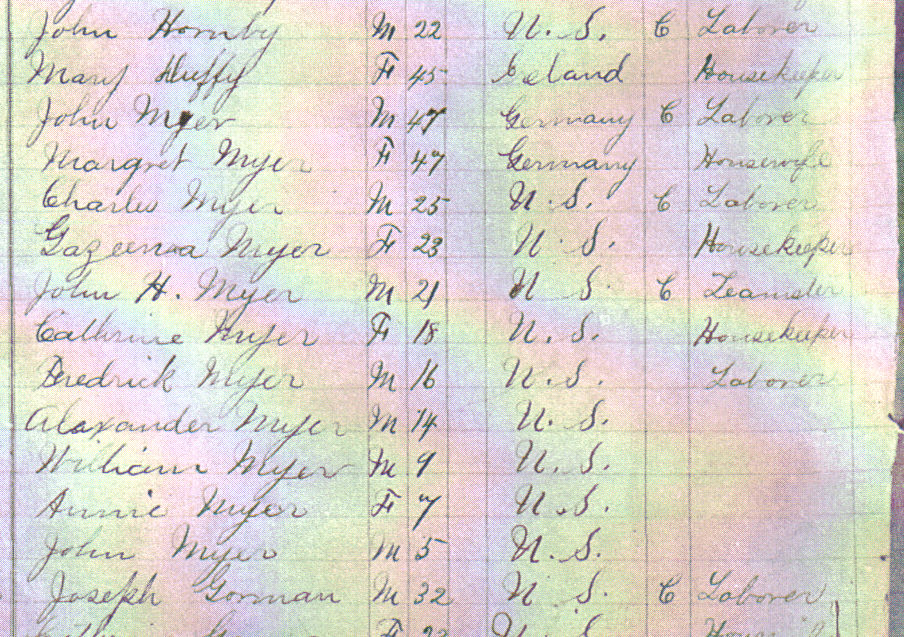 February 16, 1892, 2nd Election District, 8th Ward in the City
of Brooklyn, County of Kings:
February 16, 1892, 2nd Election District, 8th Ward in the City
of Brooklyn, County of Kings:
- John Myer, M, 47, Germany, Laborer, U.S. Citizen;
- Margret Myer, F, 47, Germany, Housewife;
- Charles Myer, M, 25, U.S., Laborer;
- Gazeena Myer, F, 23, U.S., Housekeeper;
- John H. Myer, M, 21, U.S., Teamster;
- Catherine Myer, F, 18, U.S., Housekeeper;
- Fredrick Myer, M, 16, U.S., Laborer;
- Alexander Myer, M, 14, U.S.;
- William Myer, M, 9, U.S.;
- Annie Myer, F, 7, U.S.;
- John Myer, M, 5, U.S.
This record is interesting because nine children are listed: all the
children who made it to adulthood are here. We also know of Dora and
Dietrich, that's eleven. And in the gap between Dietrich and William [A.],
there's room for at least one more child. Who?
July 29th, I received via inter-library loan the booklet: Schaub, Hans.
"Hintergründe der Auswanderungen aus Oberfranken nach Nordamerika".
In: Heimatbeilage zum Amtlichen Schulanzeiger des Regierungsbezirks
Oberfranken. Bayreuth im Januar 1994 Nr. 206. Background information
about the emigration situation in Oberfranken, which affects GGM Baier
(Blaicher) and her siblings who came to America. Based on the author's
doctoral dissertation, little doubt. Made a photocopy.
There are only three entries in my logbook for August. They are
"catch-up" entries I write from time to time when I haven't recorded
everthing that's been happening.
On August 7th I noted that Alice has been busy, exploring the
Family Search website. Wrote she in an email: "I'm like a kid
with a new toy on this website." It's working well,
not only for the Felbingers and the Prahls, but the Korfmans as well.
Alice pulled up a Charles Pfortner, private, also in Co. C of the
45th New York Infantry. I'd seen his entry some time ago, and 'tis
intriguing to think the Felbinger side might have served with the Prahl
side in the war, but without additional information it's difficult to know.
Alice has also been going further afield with her research. She wrote me
that she found:
1) Marriage December 6, 1903 of William Meyer /
Mary I. McDermott, in Boston MA. He born 1883; parents: John H. Meyer,
Katherine Dopman. She thinks it a second marriage. I am not so sure,
but certainly an intriguing entry that needs a follow-up.
2) Marriage, June 22, 1910 of Henry Baier / Alexandria Tastula, in Fitchburg, MA.
Second marriage for both. Groom from Helmbrechts, Germany, b. 1861;
father, Georg Baier; mother Margaretha Ordnung. Would be good if could find
Henry's first marriage.
3) I suggested to Alice to look for GGP Blaicher. In response, Alice wrote
saying that all she had found was two records for a Louis Bleicher,
b. 2/1886; d. 1/6/1887 (common variant spelling). The birth record says:
Boston, Suffolk; parents: Charles Bleicher; mother, Henrietta Bleicher.
The death records says: d. Boston, 1/6/1887; b. Cranston, RI. At the time
I thought this strange, because it would shorten the amount of time for
the birth of GM Christina Blaicher Prahl (b. August 3, 1886, according to
Grampa).
While I write this report in March 2011, I have gone back and looked in the
Family Search files. Since Alice's writing in August the Mormons must have
added images, so I can look directly at both the birth and death records
for Louis. I am reasonably convinced he is a true son of GGP Carl and
Henrietta Blaicher. The birth record appears as part of a continuous
listing of births in Boston for the year 1886. It gives the date of
birth for Louis as February, but does not list a day. His father Charles
is listed as a teamster (an occupation he also plied in New York). Further,
the birth records on the page are not in any particular chronological order
by date, but are a hodge-podge of listings. This leads me to believe the
record of Louis' birth was not contemporaneous with the event. The death
record is more detailed. It lists his death as January 6, 1887; age at
the time of death, one year and eleven months. If this is so, it would
mean a birth in February *1885*, not 1886. This would be more than
sufficient time for him to have been born, and then a sufficient
gap of time for a pregnancy leading to the birth of GM Christina Blaicher
Prahl. According to both birth and death records, the Blaichers were living
at the "rear, 188 Pynchon Street" in Boston. There is no Pynchon Street in
Boston, not in 2011. A check of Wikipedia led to an article about
Washington Street in Boston, and in the article Pynchon Street is now
called Columbus Street: that little mystery is resolved. According to
Louis's death record, he died of meningitis; he was born in Cranston,
RI. Did the Blaichers marry there, 1884 perhaps? This would make sense,
but there is no family story of the Blaichers ever being in Cranston,
only that GM Christina was the first child, born in Boston. As I
wrote to Alice in August 2010, Louis's very existence comes as a
revelation. But the event of his life should not come as too much
of a surprise. Obviously Grampa would emphasize the living (no point
in dwelling on the dead, even if he knew of them), and Gramma as his wife
would of course hold a special place. That Grampa did not mention
the Blaicher twins William and Henry, born in 1905, is another facet
of this phenomenon. Last, our basic knowledge of the Blaichers
is based on the article in Schlegel's American families of German
descent, written not merely to express the interest or vanity
of some individuals wanting their names in a book. Schlegel was
written as much to relate to the broader American public in 1916-1917
that Americans of German descent were loyal, faithful and true-blue,
so obviously positive aspects would be emphasized, negative aspects
downplayed or ignored.
In August 2010 I double-checked the 1900 Federal census for the Blaichers.
There they noted that they had had *seven* children, of whom six were living,
but on the census only five are listed (Arthur, Helen, Carl, Joseph
and Violet). GM Christina is not listed, nor have I ever found her
in the 1900 census, but we know she was alive. So: who was the
seventh child? Best guess now is Louis. As William and Henry
were born in 1905, to the best of my knowledge (at the time of
this writing, March 2011) the Blaichers had nine children altogether.
LIST OF BLAICHER CHILDREN HERE
As I write this report in March 2011, two other thoughts occur to me.
First, if Louis's birth was reported in 1886 and the report mentions
the Blaichers were living at 188 Pynchon Street in Boston (Roxbury
or Brookline, I am vague on Boston geography), and his death record
also indicates the Blaichers were living at the same address in 1887,
this information also resolves an issue of long standing for me:
where in Boston were the Blaichers when GM Christiana Blaicher Prahl
was born August 3, 1886? Well, obviously at the same address.
A little piece of deductive reasoning goes really far. In the moment, the
web sites do not have records for GM Christinia in Boston, but I can
now afford to wait; I can certainly refrain from spending a lot of money
to have researchers in New England check information in Boston, though
perhaps I might to find a baptismal certificate. Second, I thought to
run GM Christina through the Family Search site and expand the search to
include her life span. This search brought up an entry for her in the
1905 New York State census, living with Joseph H. and Lillian Anrig at
983 Amsterdam Avenue in Manhattan, New York City. A delightful
find: it mitigates the lack of record in the 1900 Federal census, and
puts her squarely in place to meet Grampa sometime in the last years
of the first decade of the 20th century. Glad that's taken care of.
I sent off the New York State census record to Alice. She replied
with the comment that perhaps the reason we have not found GM
Christina in the 1900 census is that she was off somewhere else
finishing her education, and not living with her parents and siblings,
as the 1900 census indicates. Alice cites Schlegel, noting that the entry
for GM Christina states (vol. 3,p. 84): " ... graduated from the New
York Public School No. 54 at One Hundred and Fourth street and
Amsterdam avenue [there is a playground there now, on the northeast
corner of the intersection]. She then studied music on the piano,
and also took lessons in embroidery, and was later employed as
cashier in the confectionery and catering business carried on by
her uncle, Joseph Anrig". An interesting theory by Alice, not
exactly confirmed but certainly suggested by the wording in Schlegel.
Back to writing the 2010 annual report. August 15th the logbook
notes I sat down to write for the German Genealogy Group Part I of an
essay: "Travels with my ancestors: a journey through Franconia",
a report of my research trip to Germany in April. As these pages obviously
show, my writing style is too expansive to keep the article to a few pages,
so I broke it up into two parts. In the two articles I chose to emphasize
the human interest side of my research trip, and downplay the more tedious
research elements. The two articles appeared consecutively in the January
and February 2011 issues of the Ahnenforscher, GGG's monthly
newsletter.
Alice sent an email saying she had looked at "Uncle Johnny" Meyer's draft
registration card, noting that according to the card he had been on active
service with the U.S. Army field artillery for nine years. Had to go back
and read it for myself; best guess his period of service would be sometime
between his 18th birthday (1904/06) and nine years after (1913/1915). Given
this information, I am surprised he was not called back to serve in World
War I. Alice wanted to know if we might find his military record. Little
idea, because it was still the peacetime Army. But obviously the first
place to ask would be in the National Archives in Washington, where I was
in June.
The August 31st entry notes Alice's arrival for some days in New York.
She (We) had lists of people to search for in the Municipal Archives.
Alice's list:
- Dora Meyer: Sister of GM Cenie Felbinger; "died young", sometime
between April 1872 / June 1880;
- William Meyer: After much spade work digging through Greenwood
Cemetery records (bad pun!), Alice thinks the William Meyer, d.
February 1882 at one month and buried in the same section and lot as
Dietrich Meyer the most likely candidate. There are seven other
William Meyers in the same time frame between Dietrich (1879) and
William A. Meyer (1883) who might fill the bill;
- Charles Meyer. Marriage record to Anna Schoelles, November
20, 1893, Kings number 5197; with birth record for Charles F.H.
Meyer, b. 1894 (listed in 1900 Federal census as son);
- spouse of Fred Meyer: December 6, 1916, Kings number 14915;
- Dora Meyer: Sister of GGF J.H. Meyer;
- Henry Kleen.
To this list I added my own:
- 2GGF Charles Prahl: Marriage to Katie R. Cornell, 1881;
- Mathilda Prahl: Child of marriage, 2GGF Charles and Katie;
- Katie Prahl: Second marriage to George Kline (1897);
- Katie Prahl: Death record as Kline, 1905;
- George Kline death record.
Within a couple days Alice and I were off to the Municipal Archives,
September 2nd. This is an anniversary day: 130 years ago
this date, our recently discovered GGA Lilly Felbinger died of cholera
infantum. Told Alice: we think we have a family member cheering us on.
We pursued our lists:
- William Meyer. Died February 28, 1882 at 11 AM, at 170 4th
Avenue, Brooklyn. Kings death certificate, number 2554. Yes, William
is the missing twelfth Meyer child, lived one month, sixteen days. This
would put his birth on/about January 12, 1882. COD: Pneumonia, spinica.
We now have all the Meyer children. My logbook does not indicate whether
we looked for a birth certificate; I may need to go back and do this;
- Dora Meyer. Dora has not been among the missing; rather:
when did she die? While Alice worked on other family members, I went
looking for Dora. I was having no success with the old handwritten index
files, so I switched to the online index, and ran records as a soundex
search. Such search brought up a Myers, Dora in 1879 at 8 years,
which would put her at an 1871 birth. I retrieved the certificate: yes!
Kings death certificate number 10232, December 6, 1879 at 5 AM; residing
at 238 Flushing Avenue (near the Navy Yard), which for me was the tip-off,
having found the Meyers there in the 1880 Federal census under "Myer" at
that address. COD: Diphtheria. This record also confirms, as Alice
pointed out, the correctness of Aunt Gene's comment to me in 1980:
"Dora died young". Yes, she did; but not as an infant. Buried in
Greenwood Cemetery;
- Carl Meyer / Anna Margaretha Scholles marriage. Married
November 20, 1893, in St. John's German Evangelical Lutheran Church,
281 Prospect Avenue, Kings marriage certificate number 5197. Valentin
Schoeller and Kate Meyer (Uckert) were the witnesses;
- Alexander Meyer / Anna Minnie Stumpf marriage. Married
January 1, 1903, Kings marriage certificate number 175. Uncle Alex
was 26 years old at the time, Minnie 20. When Alex died five years
later in the automobile accident, his death certificate indicates he
was already a widower. A preliminary search for Minnie's death
certificate turned up nothing;
LIST OF MEYER CHILDREN HERE.
And now the Prahl records:
- Charles Prahl / Katie R[obinson] Cornell marriage. Married
October 28, 1881, Manhattan number 6982. So much of this record is
spurious. CP's age is listed as 51 (actually 54); Katie's age as 19
(actually 17, if the 1870/1880 censuses are to be believed). Her mother
Laetitia signed the certificate, which leads me to think Katie's father
was already dead. Also: CP was living at 1486 East Boulevard, New York.
My own guess is that this would be along Broadway (often referred to as
"The Boulevard" in the late 19th century). But it also means the house
numbers would be different, because 1486 Broadway now is at 44th Street.
Possible at this address? ;
- Mabel Lloyd Prahl, birth. Born September 6, 1888; Kings
birth certificate number 8704. Father: 2GGF Charles Prahl, 63 years old;
Mother: Katie Robinson Prahl, 24. Living at 101 Winfield Street in
Brooklyn. Alfred H. Lloyd was the attending physician, resident at
233 East 79th Street, New York City (Manhattan). Noted: Mabel as the
4th child of the couple: needs research;
- George W. Kline / Katie R. Prahl marriage. Married November
1, 1897. Manhattan marriage certificate number 16530. Kline living
at 233 East 85th Street, Manhattan; age 53; widower. Katie R. Prahl;
living at 221 East 81st Street, Manhattan; age 33; widowed.
Strange: 2GGF Charles Prahl was still living. He turns up in the
Federal census of 1900 as a boarder at 38 Center Street, Clinton,
Hunterton County, New Jersey. Alice points out to me that this is
the address of Henry F. Angle. I have a letter written by 2GGF Charles
in 1901 to his granddaughters Adelaide and Mathilda on the letterhead
of H.F.Angle, a watchmaker in Clinton. Simply, 2GGF was living
with his employer. The letter is written in a good steady hand, its
contents quite lucid for a man of seventy-five years who was to die
three years later in part by senile dementia.
- Kate R. Kline death. Died October 7, 1905, Manhattan
death certificate number 31694. Deceased lived at 207 East 83rd Street;
married. COD: chronic alcoholic gastritis and hepatitis; secondary
cause, myocarditis. Effectively, Kate was alcoholic. When this
condition may have started is anyone's guess after 105 years. And
depending how her condition progressed: did CP throw her out; did
she no longer want to deal with an elderly man who may well be
starting to decline; or both? No way to know really, but all very sad.
At face value (not having looked for a writ of divorce) this is the
first documented case of bigamy in the family, and could well exemplify
what Professor Wills said in her Greenwood presentation: separations,
divorces, and remarriages without benefit of divorce
may be much more common than we realize;
- George W. Kline death. After looking at this record, I
decided this was not the George W. Kline in question, but perhaps I should
look again. I find no specific notation in the logbook as
to why I thought this.
Labor Day Sunday Alice and I decided not to go to Queens to find
the parish where Mom and Dad were married (bit of a journey
for that one). Rather, we chose instead to go north to West 134th
Street to visit our friend the Rev. Rhonda Rubinson, who is now
priest-in-charge at St. Philip's Episcopal Church. Wonderful time
there. Apart from visiting an old friend, a bit of method in this:
Alice has never seen the site of 507 Lenox Avenue (now: Malcolm X
Boulevard) at the intersection of 135th Street. At the end of the
19th/beginning of the 20th century the west side of the Avenue was
all brownstones, and the residence of 2GGP Merkel, GGM Delia Merkel
Prahl, and Grampa Prahl and his two sisters Adelaide and Mathilda.
The Schomberg branch of the New York Public Library is there now.
In the evening Alice and I ran daughter Dora Meyer through the
Greenwood Cemetery records looking for a citation to her grave.
We are clear she is not buried as Meyer, Meyers, Myer, Myers, Meier
or Meiers. I also ran a search through the years 1878-1880 using "D"
for first name, "M" for last name, and found no entries coming anywhere
close for a Dora Meyer. We may have to make inquiry through Greenwood's
genealogical services to figure this one out.
Labor Day Alice and I ran "Prahl" through the Family Search pilot site,
"New Jersey Deaths" and "New Jersey Births & Christenings". We found
the following citations:
- Male Prahl +14 October 1882 Cran. Union NJ; father: Charles Prahl, Germany;
mother: Katie Prahl, U.S.; B06587-7, NJ-EASY, 589071;
- Walter Prahl *7 Nov 1883 Cranford, Union, NJ; father: Ch. Prahl; mother:
Katie Cornell; C02317-4; NJ-EASY; 494198;
- Arnold Prahl +4/15/1886 Age: 0; Cranford, NJ; father: U.S.; mother: U.S.;
806596-9; NJ-EASY; 589309; Ref. v. 21, p. 433. As this citation does not
list the parents' names, the record can reasonably be questioned. These three
records taken altogether, however, fit very nicely with the record of
Mabel Lloyd Prahl in Brooklyn in 1888.
September 7th, Tuesday, Alice and I went out to Calverton National Cemetery
to see Mom's and Dad's graves. We found them in a state of renovation:
maintenance men were replacing with new sod the burned-out turf I found last
year. This is Alice's first real visit to the grave: Dad was buried in
February 1983; Mom, February 2009. At Dad's death, Mom had not wanted Alice
flying in from Canada, fearing the winter weather (actually it was sunny
weather the whole time in New York, seasonably chilly). In 2009 we did
not take the time to visit the gravesite when we buried Mom. A lot of years
to have to wait. In the afternoon, we went looking for the Bungalow in Mastic.
This year, with map and picture in hand, we finally found it on Carlton Avenue.
Of this visit, I will have more to say later in this report.
From September 8th to the 11th Alice and I were off to Vermont to visit our Cooper
cousins. At the same time, Bob went to visit his sister and brother-in-law in
Ottawa, and they came down to Vermont as well, so several families were altogether at
the same time: a gathering of the tribes, a good time was had by all.
After I got back to New York, right back into research:
- A book showed up through inter-library loan that Alice had wanted
to see because it would relate to Bob's side of the family.
Of course these things never arrive in time. Kern, Albert. Homeland book
of the Bessarabian Germans (translation of: Heimatbuch der bessarabien
Deutschen). Fargo, ND : Germans from Russia Heritage Collection, ND State
University Libraries, 1998. Preliminary examination indicates the book gets
down to the district, parish and congregational level, but no further. Places
of interest to Bob: Kischinev parish, Strymbenii congregation. Otherwise, the
book is about the expatriation of the the Germans back to the Reich in 1940 when
the Soviet Union took Bessarabia from Romania as part of the German-Soviet
non-aggression pact of August 1939. No interest there because the Korfmans (or
Bessels: I never quite get this straight) left long before this.
- Katie Cornell: "And where is she buried?" This thought occurred to me
the week of my return. A check of the death certificate indicates "Fresh Pond".
The only "Fresh Pond" in the immediate New York metropolitan area is: Fresh
Pond Crematory, 6120 Mount Olivet Cresent, Middle Village, New York 11379; telephone
number: 718-821-9700. This is on the west side of Lutheran Cemetery, what
appears to be a comparatively short walk from the end of the subway line.
A little quick research indicated that line was extended at ground level
to the Cemetery in 1906 ... just in time for her to be buried at the Crematory
in 1907. Send a letter with the requisite fees; on the other hand, a trip out
would be a lot cheaper.
- Friend Rhonda sent me a note that there are several pictures of Lenox
Avenue and 135th Street in the book Harlem on my mind. The photos are
after the Merkels/Prahls left, of course, but they also show the neighborhood
before the Schomburg Library was built on the corner. I will still have to
be in contact with the Library in the hope of finding a photo of the corner
before the Library was constructed.
My logbook indicates that from September 20th to October 16th I worked
principally on 2GGF Ignaz Merkel's pension records. First order of business
was to sort the entire file by date; yes, badly out of order by date. After
getting all the sheets arranged in chronological order, I pulled out the papers
that National Archives sent me so many years ago, first to know that I had
photocopied them again, and second to see how they fit in the picture of the
larger file and to integrate them with the new material.
This work was a mess, but after examining each individual photocopy, I
could come up with a basic story. After his military service 2GGF Ignaz
may well have collected the pension voted by Congress in 1862 to be paid
to every veteran who had spent more than ninety days in Federal service
during the war. From the records this possibility is not entirely clear.
At the start of the records, Ignaz applied for the pension in
1879. He spent the next thirty years of his life battling with the
Board of Pensions (Department of the Interior) to obtain what he
considered his just due as an *invalid* pensioner because of his wound.
So the story goes: Ignaz was wounded by gunshot on May 1, 1863.
The wound itself was minor, doing damage to his large right toe.
In his pension claims, Ignaz stated he was removed to the 11th
Corps Hospital (where? which of many?), and was kept there for
three days. Further, he claimed that he did his time, spending
three continuous years in the field. As a result, the wound
caused him all kinds of physical problems, especially after
rheumatism set in from all the exposure to the elements.
Through the thirty years until his death, Ignaz must have
spent untold amounts of time and money on lawyers and doctors
to contest the Board's rulings, trying to obtain a larger
pension. One can guess the amount of money spent was probably
larger than what he actually recovered. The crux of the matter was:
there was no *contemporary* record of the alleged wound. Not hard
to understand. Ignaz was wounded May 1st. On May 2nd, Stonewall
Jackson assaulted the right wing of the Army of the Potomac with a
devastating attack. The 1st Brigade, 1st Division, 11th Corps
(consisting of the 45th New York, along with the 41st and 54th
New York regiments, and the 153rd Pennsylvania) suffered the
full weight of the initial onslaught that effectively routed
and dislocated the entire 11th Corps. Considering the collapse
of the entire right wing of the Army of the Potomac and the
desparate measures required to save the rest, it is easy to
understand that written records had low priority in the
immediate circumstance, even in the field hospitals. But:
in all armies, nothing happens or has happened if the
paperwork's not done. By a divine providence Ignaz's life
was spared by being wounded the day before, so he missed the
whole fiasco. But this meant he would face the equally
formidable, intractible foe of the Board of Pensions to
the end of his days. Early on, the Board must have suggested
to him that if he could get an officer to certify the alleged
wound, they would reconsider the matter. At the remove of at
least 15 years, where would Ignaz find one? So he got
two old army buddies to testify on his behalf.
Non-commissioned officers (his former sergeant and corporal)
to be sure, but the Pension Board (like all pension boards)
effectively came back with: "Yeah, right, old vets stick together".
And though the doctors of the Board of Pensions acknowledged that Ignaz
had indeed been wounded somehow, in its considered opinion the Board
did not think the severity of the wound warranted a substantial
increase in his pension. Over the years there was some slight
increases in the benefit, until in 1907 Congress granted
everyone the same pension benefits simply on the basis of age.
Ignaz did not live long enough to enjoy the $20 a month he was
now collecting: he died in December 1908.
After having read through the papers, I decided to write up a
descriptive inventory of the file. This inventory permits
me to gather the necessary information from each application,
and to comment on the information. My logbook from September
20th to October 16th is filled with the minutiae of how I
wrote the inventory. I feel no need to fill to report
that detail here, for I wrote much of it into the inventory
itself. I will comment here that the inventory was written to
the best of my ability. Several pension application pages were
filled with the comments of the Board of Pension doctors,
and doctors' handwritings then are as bad as they are now.
Unfamiliarity with medical terminology has made the inventory
less than perfect. Last, as of this writing the inventory is
not complete, because it needs to be checked against the actual
file in Washington. I will have to wait to make that trip again.
URL FOR INVENTORY HERE.
While working on the inventory, I also spent time on other projects.
These included:
- Pulled up several pages on Civil War pensions from the Internet,
to get a better perspective on the pension process altogether;
- Did a quick review of the Bessarabian book Alice had asked for. I
photocopied the chapters on the basic history and organizations and the
Diocese of Kirchinev and this should be sufficient for her. Note to
myself: the Korfmans from Bessarabia, the Bessels from Kozan, according
to Alice;
- took time out for an Alice request: found the World War I draft
registration for great uncle William Anderson Meyer. Though the
information is slightly off, gotta be him: living at 344 7th Avenue
in Brooklyn; b. February 14, 1882 (Zion: February 13, 1883); age 37
(even on this record that would be OK if the year were 1919!); a driver
for the Sheffield Farm Milk Company at Carlton Avenue/Pacific Street,
Brooklyn (in the neighborhood); and married to Dorothy C. Meyer. Yes,
think we found him, and "Aunt Dot". After sending off Uncle Will's
card to Alice, she returned a note to me that John Uckert was a stableman
for Sheffield Farms Milk Company at the time of his death, and I have
the dim recollection that Uncle Charles worked for them also;
- on the 30th Alice sent me another email that Uncle Will had first
been married to Mary McDermott in Massachusetts; any children were with
Dorothy (b. Thering). In Family Search Alice has found Dora Thering
in the 1905 NYS census, 17 years old living at 1774 Pacific Street in
the household of Herman Drayer (uncle), her estimated year of birth
1888. Also found a birth record for Christina D.M. Thoering, b. June
15, 1887 in Newark, Essex, NJ; father, Otto M. Thoering, age 24, b.
Germany; mother, Dorothea Drayer (sister of Herman D.?), age 27, b.
Germany. Still looking for a marriage record for Uncle Will and
Aunt Dot, but patience ...
- October 20th, an email from Alice about the Doppmanns (and others).
The most intriguing of these is from Family Search, "New York Marriages
1686-1980": Friedrich Wilhelm Dapmann [sic] b. 28.IX,1834
Bertha Gartler [sic], b. 17.X.1838 [but Alice thinks Kuttler]; married
16.1X.1860 -- First German Presbyterian Church, Rivington Street,
NYC. Interesting: this is the church where Charles Edward
Prahl was baptized in 1855. Knew it had to happen at some point, that
the Felbinger/Prahl families would have to cross paths at some point
before Dad and Mom. 1880 Federal census: Frederick Dopmann; Brooklyn;
b. 1834 Germany; age 46; Stevedore. Bertha Dopmann; b. Germany; age 42;
Anna Dopmann; age 9. In 1900 census, Bertha D. is living 337 South King
Street, Ionia City, Ionia, Michigan; immigrated 1858; widowed; 1 child:
Anna Showerman, age 28; to Seymour Showerman, age 40, b. Michigan; also
listed Cutler, George Sr., b. 1833; Cutler, Katharina, b. 1830; Cutler,
Sophia, b. 1865. Bertha went there to be with him after Frederick died.
Zion records indicate a son F.W.D., d. Jan. 15, 1868 (2 y., 2 m., 6 d.),
Kings #12706. Also baptismal record for Anna: b. Sept. 26, 1871, bapt.
Dec. 24, 1871. Bertha from Wankheim, Württ. Sent all this information
to Alice October 23rd.
My logbook notes I started working *finally* on the Helmbrechts records
on October 17th, after five months. This work occupied me through the end
of the month. As I read through my log notes, I am quite clear that the
Baiers and Ordnungs are as troubling to me as the Meyers and Doppmanns,
and almost as difficult to keep straight, to bring Ordnung out of chaos.
Happily, the records of GGM Heinrietta Baier's (Blaicher's) siblings have
been clear enough; it is getting back behind them to the prior generations
is where the confusion comes in.
3GGF Johann Baier, Metzger, seems to come out of nowhere. In addition
to 2GGF Johann Georg Baier, he has an older son Johann Christian B., b.
6.III.1824, d. 27.IX.1826. And a younger son, Georg Heinrich B., for
whom I have not accounted: he is listed on the baptismal record
for the first child of 2GGP Baier's first child Georg Heinrich, bapt.
18.IV,1849, d. 25.I.1850. This record also indicates that 3GGF Johann
Baier (and I may assume 3GGM Baier as well) is in America. But
note also that on the marriage record of 2GGP Baier, 3GGF Baier is already
dead: perhaps in America, perhaps not. So: I need to check for death
records of both 3GGP Johann Baier and Kath. Marg. (Barb.) Baier (b.
Heerdegen (Kort)). Of course, the G.H. Baier as godparent might be
the son of a different Johann Baier, but I think this unlikely.
The Ordnungs are not much better. Some added confusion here is that
3GGM Katharina Marg. (Barb.) Ordnung was first married to Johann Daniel
Merkel (no relation to the Ignatz Merkel family of Baden), whom she
marries in 1810 and divorces. He marries a second time in 1821, and
she marries 3GGF Johann Ordnung in 1824. This much is clear. I
need to find the Merkel children, if any, as they are also cousins.
The difficulty is that 3GGF Johannes Ordnung (b. 1785) is listed as the
second son of Jakob Ordnung, farmer in Günthersdorf. Thing
is: I have another marriage record for a Johannes Heinrich Ordnung
(b. 1780, m. 1809 to Sabina Kath. Lenz, so he is listed as 29 years old)
who according to the record in the 3rd son of Jakob Ordnung, farmer,
same place. Some one is very confused, though it could be the recorder
of the records. The marriage record for Johannes Heinrich O. indicates
Günthersdorf is ordered with Schauenstein (north of Helmbrechts),
and a quick check of LAELKB indicates they have those records, so I may
be able to get behind the Ordnungs.
And in the midst of all this wrestling with the Helmbrechts records, I
noted in the logbook, October 29-November 2, that I spent some time
transcribing the Richmond County Clerk's copies of the two original land
deeds for Woodland Cemetery. Apart from the difficulty of the hand, I
was slowed down by the fact that the Clerk indicated no punctuation
in the copies. I suspect this allows the lawyers to interpret the deeds
without consideration of punctuation, but it makes transcription harder.
November 1st and 2nd I wrote out the second part of "Travels with
my ancestors" for German Genealogy Group's newsletter.
Saturday, November 6th I attended a conference at NYPL sponsored by New York
Genealogical and Biographical Society: "Beyond the Basics", presented
by John Phillip Colletta. Colletta wrote the book They came in ships,
one of the standard texts on how to find your ancestor in the passenger
manifests. I confess: I have bought the book, but not read it. Obviously
I will have to read it now because I have had not luck finding 2GGF Prahl
or the Meyers and Baiers in the records. Program for the day: 1) Passenger
arrival records; 2) Naturalization records; 3) Turning biographical facts into
real-life events: how to build historical context; 4) Breaking through
brick walls: use your head! Basically I went for the first lecture,
and the others were just fine.
While sitting in church the next day, and ruminating on what I had learned
the day before, I realized I actually do know a lot about 2GGF Prahl's
passage, I just have not found it in the records:
- Carl Johann Hans Prahl: b. September 19, 1826 in Oldesloe; first
child of Carl Friedrich Prahl, watchmaker, and Johanna Martha, b. Lundt;
- from several accounts, he participated in the Schleswig-Holstein uprising
of 1848, was captured at the Battle of the Bov, imprisoned in the prison
ships in Copenhagen harbor, and was at some point released and repatriated
back home. This information needs to be confirmed;
- his marriage to Friedricke Henrietta Anna Storch is not recorded in
the Oldesloe registers. As she was born in Kiel, it is reasonable
to think they were married there (as the custom is to marry in the home
parish of the bride), or perhaps elsewhere;
- their first child, Adelaide, was born December 20, 1850, baptized February
4, 1851; their second child, Johanna Maria, was born May 29, 1852, and baptized
July 2, 1852;
- 3GGM Johanna Martha Prahl, b. Lundt, dies December 21st, and is buried
December 27, 1852;
- while all this is going on, the political situation in Holstein and Oldesloe
has stabilized but not improved: the Danes and the Schleswig-Holsteiners have
concluded peace with a return to the status quo ante. This means the Danes
came back in, and according to published accounts were repressive in dealing
with their subjects, little doubt making life difficult for those who had
participated in the uprising. This would make getting out of town
at the least, and perhaps emigration to America, a desirable thing;
- according to Grampa (as told him by his grandfather, and recorded in
Schlegel, and then believed by everyone else), Carl Johann Hans Prahl
emigrated to the United States in 1853. Indeed, there is documentary
evidence of this: according to the 1900 Federal census 2GGF Charles Prahl
was living at 38 Center Street, Clinton, Hunterton County, NJ as a boarder.
He stated he was born in 1828 [wrong], widowed [correct], *not* naturalized
[wrong], and came to the U.S. in 1853 [good guess];
- 2GGM Friedrike Prahl came on the bark Rastede with the two girls
already born, Adelaide and Maria. According to the Hamburg ship registers,
they left Hamburg on October 15, 1853. According to the passenger manifest,
they arrived in New York December 5, 1853. Again according to the passenger
manifest, Maria died at sea. Journey: 51 days. Parenthetically, the Rastede
arrived in New york on the prior voyage August 8, 1853. With a few days in
port before sailing again, so from August 8th to October 15th: 68 days to
complete the return trip;
- in the baptismal register of the First German Presbyterian Church,
Rivington Street, Manhattan, 2GGP Prahl's first child born in the United
States is Charles Edward Prahl, born February 2, 1854, baptized September 27,
1855. This baptismal registration is the critical document. *If* this
registration is correct, it means 2GGM Friedrike took passage while she was
pregnant. This circumstance would have been a significant hardship, because
she traveled in steerage with two small children in tow and without benefit of
husband. Such conditions would certainly account for Maria's death, and more
surprising that Friedrike survived and was later delivered of a child
who lived until 1892;
- therefore, the circumstances of his wife would put 2GGF Carl (Charles, in
the United States) Prahl on a very tight timetable. Allowing that human
biology was remarkably similar in 1853 to what it is now, a birth of February 2,
1854 would put conception on or about May 2, 1853 (nine months). A few days
to travel from Oldesloe to Hamburg (a distance of approximately 50 kilometers
= 30 miles); some days in Hamburg before sailing; 51 days at sea to New York:
estimated time of arrival for 2GGF Charles Prahl would be middle to the end of
June 1853, perhaps into the first two weeks of July. A letter back to Oldesloe
would take at least as long, so word to pack up and come to America would
reach 2GGM Friedrike middle to late August/early September at the earliest;
- as noted, all assumptions depend completely on the baptismal record
of son Charles Edward Prahl being correct. In the 1860 Federal census, Charles
Edward is listed as being six years old (so a birth in 1854); but in the 1870
Federal census he is listed as being 15 (so born in 1855); and in the
1880 Federal census when he can speak for himself at 57 Burr Street, New
Haven, Connecticut: 27 (so born in 1853). Seems the Prahls were a tad
slippery with dates (nothing new there);
- to add a touch of mystery to this equation: there is one other passenger
from Oldesloe on the voyage of the Rastede. Combining both the Hamburg
and New York records, this individual is Georg Mühlhausen, male, twenty-one
years of age, a baker. I have often had the thought this person is 2GGF
Charles Prahl incognito, but I have no evidence of this;
- therefore, to narrow the search of individual passenger manifests:
the arrival of 2GGF Charles Prahl would likely have happened at the
extreme earliest in the middle, and more likely at the end of June 1853.
To further narrow the search, only ships coming *direct* from Hamburg to
New York. To be comprehensive in the search, I would take the period from
June 1 - July 31, 1853, then expand to other ships in the same period.
I would be looking in original ship manifests for a man, traveling alone,
a watchmaker or jeweler by trade, approximately 27 years of age; and given
his propensities on the matter: claiming *Danish*, not German nationality.
Charles Prahl claimed he was Prussian only after the Prussian takeover of
Holstein in 1864). On his original application for citizenship on May 30,
1865, he renounced his allegiance to the dukes of Schleswig-Holstein; on
the second application in June 28, 1867 he renounced his allegiance to
the king of Prussia;
- if not found in the specified time period, then the search must be
expanded to the whole of 1853, all other parameters being the same;
- last: to consider Colletta's observations: 2GGF's name may be misspelled
(he is certainly not under Prahl); he may have come under an assumed name
(after all, he was to some extent on the lam); date of arrival, name of ship,
information given by him either unknown or wrong; passenger manifest of the
actual ship has been destroyed at some point, certainly the Hamburg records for
the period January/June 1853 went missing in the 1920s.
November 9th I went to the monthly presentation at NARA on Varick Street.
This month the topic was military records as a source of family information.
Some resources to note:
- Regular Army enlistments, 1798-1894 (RG94, entry 91);
- Register of Enlistment, U.S. Army, 1798-1914 (microfilm M233; registers
1-35, 1798-1821 include officers); M-566 - 1805-1821; M567 - 1822-1860; M619 -
1861-1870; M711 (years not noted in my logbook);
- 1916 the Veterans' Administration took over administration of pensions.
There were (are) different types of pensions: disability pension, invalid
pension, service pension, widows' pension. The general index to pension
files is on Ancestry.com;
- 1775-1802 Volunteers, enlisted and officers Regular Army enlistments
1789-1912; compiled service records, muster rolls. bounty land warrant
applications between 1812-1855;
- Order records: Service Record NATF-86 form; pensions: NATF-85 form:
National Personnel Records Center, Military Personnel Records. St. Louis.
Also separation records: DD-214. Army personnel discharge records from
November 1, 1912 - January 1, 1960 were lost in a fire: mostly World War I
records;
- for New York, there are Indexes to Selective Service records of
volunteers, the Revolution, 1812, Civil War; World War I records on Ancestry;
World War II registration cards. Records of the Provost Marshall include 1400
vols. New York and New Jersey and those who didn't get drafted in the Civil
War; state pensions are in the state archives.
My logbook notes that on November 20th I had spent the week cleaning up the
last of the work from Nuremberg for this year, as well as preparing the
transcriptions of the Woodland Cemetery records. November 26-27th,
Thanksgiving weekend, I started downloading pictures from the new camera.
This task proved easier than I had thought, but I did want to do this as
a project that I would devote myself only to this.
November 28th I started a project I had not really thought to do, but got
into it as I went along: I wrote a short paper about the Bungalow in Mastic,
pulling out pictures from Mom's photo album, as well as the couple photos
of the Bungalow I had taken in September.
Monday the 29th, I went across to Staten Island to report to my fellow
Cemetery trustees of my progress on behalf of the Association. While
crossing the intersection a block from my destination, I was struck
by a car and thrown to the ground. Police and emergency medical
personnel were called and arrived in a few minutes. I was removed
to the local emergency room and treated there. I returned to Manhattan
the following day. My injuries were not particularly serious physically,
but altogether I was well shaken by the incident and it took me well
into January to make full recovery.
There are a few entries in my logbook for December. These relate
principally to putting the finishing touches on Part II of my travel paper
for the German Genealogy Group and mailing it off, and finishing and editing
my paper on the Bungalow. After I made the first completion of the Bungalow
paper, I realized why I had been so seized by it: it was a year ago I had taken
the trip to Riverhead, NY to the Suffolk County Clerk's Office to find
the information, and I finished the paper on the eve of Grampa's 128th
birthday: Happy Birthday, Grampa!
URL FOR BUNGALOW RPT HERE.
This finishes the report for the year 2010. Much work has been accomplished;
much work remains to be done.
-- Finished 1st draft Shrove Tuesday, March 8, 2011. Off now for pancakes!
Finished 1st read-through and corrections by March 12th.
Second proof and corrections: April 12th, mid-Atlantic; April 28 - May 3, 2011.