- Examine the mouth of the patient to determine the extent of the anatomy necessary to capture in the preliminary impression to make a cast to aid in the diagnosis, treatment plan, and fabrication of the prosthesis.
- Try in the impression tray to ensure proper fit without impingement on soft tissues.
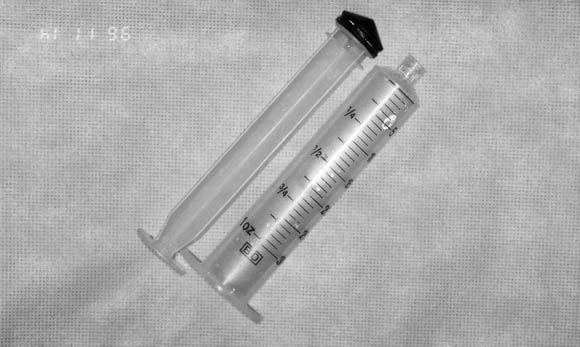
- Make a full mix of irreversible hydrocolloid part and load it into the back end of a disposable 20 ml or 30 ml syringe
 (Fig. 1)
with a scooping motion before the plunger is inserted into the barrel.
The tray should be simultaneously loaded with the remainder of the same mix. When the operator is working alone, load the syringe first, then the tray.
(Fig. 1)
with a scooping motion before the plunger is inserted into the barrel.
The tray should be simultaneously loaded with the remainder of the same mix. When the operator is working alone, load the syringe first, then the tray.
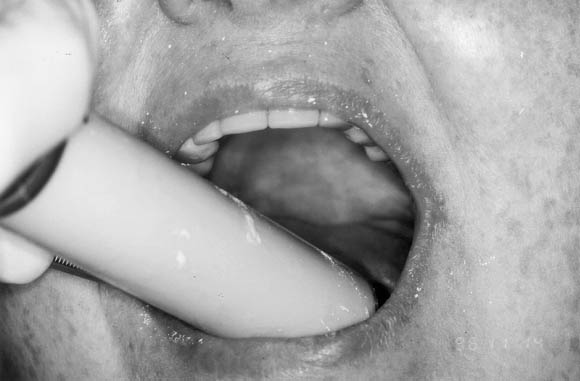
- Proceed to the mouth of the patient and syringe the irreversible hydrocolloid material into the critical portions for the impressions
(Fig. 2)
, and immediately place the loaded impression tray in the usual manner.
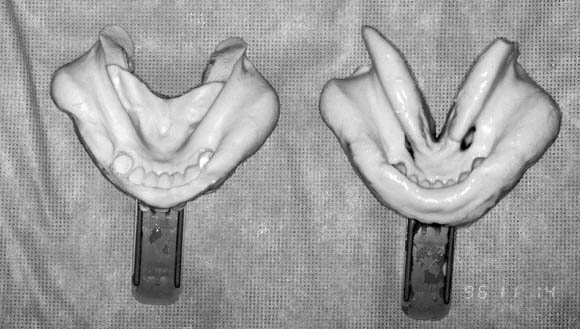
- When the irreversible hydrocolloid gels, remove the tray from the mouth and examine it for defects, making certain that the complete impression has been obtained
(Fig. 3)
, all the borders, extensions, and details that are needed to make a more accurate diagnosis and appropriate treatment plan for the patient have been captured
(Fig. 3)
.
Fig. 1.
Plastic syringe, 20 ml, used to carry irreversible hydrocolloid difficult to reach portions of arch. Syringe is back-loaded in scooping motion and plunger is then reinserted.
|
|
|
Click on Image to view full size
|
Fig. 2.
Syringe used to carry irreversible hydrocolloid material to mandibular anterior labial vestibule in patient considered for immediate denture prosthesis. Loaded impression tray is then immediately inserted in usual manner.
|
|
|
Click on Image to view full size
|
Fig. 3.
Preliminary impression on left was made in usual manner. Preliminary impression on right was made with plastic syringe procedure used to carry irreversible hydrocolloid material to vestibules, which resulted in more detailed capturing of complete vestibular anatomy in preparation for possible immediate denture prosthesis.
|
|
|
Click on Image to view full size
|
The disposable syringes are relatively inexpensive, however, they can be cold-sterilized for reuse. It is helpful to have one syringe per arch impression to avoid cleanup time during the procedure. Some clinicians may also prefer to enlarge the tip for better flow, although this has usually been found to be unnecessary.
This simple procedure not only allows routine capturing of all the oral anatomy needed for proper treatment planning, but also requires less quantity of material in the tray, which reduces the tendency for gagging and creating an anxious patient. It also requires less pressure to force the irreversible hydrocolloid to flow into hard to reach portions of the arch and requires no additional chair time. The procedure is inexpensive, simple to use, and may also be applied to the preliminary and definitive impressions for the immediate denture patient when the presence of malpositioned teeth may prevent the capturing of vestibular anatomy with the usual impression procedures by using a tray alone.
1. Smutko GE. Making edentulous impressions. Dent Clin North Am 1977;261-9.
2. Freeman SP. Impressions for complete dentures. J Am Dent Assoc 1969;79:1173.
3. Coilett HA. Complete denture impressions. J Prosthet Dent 1965;15:603-4.
4. Roberts AL. Principles of full denture impression making and their application in practice. J Prosthet Dent 1951;1:213-28.
- aGraduate Student in Advanced Prosthodontics.
- bAssociate Professor and Director, Advanced Prosthodontics Education.
- J Prosthet Dent 1997;78:332-3.
- Reprint requests to:
DR. JASON J. PSILLAKIS
50 HAVEN AVE.
BOX B-136
NEW YORK, NY 10032
Copyright © 1997 by The Editorial Council of
The Journal of Prosthetic Dentistry
.
- 0022-3913/97/$5.00 + 0 10/1/83399
