Because of the need to hear the sound through the stethoscope during blood pressure measurements (Part I), please be quiet throughout this lab session.
In each laboratory room there is a set of water buckets for studying the effect of temperature on cutaneous vessels (Part III). One subject from each table will do this experiment, and different tables should do this at different times.
Form teams of two and take each other's blood pressure. Enter the data in the table on the next page.
Measurement of human blood pressure is usually by the indirect method in which the blood pressure is estimated from the influence of externally applied pressure on the blood flow through a limb. Wrap the blood pressure measuring cuff (approximately 12 cm breadth) around the upper arm of the subject. Place the stethoscope head gently in the antecubital fossa over the brachia artery (identified by sensing the pulse). Can you hear any sound without inflating the cuff? By squeezing the bulb (with the side vent valve closed), which is attached to the cuff and the manometer, raise the cuff pressure to approximately 160mm Hg. Lower the cuff pressure gradually (2-4 mmHg per sec) by opening slightly the vent valve; watch the mercury level in the manometer while listening through the stethoscope. The pressure at which the sound first appears (sharp, tapping sound) is the systolic pressure. With progressive decreases of cuff pressure, the sound first becomes louder, and the thudding sounds gradually fade and become muffled. The pressure at which this muffling occurs is taken as the diastolic pressure. Usually the sound disappears a few mm Hg below the point of muffling. Release the cuff pressure completely and wait for 10 seconds before making another measurement. What would be the effect of using a cuff that is too large or too small? Should one use a cuff of different size for the obese subject or for a small child?
A. Comparison of Methods of Blood Pressure Measurement. With the subject sitting, determine the blood pressure by using the auscultatory method described above. In addition, also determine the pressure at which the radial pulse begins during gradual deflation of the cuff (palpatory method). Take three readings for each method of determination, alternating one with the other. Before beginning the palpatory measurement, count the pulse for 15 seconds and record the pulse rate per minute. During each blood pressure measurement, also note the pressure at which the mercury column oscillate. Compare the systolic pressure determined by auscultation with the readings obtained by palpation and visual observation of oscillation. Explain the differences. Can you determine the diastolic pressure by palpation?
B. Effects of Body Position on Blood Pressure and Pulse Rate. Allow the subject to lie flat for 3 minutes, then make three blood pressure measurements by auscultation and take the pulse rate three times. Let the subject stand up, and take four blood pressure and pulse rate measurements in quick succession (approximately 1-minute intervals). Compare the systolic pressure, pulse pressure (= systolic pressure - diastolic pressure) and pulse rate in different positions. Explain the differences.
| Systolic/Diastolic | Pulse | Pressure at | |
| Pressures | Rate | which oscillation | |
| (mm Hg) | (per min) | begins (mmHg) | |
| a. COMPARISON OF METHODS | |||
| Auscultatory 1 | ___________ | ___________ | |
| Auscultatory 2 | ___________ | ___________ | |
| Auscultatory 3 | ___________ | ___________ | |
| Mean | ___________ | ___________ | ___________ |
| Palpatory 1 | ___________ | ___________ | |
| Palpatory 2 | ___________ | ___________ | |
| Palpatory 3 | ___________ | ___________ | |
| Mean | ___________ | ___________ | ___________ |
| b. BODY POSITIONS | |||
| Supine 1 | _____/_____ | ___________ | |
| Supine 2 | _____/_____ | ___________ | |
| Supine 3 | _____/_____ | ___________ | |
| Supine 4 | _____/_____ | ___________ | |
| Mean (2,3,4) | _____/_____ | ___________ | |
| Standing 1 | _____/_____ | ___________ | |
| Standing 2 | _____/_____ | ___________ | |
| Standing 3 | _____/_____ | ___________ | |
| Standing 4 | _____/_____ | ___________ | |
| Mean (2,3,4) | _____/_____ | ___________ | |
| ___________min | _____/_____ | ___________ |
| ___________min | _____/_____ | ___________ |
| ___________min | _____/_____ | ___________ |
| ___________min | _____/_____ | ___________ |
| ___________min | _____/_____ | ___________ |
C. Effects of Exercise on Blood Pressure and Pulse Rate. (One subject per table). After measurements of blood pressure and pulse rate in the control state (quiet standing), the subject performs 30 deep knee bends in 30 seconds, with the blood pressure cuff wrapped around his upper arm but disconnected from the manometer. Immediately at the end of the exercise, connect the cuff to the manometer, and determine blood pressure and pulse rate as soon as possible. Repeat these measurements (Note the time of measurement) until the values return to control levels.
Using the control data and the first measurement obtained immediately after exercise, calculate the effects of exercise stroke volume, cardiac output and total peripheral resistance by using the following assumptions: (a) the control cardiac index (cardiac output per unit body surface area) is 3.3 L/min/m2, (b) the effect of the exercise on stroke volume is proportional to its effect on pulse pressure, and (c) the mean arterial pressure equals diastolic pressure + (pulse pressure/3).
| Control | Execise | |
| Measured Data | ||
| Systolic Pressure (SP, mmHg) | ______ | ______ |
| Dyastolic Pressure (DP, mmHg) | ______ | ______ |
| Pulse rate (HR, per min) | ______ | ______ |
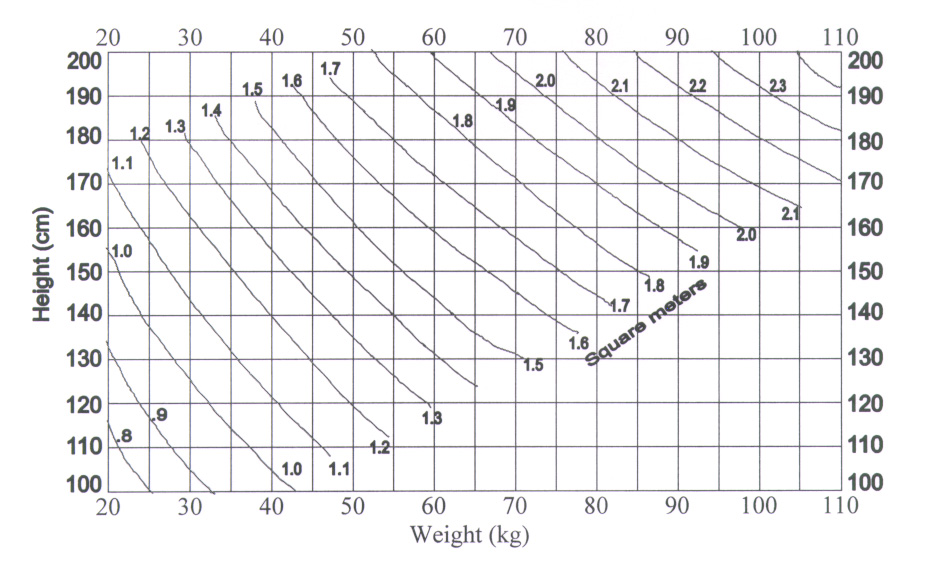
| Body surface area (SA, m2: estimate from hgt. & wt.) | ______ | ______ |
| Calculated results | ||
| Pulse presure (PP = SP-DP) | ______ | ______ |
| Control cardiac output (COχ = 3.3 SA, L/min) | ______ | ______ |
| Control stroke volume (SVχ = COχ/HRχ' ml) | ______ | ______ |
| Exercise stroke volume (SVE = SVχxPPE/PPχ' ml) | ______ | ______ |
| Exercise cardiac output (COE = SVExHRE' L/min) | ______ | ______ |
| Mean arterial pressure [MAP = DP+(PP/3), mmHg] | ______ | ______ |
| Total peripheral resistnce (TPR = MAP/CO, mmHg-sec/ml) | ______ | ______ |
Hemodynamic Effects of Exercise (Percent of control):
100 HRE / HRχ = __________%
100 SVE / SVχ = __________%
100 COE / COχ = __________%
100 MAPE / MAPχ = __________%
100 TRPE / TRPχ = __________%
Chart for determining surface area of the human according to the formula:
Surface Area (sq.cm.) = Wt0.425 x Ht0.725 x 71.84
Wt is the weight in kilograms, and Ht is the height in centimeters. (From DuBois and DuBois. Arch. Internal. Med. 17:865,1916)
A. The White Reaction. Draw a blunt instrument lightly across the skin. Observe the area for a few minutes. The response to this mild mechanical stimulus is independent of the local innervation.
B. The Red Reaction. Draw a blunt instrument firmly across the forearm. The lighter flush of an arteriolar flare may be seen peripheral to the red reaction.
C. The Triple Response. Draw a blunt instrument 6 to 7 times over the same area of the skin. Look for local vasodilation, the flare, and local edema.
D. Veins. Examine the veins of the hand and then allow the hands to hang at he side. Note the size of the veins. What is the effect on the veins of opening and closing the fist several times? Raise the hand slowly from the subject's side. At what level do the veins collapse? What is the effect on the veins of the forearm and hand of applying a blood pressure cuff to the arm inflated to a pressure of 40 mmHg for 3 to 5 minutes? At supine position, examine the degree of distension of the right external jugular vein. Observe the pulsation of the right internal jujular vein. What is the relationship between the jugular venous pressure and the right atrial pressure? How do the blood volume and cardiac output affect the jugular venous pressure?
Record blood pressure and pulse rate from right arm at 1 min intervals until a stable reading is obtained. Continue the recording and perform the cold pressure test by placing left hand and lower forearm in basin containing equal parts of water and ice for 2 min. What is the effect of cold pressure test on blood pressure and heart rate?
| Blood Pressure (sys./dias.) | Pulse Rate (/min) | |
|---|---|---|
Control
1 min (in ice)
2 min (in ice)
3 min
4 min
5 min
Each electrocardiographic lead is labeled with the initials of the extremity to which it must be attached. The chest lead is designated similarly. In order to record the standard leads I, II and III, and leads aVR, aVI and aVF, it is only necessary to turn the dial to the leads desired. When recording the chest leads, the dial is turned to V, and electrocardiographic recording are obtained by moving the chest lead to each of the standard sites, VI-6, as follows:
V1 - Fourth intercostal space at right sternal border
V2 - Fourth intercostal space at left sternal border
V3 - Halfway between V2 and V4
V4 - Fifth intercostal space at mid clavicular line
V5 - Anterior axillary line at the same level as lead V4
V 6 - Mid axillary line at the same level as leads V4 and V5
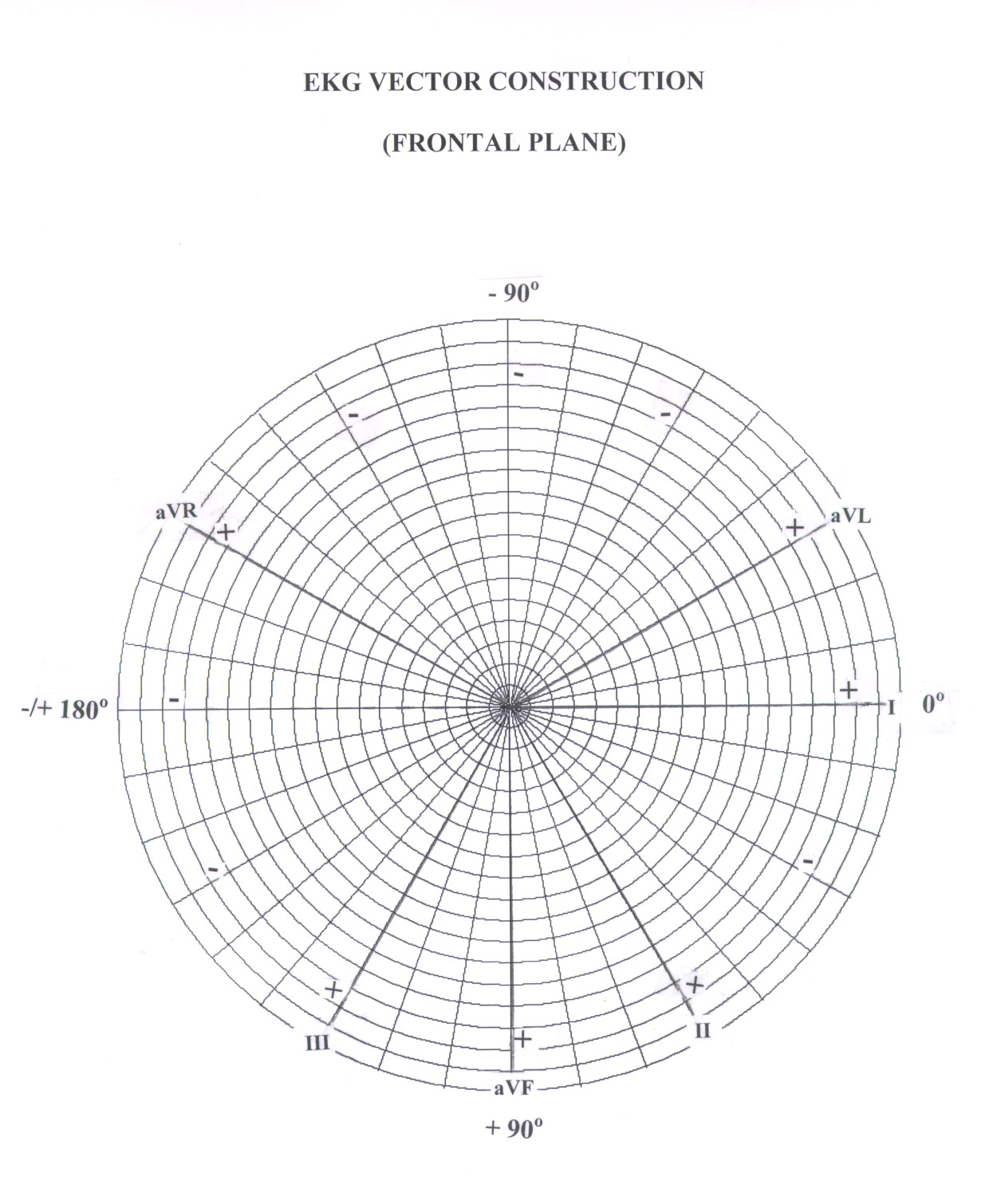
Identify P, QRS and T in each lead. Use a stethoscope to listen to the heart sound at the apex. What is the relationship between electrocardiographic waves and the heart sounds? With the use of Einthoven's triangle, determine the direction of the QRS axis from the means QRS amplitudes in leads I and III. Knowing the paper speed (25 mm/sec; 1mm = 0.0 sec), measure and calculate the following parameters from lead II:
R-R interval = mm
Ventricular rate = 25x60/R-R = /min
PR interval = sec.
QRS duration = sec.
QT interval = sec.