| Microcirculation and Transcapillary Transport |
|---|
| |

|
- Poiseuille-Hagen Law: R = 8ηL/Nπr4
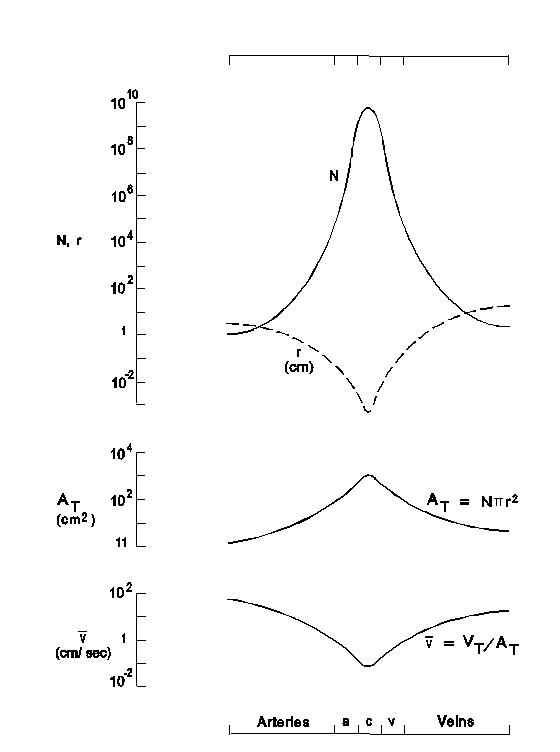
- From aorta to capillaries, L decreases to 10-4, N increases to 109, r decreases to 10-3; there is an overall reduction of R from the geometric factors.
|
| |
|
- Compare the number, radius, cross-sectional area, and blood flow of blood vessels.
- The linear velocity of blood is lowest in the capillary because of its largest total cross-sectional area.
|
| |
|
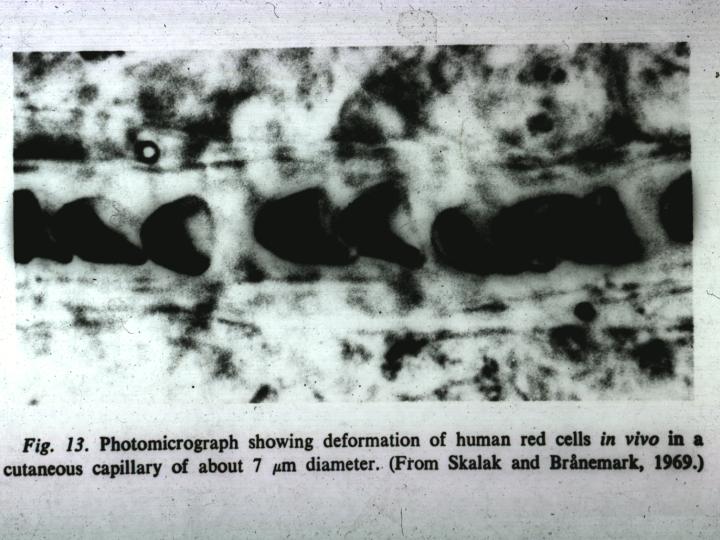
- In microvessels, blood viscosity (η) is lower than that in large vessels due to the following 3 reasons.
- RBC deforms like a parachute, keeping η low.
- The flow of plasma layer between RBC and endothelium makes η low.
- The transit time of RBC is shorter than that of plasma; the microvessel hematocrit is lower than that of large vessel (some microvessel hematocrit can be as low as 10%); the low microvessel hematocrit makes η low.
- The low η together with the low R from the geometric factors makes total microvessel resistance very low.
|
| |
|
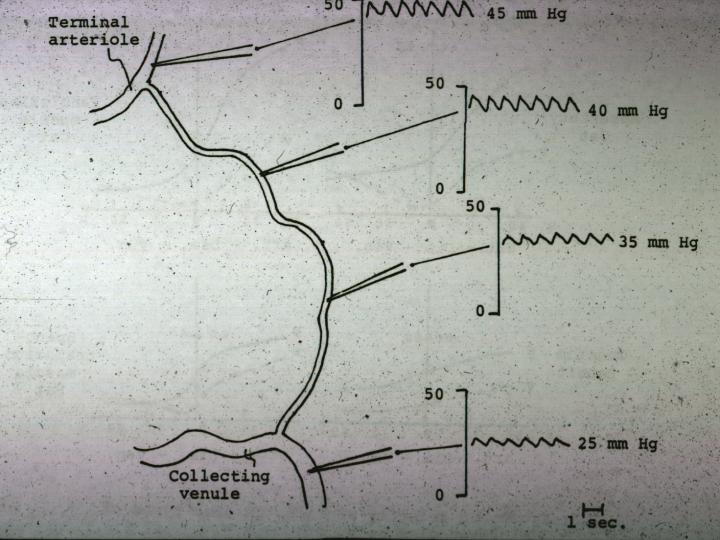
- The microvessel pressure and flow can be determined; the resistance calculated from the Poiseuille-Hagen Law is indeed low.
- Note that the pressures in microvessels remain pulsatile.
|
| |
|
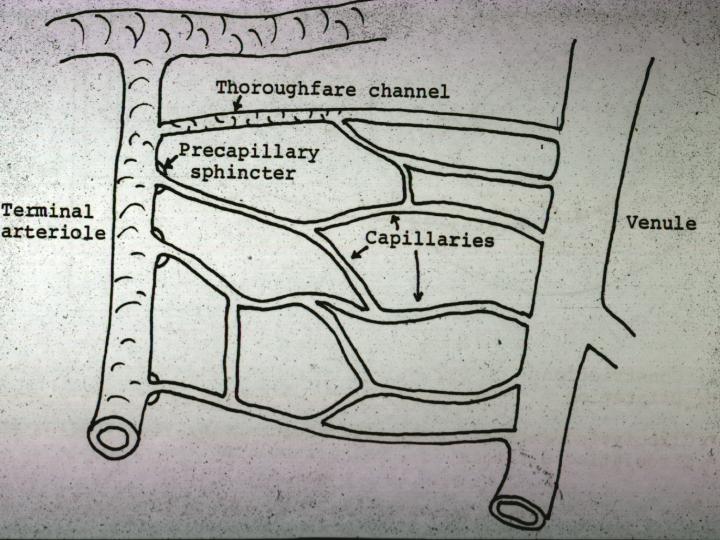
- Arterioles and venules have one layer of smooth muscle; capillaries do not have smooth muscle.
- The precapillary sphinctors determine how many capillaries open. When precapillary sphinctors relax, there are more capillaries open (recruitment phenomena).
- Note that there are no postcapillary sphinctors.
|
| |
|
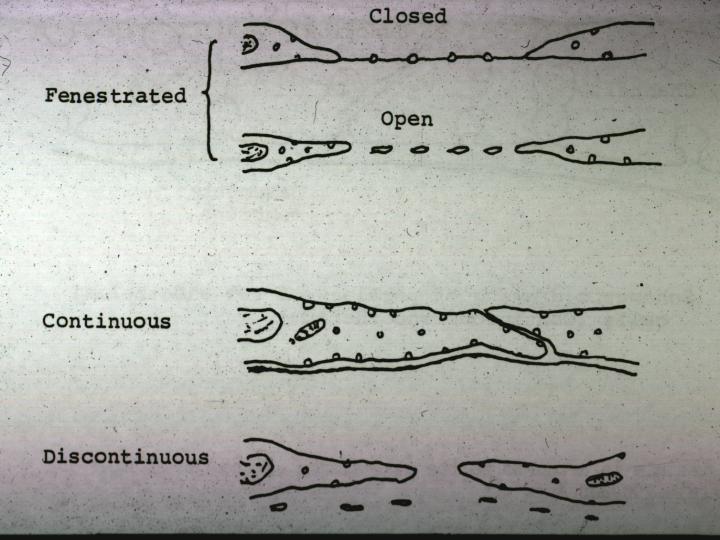
- The fenestrated and discontinuous capillaries can serve as the large pore system of transcapillary transport.
|
| |
|
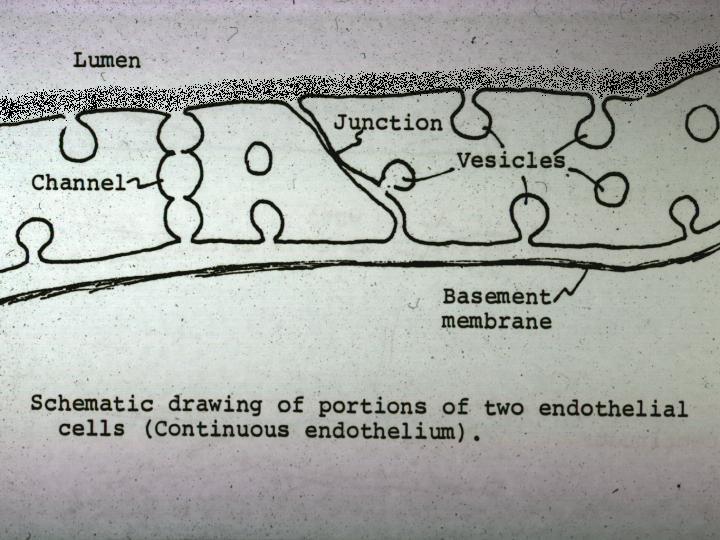
- The glycocalyx layer at lumen surface is now considered as the macromolecular sieve; the intercellular junction is considered as the barrier of water flow.
- The characteristic features of capillary are the plasmalemmal vesicles and the tight junction between endothelial cells.
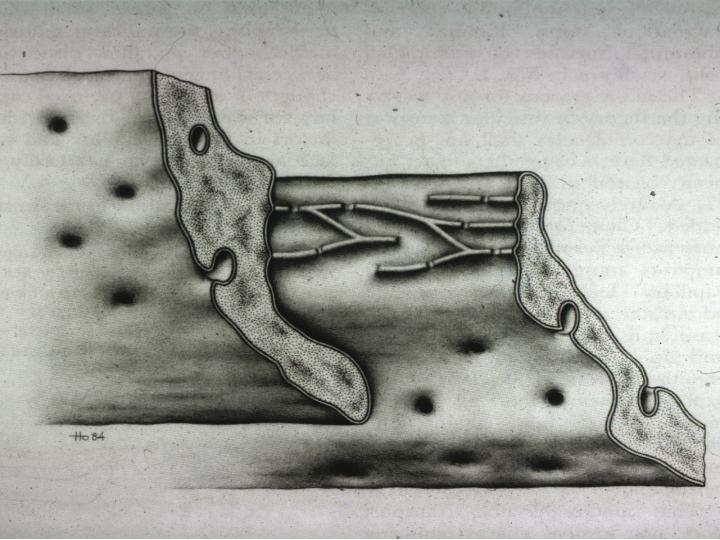
- Serial sectioning EM suggests that the vesicles are all connected to outside; they do not shuttle between the two surfaces. The tight junctions are not a real transport barrier; they are disrupted in the three dimensional view.
- When vesicles form channel, they can serve as a large pore system of transcapillary transport.
|
| |

|
- Serial sectioning EM suggests that free vesicles are conncected to outside. All vesicles are membrane invaginations.
|
| |
|
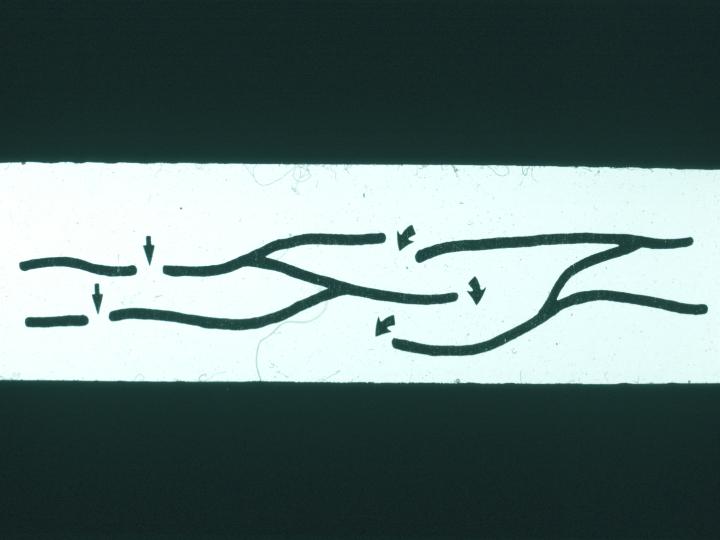
- The tight junctional strands are not continuous.
|
| |
|
- Water and small molecules up to the size of albumin can pass through the tortuous pathway.
|
| |
|
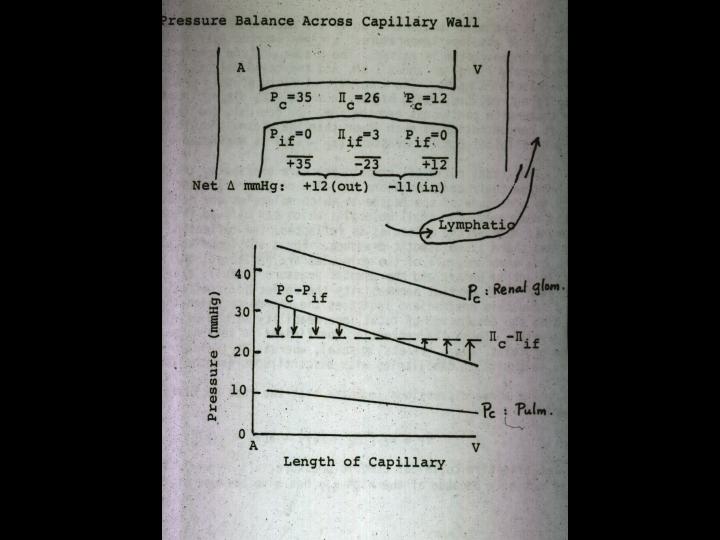
- Water flow (filtration/reabsorption) follows the Starling's hypothesis; the rate of filtration is:
Jv = Kf[(Pc-Pif) - σ(πc-πif)]
- Pc is high in renal glomeruli; Pc is low in lungs.
- Kf is determined by the permeability of intercellular junction; σ is determined by the integrity of the glycocalyx layer and the size of plasma proteins.
|
| |
|
- Moving of molecules together with water flow is called convection.
- Moving of molecules without water flow is called diffusion; according to the Fick's principle, the diffusion flux is: Q = D·A·(Δc)/d
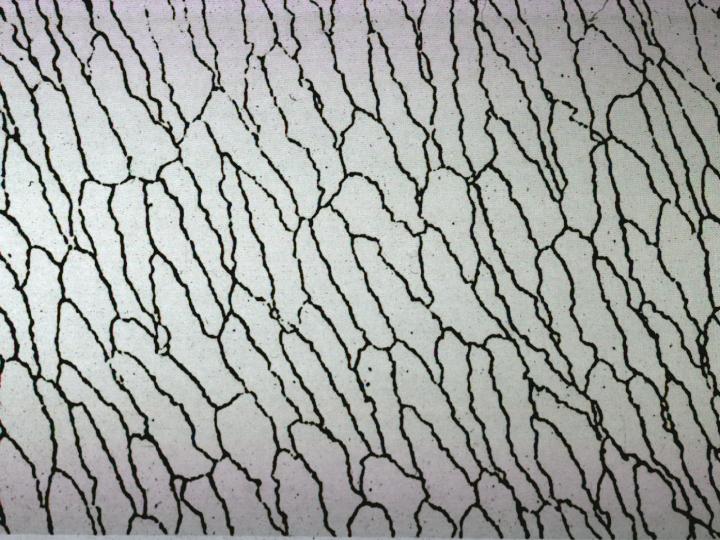
- The en face view of the lumen surface of endothelium stained with silver nitrate shows the relative magnitude of surface area that the entire surface is permeable to lipid soluble molecules; the small area of inercellular junction (0.1 to 1%) is permeable to water soluble molecules.
- The recruitment phenomena can markedly increase the area of transport.
|
| |
|
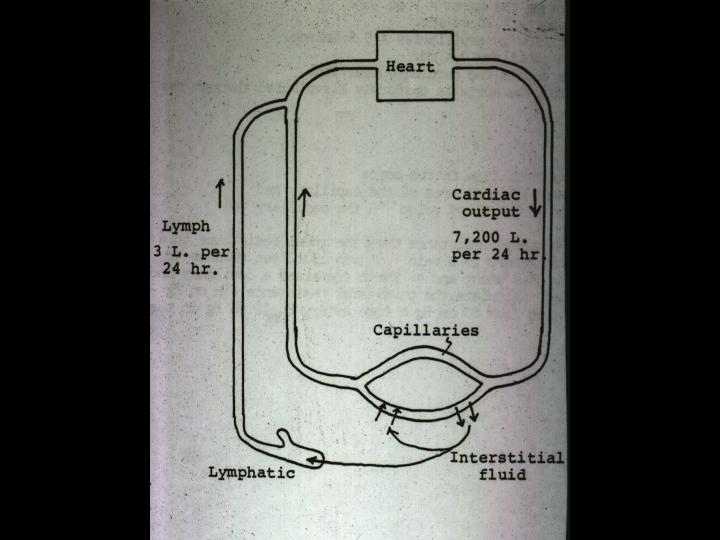
- The lymphatics endothelium is a discontinuous endothelium; lymphatics flow is facilitated by muscle pump and respiratory pump.
- By magnitude, the major pathway of transcapillary transport: 1) water: intercellular junction; 2) Water soluble molecules to the size of albumin: intercellular junction; 3) large molecules: fenestra, discontinuous junction, channels; 4) lipid soluble molecules: entire endothelial surface
- Edema results from: 1) increased Jv per Starling's hypothesis; 2) blockage of lymphatics; 3) dependent edema (body interstial space is connected; the interstial water can slowly flow to the lower part of body by gravity)
|
| |