| History of the City of New York - Field Trip 6Morningside Park, The Bronx and Yankee Stadium
|
| 
|
|
| History of the City of New York - Field Trip 6Morningside Park, The Bronx and Yankee Stadium
|
|
|
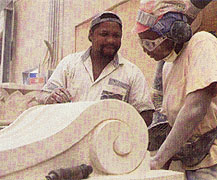 Stonecarvers at St. John the Divine |
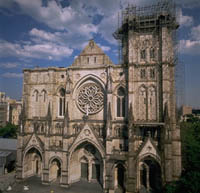
In the seventies, the Rev. James Parks Morton wanted to restart the building (which had stopped during WWII), and also help the poor in the community, so he set up a program to train unskilled workers to carve stone for the cathedral. People thought he was crazy, and that the skill taught was useless. As it turned out, the work at St. John's is still going on, and other cathedrals have also commissioned work from the laborers at St. John the Divine, for repairs and restorations.
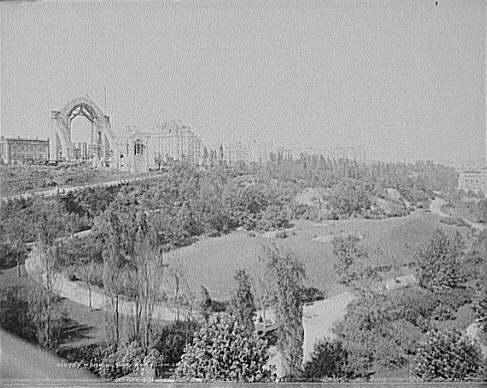 Morningside Park with St. John's constuction on the left |
The park deteriorated over the years, but in the 60's Columbia University unveiled a plan to build a gymnasium there. The gym was supposed to accomodate both Columbia students and people from the neighborhood. Unfortunately, the architects' plan had great state-of-the-art facilities for the students, but a small, underdeveloped sction on the bottom floor for the residents of Morningside Heights. Needless to say, the plan was not met with favor, and appears to have touched off the infamous riots in 1968. Since then, nothing has been done with the park, and it stayed a disreputable and unsafe place. Recently, however, Columbia started funding a volunteer project to help fix up the park, and it seems to be working. When we walked through to the subway, there were at least two soccer games going on, there was a clean pond with a man-made waterfall, and the park was generally pleasant. It still needs work, of course, but there seems to be hope.
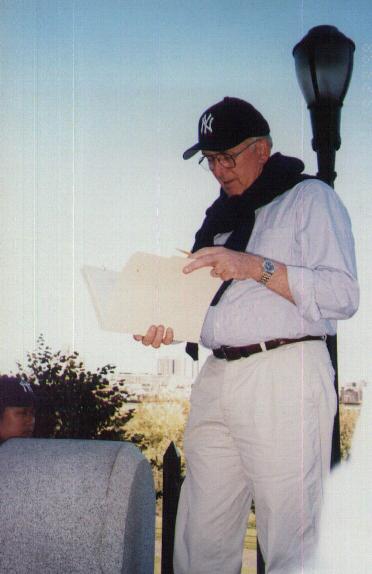 Prof. Jackson at the top of Morningside Park |
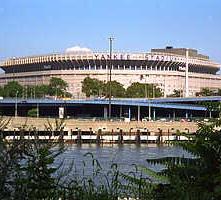
We continued down the Grand Concourse and discussed the various famous public schools, the transition from a predominantly Italian and Jewish neighborhood to an African-American and Hispanic one. Finally, we stopped in Joyce Kilmer (yes, the guy from the CU Bad Poetry Contest) Park and talked about the Yankees' (read: Steinbrenner's) desire for a new stadium. Basically, Yankee Stadium, with all of its history, doesn't have the modern money-making luxuries like Skyboxes, which can be rented for the season to companies, generating large profits. Also, the Bronx has a bad rep, and the owners think they can attract more fans in a better location. So far, there appear to be three options:
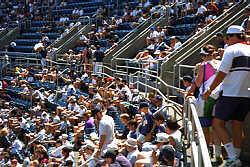 The stands at Yankee Stadium |
2) The team, in conjunction with NYC, will build a new stadium on the West Side of Manhattan.
3) Yankee Stadium can be leveled, and a new stadium can be built on the site, during which time the Yankees would play their home games in Shea Stadium in Flushing.
The questions that arise are: how will a move affect the economy of the Bronx? Are there a lot of people in the borough who derive their income from the team's presence? Also, how important is it to the city to keep the team in New York, realizing that games (specifically the post-season) may bring tourists who spend money on NYC food, hotels, and other items? Last is the sentimental issue. Yankee Stadium is "The House that Ruth Built," home of one of the greatest teams in baseball history, a team which single-handedly revived the game of baseball in the United States. How could the Yankees play anywhere else? How could they be anything but "The Bronx Bombers?"
During our free time before the game, we found a great little souvenir shop next to the Associated supermarket around the corner from the stadium. They have all of the hats for two-thirds to half the price of the other vendors, and they have lots of other accessories as well, like sunglasses, cards, and other items. Definitely worth checking out.

The field at Yankee Stadium |
by David Sanders
For a full recap of the game from CNN/SI click here.
A 360-degree interactive photo of Yankee Stadium
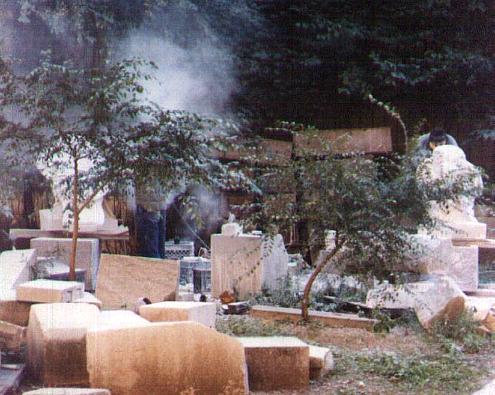 Stonecarvers at work (behind trees) |
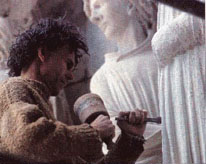 Detailed work on a statue |


Main Page || Course Requirements || Syllabus || Trip Summaries || NYC Links