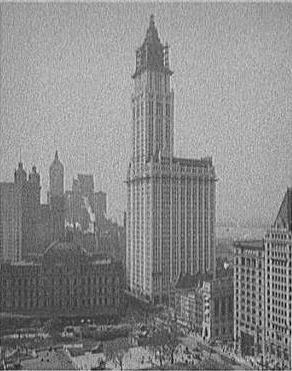
The Woolworth Building
|
The Woolworth Building |
The Woolworth Building, further down Broadway, was built in 1913 by five and dime magnate F.W. Woolworth. He paid cash for it. The President of the United States threw the switch to turn on the lights. Carved into the lobby's vaulted celing are two funny little statues: one is of Woolworth holding bags of money and the other is of the architect Cass Gilbert. The Building is nicknamed "The Cathedral of Commerce."
Across the street is City Hall Park, once the site of a Victorian-style post office. City Hall, just north of the park, was constructed between 1803 and 1812. President Lincoln lay in state there. Cheaper stone was used for the Back of City Hall because they ran out of money. It was on the edge of town, so they thought no one would ever see that side of the building anyway. A statue of the hero Nathan Hale, an American spy
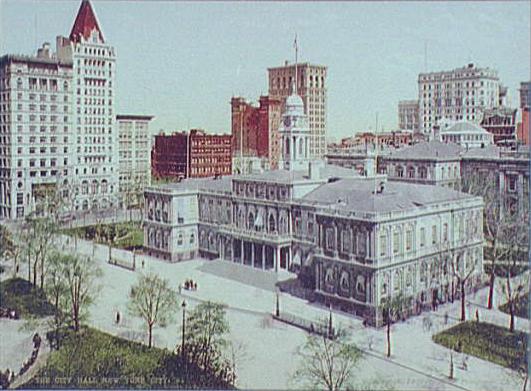 City Hall and its park c.1900 |
Next we visited the Tweed Courthouse, behind City Hall. Tweed and his cronies diverted the money allocated for building it into their own pockets. Tweed later died in jail, although he was never actually convicted. We were permitted inside the rotunda. It is now used to ouse city offices.
I missed part of the tour because I ran into an old friend across from the Municipal Building, where a friend of mine recently went to get married. Vendors stand outside the front entrance in case a passing bride needs a last minute bouquet.
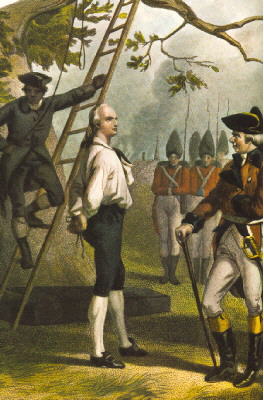 Nathan Hale's execution |
Finally, we walked through Little Italy, trying to locate the site of the Ravenite Social Club on Mulberry Street, former hangout of John Gotti. We stopped at the Old St. Patrick's Cathedral, built in 1809. From the 1830's to the 1850's it was the target of anti-Catholic riots. The parishoners there were mostly Irish. There are catacombs under the church. The first parochial school was started across the street on Prince and Mott. On Hester St. we saw an old rear tenement house from the parking lot next door. These are now illegal because they prevent light and air from entering the apartments.
by Diane Raphael
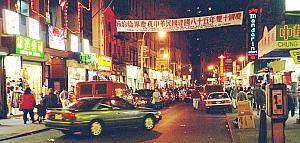 Chinatown at night
| 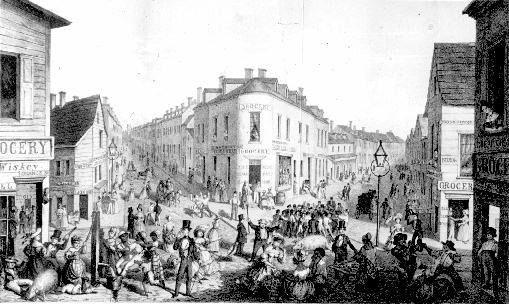 Five Points c.1827 |