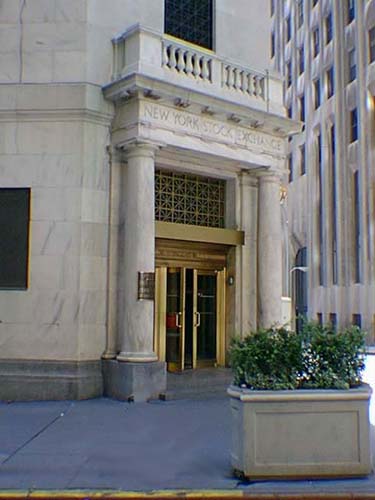
The NY Stock Exchange
Financial District
|
The NY Stock Exchange |
The Museum's current exhibition is on the Empire State Building. "Building the Empire State" has documents from the original project, pictures of the construction, and a movie. Before we started touring the hall which contains the Museum, Ms. Willis spoke to us and gave us some background. It was clear that she was an expert, because she talked very quickly for at least twenty minutes, and I could tell she had a lot more to say.
We learned a lot about the Empire State Building. For starters, it's 86 stories tall, and it took only 11 months to build! At its peak rate, construction was as fast as one story a day. Not only that, but it was under budget as well. The speed of construction was necessary because back in the twenties and thirties, May 31 was "Moving Day," when all the leases for the following year were signed. If you had a lot, and your construction wasn't finished by May 31, you'd lose a whole year's rent. The Empire State Building was built in 1931, in the middle of the Great Depression, which made this feat even more spectacular. It could never happen today, but the firm of Starret Brothers and Eken excelled at organization, and was also not hampered by bureacracy, unions, and safety measures. This does not mean that the ESB was unsafe: contrary to the popular notion that one person dies for every story built, only five people died during the construction of the ESB.
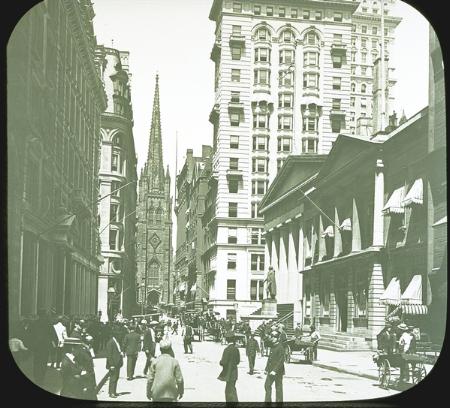 Turn-of-the-Century Wall Street |
Other facts about the ESB: It was the tallest building in the world from 1931 to 1971. At 1250 feet, it surpassed the Chrysler Building by 200 feet and the Manhattan Company Building at 40 Wall Street, the third tallest, by more than 300 feet. Its five-story base covered two acres and its eighty-five floors of offices boasted more rental space (2.25 million square feet) than the Chrysler Building and 40 Wall Street combined. At peak activity, 3,500 workers were employed on site.
What made the ESB possible was the new steel-frame method of construction. Instead of the old way, using masonry to build the walls, steel girders were riveted into a giant frame which supported the entire weight of the building. This allowed higher buildings to be built, and more and larger windows on the upper floors. It also kept the wall thickness relatively equal on all floors, unlike a masonry building, in which the walls got thicker as the tower rose. With this new technology, it seems strange that the ESB isn't a wider tower. This is due to the 1916 zoning law, designed to allow more light and air onto the street, that required a large setback at the sixth floor, and further setbacks on the way up the tower following a hypotenuse at a designated angle. In addition, the law only allowed towers above a certain height to have cross-sectional areas up to one-quarter of the total lot area.
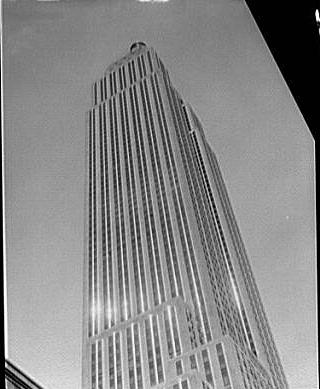 The Empire State Building c.1933 |
One of the most interesting parts of the museum was the section on the riveting gangs. The job of the riveters was to fasten all of the steel I-beams together. One worker would heat the rivets in a large bowl until they were white-hot. Then he would choose one and fling it as much as 30 feet to another man, who caught it in a special steel funnel. The rivet was then placed in the appropriate hole and pounded in, while on the other side, a tool shaped the outcoming end into a rounded top. The rivet welded itself into the girder, and then cooled.
After we finished touring the museum, we walked around the corner onto the street with the Equitable Building, which precipitated the zoning law of 1916 by blocking all of the light on the street beside it. We continued on to Trinity Church. Trinity was one of the largest landowners in NYC, an donated the land for the original Columbia University. Most of the land has been sold off since then. After a quick tour inside we went into the cemetery and looked for famous people's graves. (Actually, I didn't enter the Church, but I found some great deal on books and comics across the street at some vendors' tables.) We saw the graves of Robert Fulton, Alexander Hamilton, and other interesting historical personas. It was a fascinating trip.
By David Sanders
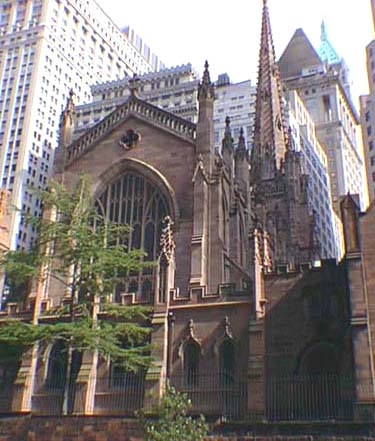 Trinity Church
|  Trinity Churchyard Map (172Kb) |
Main Page || Course Requirements || Syllabus || Trip Summaries || NYC Links