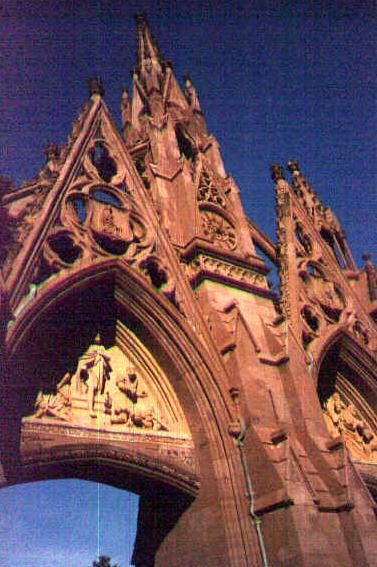
Close-up of the gate
Greenwood Cemetery
|
Close-up of the gate |
In 1800, cemeteries in the city were in terrible conditions. Each church had a cemetery; below City Hall Park alone were 33 of them. Finally, the city passes an ordinance forbidding any more burials on the island of Manhattan. Henry Pierpont had the idea to put a cemetery in Brooklyn, so in 1838 he began buying property from a farmer. Greenwood cemetery opened in 1840, but for the first few years no one came. One idea was to use the cemetery for picnics, but even though this was before both Prospect and Central Parks, people still didn't use Greenwood. The turning point in Greenwood's popularity was the death of NY Governor, Senator, and Mayor DeWitt Clinton. The proprietors of the cemetery managed to convince Clinton's widow to bury the great statesman in Greenwood by promising to erect a great memorial to him. She agreed, and the cemetery took off. Today, there are over 600,000 people buried there, among them 56 Union generals, and the second highest number of politicians in the country.
The cemetery covers 478 acres, and used to have seven lakes and 30 miles of footpaths. Some of those have now been filled in. Greenwood was a huge tourist attraction, second only to Niagra Falls. Lots of postcards showed places in Greenwood cemetery. As we walked along, Cashman pointed out various graves and memorials. We saw a tremendous amount, and it was only one of five tours he gives of Greenwood, and each of them is different! Some of the memorials we saw were:
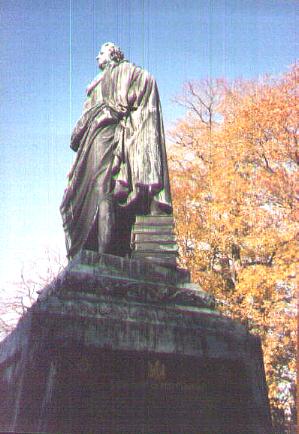 DeWitt Clinton's memorial |
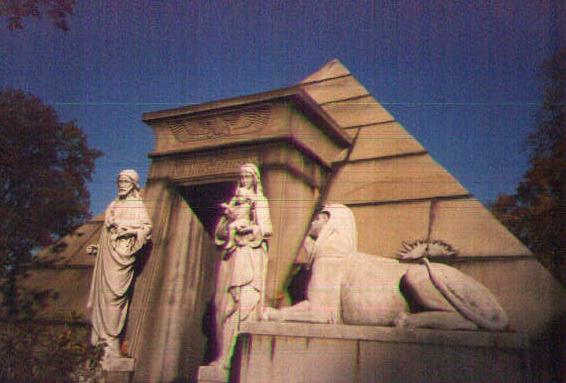 The Pyramid tomb |
Francis Ward's monument, a little boy of limestone, was sculpted by Daniel Chester French, designer of the Lincoln Memorial and "The Minuteman." Greenwood has four types of burials: cremation, regular casket, mausoleums, and underground crypts, some with glass domes. Edwin Christie, writer of "Oh Susannah," "Camptown Races," "Beautiful Dreamer," and leader of the "Christie Minstrels" has one. He went insane and jumped out of a second-floor window.
There is a large mausoleum for tobacconist John Anderson. Anderson used his money to finance the Italian patriot Garibaldi. He also gave the governor of NY $600 to buy shoes for soldiers. There are 14 Medal of Honor winners buried in Greenwood. Anderson gave money for one of their monuments. The cemetery was open to all, but is populated primarily with WASPs, because Catholics and Jews used their own cemeteries.
Frederick Augustus Otto (F.A.O.) Schwarz and his family are there, as are Barney Williams, the Irish comic who was Lincoln's favorite performer, and Van Ness-Parsons. Van-Ness Parsons was a pianist, and the author of "New Light from the Pyramids," a best-seller. His tomb is a pyramid and has lots of Egyptian symbols, interspersed with statues of Jesus, the Madonna with Child and a Sphinx.
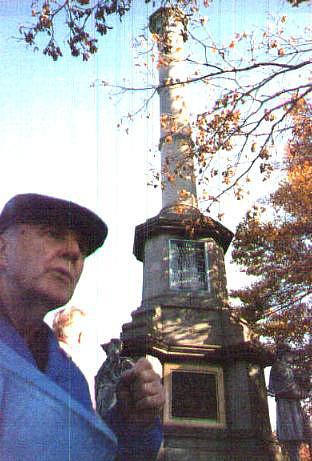 Cashman and the CW monument |
On the highest point in the cemetery (also in Brooklyn) is a giant pillar and monument to Civil War soldiers from New York City - all 148,000 of them. The relief panels on the column's base show the story of the soldier: leaving home, going to battle, getting wounded. The statues of soldiers around the base used to have swords or guns but they fell apart.
A few meters from the Civil War Memorial is the "Altar to Liberty," in honor and memory of the Battle of Long Island in the Revolutionary War. The altar was erected by Higgins, the inventor of India ink. It is commonly held that the first engagement of that battle was on or very near the site of the altar. The memorial comprises a statue of Athena holding a wreath over a low altar. During the battle, two hundred soldiers from Maryland died to allow Washington and the rest of the Continental Army to escape. Every year since 1920, Marylanders have traveled up to Greenwood, where they hold a ceremony to commemorate the sacrifice of their countrymen. The statue of Athena is on a direct line-of-sight to the Statue of Liberty.
We stopped at Leonard Bernstein, whose footstone had a few rocks placed on it. It is a Jewish custom to palce small stones on the grave of someone you visit. We saw a memorial which had a plaque to Robert Douglas Spedden, a little boy who became something of a celebrity when he (and his stuffed polar bear doll) survived the Titanic. Unfortunately, he was also one of the first children killed in a car accident. We stood on a hill and saw the graves of Ebinger of Ebinger's bakery (which Cashman remembers with fondness) and Ebbets of Ebbets' Field, home of the Brooklyn Dodgers.
Other people we saw:
The tour is very fast-paced. It's sometimes hard to keep up with Cashman, because there's so much to see. Cashman like to quiz visitors on history, usually on obscure people. Most people don't know the answers. He says no one learns history anymore. Maybe history really is for losers!
Our last stop was the chapel, which was built over a filled-in lake. It was built in 1911 as a replica of Christchurch in Oxford by the same architects who designed Grand Central Station. It was needed when Greenwood was a popular cemetery, but it was closed in the seventies. Now it's being renovated. There is also an underground receiving hall that could hold 1400. It was used when the ground was too cold to break. The bodies were then buried in the spring. People used to come from all over the country to be buried in Greenwood Cemetery. The pace has slacked off somewhat, but it's always an amazing place to visit. There are four other tours to take with John Cashman, and they're definitely worth it.
By David Sanders