ChE E3820y: POWER CONSUMPTION AND EFFICIENCY IN LIQUID MIXING (MIX)
A. SAFETY
1. Wear safety glasses at all times.
2. Wear jeans or slacks, a long sleeved shirt, and sturdy shoes that give good traction on possibly wet floors.
3. Guard against electrical hazards by making sure that all equipment is well grounded using three-wire plugs and other means.
4. Guard against falls, burns, cuts, and other physical hazards.
5. THINK FIRST OF SAFETY IN ANY ACTION YOU TAKE. If not certain, ask the TA or a faculty member before you act.
6. The materials used in this experiment, namely water, corn syrup, and potassium or ammonium chloride, pose no unusual safety problems.
B. OVERVIEW
The goals in carrying out this experiment are:
- To determine the torque (and power consumption) as a function of impeller speed for water and then for corn syrup in several cylindrical vessels of different sizes, to find the effect of baffles, impeller design, and tank diameter on torque and power, and to compare the results with correlations from the literature. You are to use two geometrically similar six-bladed turbines in tanks of appropriate size and to compae observed torques from those predicted from the correlation for six-bladed turbines by Rushton, reported in McCabe, Smith and Harriott, edition 4. The correlation is reproduced below.
- To determine mixing time in a baffled and in an unbaffled vessel filled with water, as a function of impeller speed and dimensions and baffle location, by using a tracer injection and dispersion method.
C. SCENARIO
SLACIMEHC Chemicals is moving into the production, in batch and semi-batch reactors, of several new products. It has become necessary to specify to vendors the size of the reactor vessels, the diameter and design of the impellers, the design of the baffles, and the power of the stirrer motors. Your group has been tasked to set up a pilot plant and gather both data on the efficiency of mixing and the concomitant power consumption for mixing blades that are either turbine blades or propellers. It is well known that geometrically similar systems should exhibit the same power number at a given Reynolds number in the absence of vortexing, but, nonetheless, you have been asked to verify this fact with the two six-bladed turbines. Your group has also been asked to test a novel method, based on the injection of a tracer, to measure the efficiency of mixing.
D. APPARATUS
The agitation and mixing apparatus is shown in the attached schematic diagram. The major components are as follows:
Tanks
Two small polycarbonate tanks with removable baffles, and volume of 4 L. One is filled with water and the other with Karo corn syrup. A third, larger tank, whose dimensions you should measure and record, also equipped with removable baffles, filled with 20 L of water.
Power Consumption Equipment
An electrically driven shaft can be equipped with several different impellers, including turbines, with flat blades, and propellers with pitched blades. A control knob allows the stirring speed to be set in the range of 0 to 3000 RPM, less if the maximum torque of the power supply is reached at a lower speed. A dial indicates the approximate speed, and a second dial indicates the torque. The key factors that allow power consumption to be measured in this system are:
The tank is mounted on a "torque table" whose support bearing is nearly frictionless. Thus any torque furnished to the tank by the fluid rotating within it can be determined by measuring the opposite torque needed to keep the table from rotating.
At steady state, the torque furnished to the fluid by the turbine or propeller must equal the torque furnished to the tank by the fluid.
Power consumption is the product of torque and angular velocity. Thus knowing the torque and the rate of rotation of the turbine or impeller allows rigorous determination of power consumption by the fluid.
Torque is measured by ascertaining the force that must be applied at the end of a known moment arm to hold the torque table stationary. Force ´
moment arm = torque. Note that the moment arm is a radius of the torque table and the length of this radius is the numerical value of the moment arm. The length of any connector perpendicular to the radius is immaterial.
Special notes: The torque table is prevented from turning over a large radius by restraining pins. The force measurement must be made when the table is not in contact with these pins. The force is measured by recording the value of a weight on an electronic balance, both when no torque is applied from the propeller and when finite torque is applied from the propeller. The equipment is arranged so that propeller motion will tend to lift the weight and decrease the fraction of its mass supported by the balance. The difference in recorded weights (read in mass units) multiplied by g is the force that, when multiplied by the moment arm, serves to balance the torque from the propeller. To obtain reliable results, skillful adjustment of the force measuring system is necessary.
Tracer Injection and Response Equipment
A 10 ml syringe is used to inject a KCl solution onto a horizontal plate mounted just below the water surface of the 20 L tank. A conductivity cell is mounted at the end of a stainless rod that extends to a point 1 inch above the bottom of the tank. The location of the cell with respect to the baffle(s) and the impeller can be varied. The cell is connected to a conductivity meter (YSI) which sends a signal to an A/D board in a computer. The computer acquires conductivity data at a rate of 20 points per second and plots the conductivity as a function of time. The data may be fitted to a computer-based model, described below, from which the propeller "pumping rate" can be estimated. Tank volume divided by pumping rate is taken to be a reasonable estimate of mixing time.
E. THEORY
Power Consumption
We will base the calculations on the plots in McCabe, Smith, and Harriot (Figs. 9-13 and 9-14 in the Fourth Edition, in which the power number Np is plotted against the Reynold's number NRe, for six-bladed turbines and three-bladed propellers).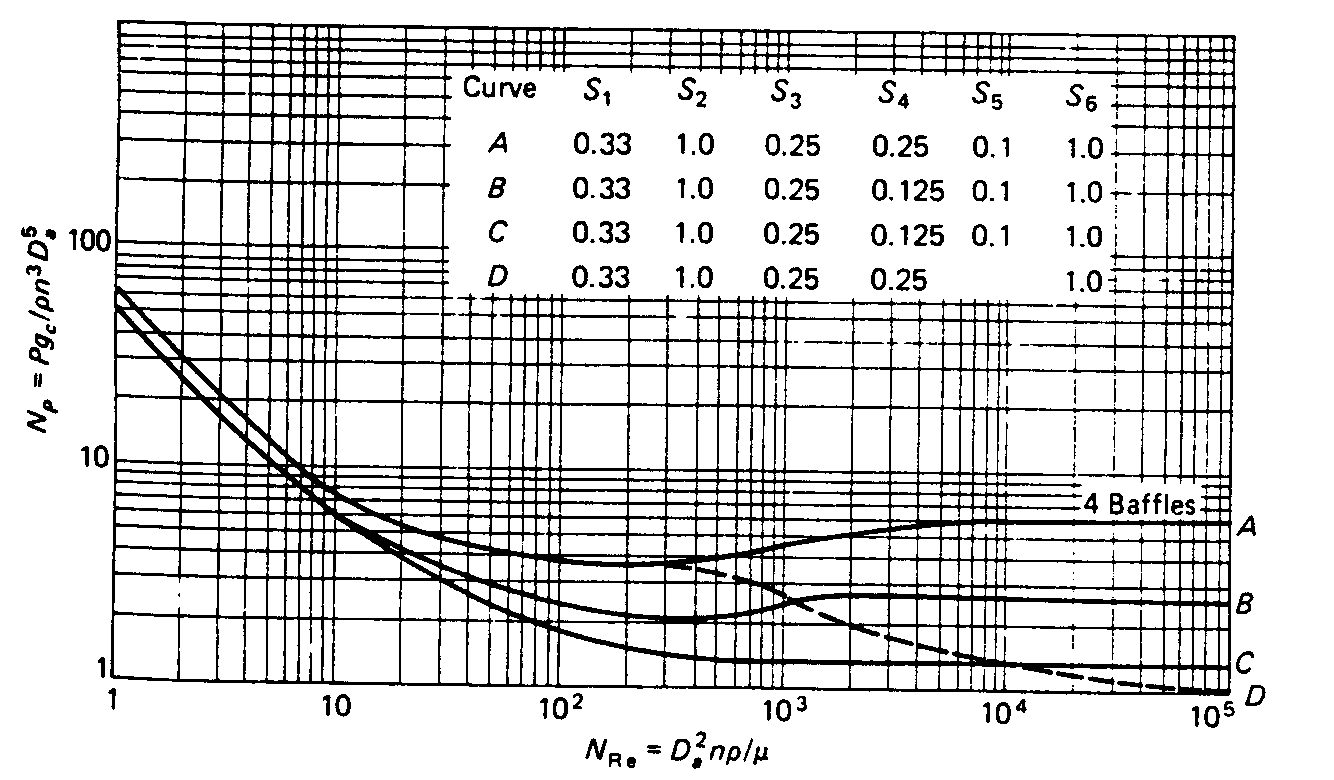 For a given run the Reynold's number will be calculated from the stirring speed, impeller diameter, and liquid viscosity. The graph will be used to find the power number, and from the power number the torque will be determined and compared with the observed torque. It will be necessary to check the dimensionless ratios on which the chart is based versus those prescribed by available equipment or fixed by the way you set up the experiment. Some important dimensions are shown in the picture below, also taken from McCabe, Smith, and Harriott.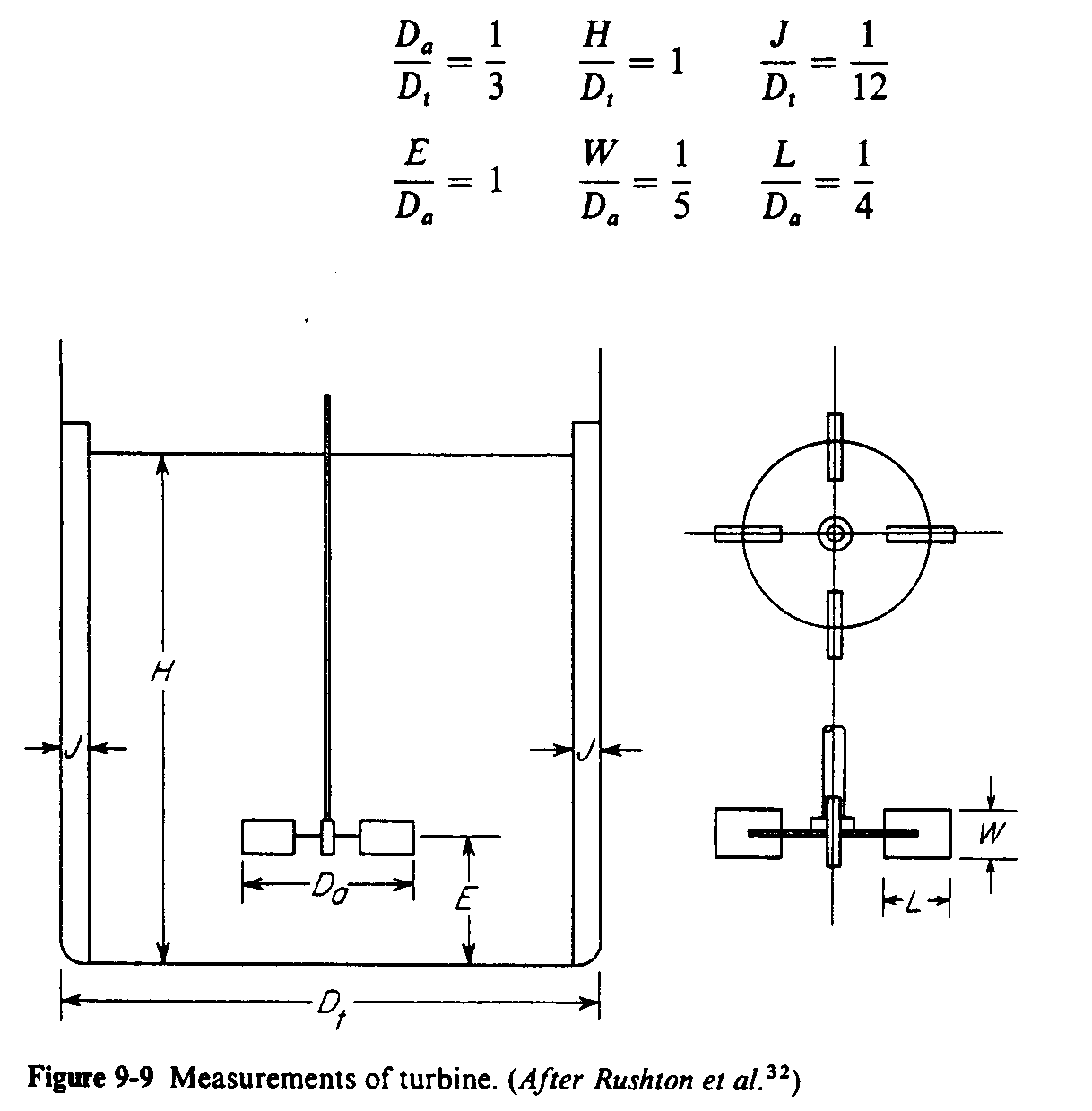
Sample Calculation
We begin with
v = viscosity = 2 cp = 0.002 Pa-s (water)
Da = impeller diameter = 0.08 m (six-bladed turbine)
n = speed = 5 s-1 (300 RPM)
Da = tank diameter = 0.3 m
d = density = 1000 kg/m3
gc = 1
baffle width = 0.03 cm
We find the Reynold's number to be
NRe = Da2 n d v-1 = (0.08)2 5 1000/0.002 = 16,000
From the graph in MaCabe, Smith, and Harriot we find
Np = P gc n-3 Da-5 d-1
and from Np we have the power P as
P = Np gc-1 n3 Da5 d = 2 Pi n T
Proceeding, the torque T is
T = Np gc-1 n2 Da5 d (2Pi)-1
T = 5 1 52 0.085 1000 (2 3.14159)-1 = 0.0652 N m
which can be compared to the observed value.
Mixing Time
Spencer has proposed a model for macroscopic mixing in a stirred vessel mixed by a propeller that has a pumping capacity, Q, (to be found). The system is considered strictly axisymmetric: the shaft is vertical and, while there may be angular velocities, their magnitude does not vary with angular position. There is no vortexing. The tank is regarded as divided into six cylindrical zones. Three of these zones are cylinders of equal size, the first representing the liquid near the axis of the tank in the top 1/3 of the liquid, the second representing the liquid near the axis of the tank in the middle 1/3 of the liquid, and the third representing the liquid near the axis of the tank in the bottom 1/3 of the liquid. The radii of these three cylinders are identical, but unknown. The three other fluid zones are cylindrical annuli whose inner radii match the outer radii of the cylinders just described and whose outer radii match the radius of the tank. Thus the fourth zone is an annulus in the bottom 1/3 of the tank, the fifth an annulus in the center 1/3 of the tank, and the sixth an annulus in the top 1/3 of the tank. Each zone is considered to be a well-mixed volume and flow occurs loop-wise among them:
1 ®
2 ®
3 ®
4 ®
5 ®
6 ®
1, etc.
To illustrate the computer-aided acquisition and real-time processing of data, Spencer has implemented this model on the computer that acquires the conductivity transients. The data may be fit to estimate both the flow induced by the impeller and the fraction of the tank volume that is in (central) down-flow versus that in (peripheral) upflow. (These flows must be equal, since this is a condition for the fluid remaining in the tank.) Spencer proposes that the mixing time be reported as the flowrate found, divided into the liquid volume of the tank. You may report mixing time as such, and also reflect on whether it is a proper measure of mixing time. The figure below is computed from Spencer's model using a simulation program (VisSim32). It shows how the conductivity pulse travels around the loop and how the tank concentration finally settles to a uniform value (here equal to 0.167 since a unit amount of material was delivered to six volumes). In your discussion of this part of the experiment consider what benefit is obtained from the curve fitting
versus just looking at the conductivity curve until it is seen to go "flat".
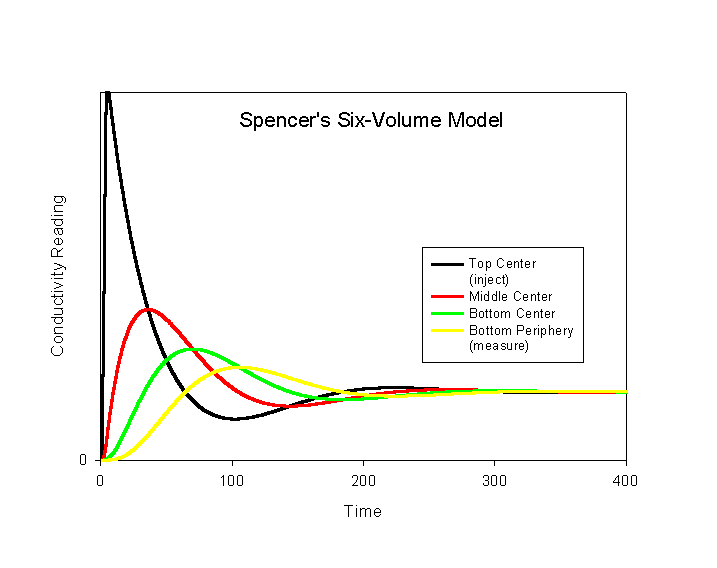
Appended to these instructions are notes provided by Prof. Spencer on how the curve-fitting is done in his program.
F. PROCEDURE
Given a tank, impeller, baffles and liquid (water or corn syrup) we will vary the shaft speed and measure the torque. This will be done using a large and then a small tank, and with and without baffles. From these we will calculate Np and Nre, and check Np vs. the value taken from the plot. Then we will run corn syrup and use the plot to calculate the viscosity. We will also determine the effect of baffles vs. no baffles on the torque and mixing efficiency as determined by the tracer injection method.
1. Fill the 4 L tank with water and remove the baffles. Mount the 4-bladed, flat-bladed impeller on the mixer shaft. The mixer shaft position is a fixed reference point in the horizontal plane. Center the torque table directly beneath the shaft. Center the tank on the torque table. The impeller should be located vertically so that it is halfway between the tank bottom and the water surface. Set the rotation direction to clockwise (CW). Increase the stirring speed slowly until a vortex forms that pulls air into the tank. This is the maximum speed for this configuration. Set the speed at zero and record the torque reading (which may not be zero). Then run at 10 speeds evenly spaced between 0 and the maximum speed, and record the torque reading at each speed. Repeat using other impellers and rotation senses. Convert the torque reading to torque (in N m) using the calibration data below.
2. Repeat the procedure above with baffles inserted in the tank, using water.
3. Repeat steps 1 and 2 using corn syrup. The maximum speed may be limited by the power available.
4. Repeat steps 1 and 2 using the 20 L tank filled with water.
5. Mount the 4-bladed flat-bladed impeller and insert in middle of the 20 L tank filled to the mark with tap water. Mount the conductivity transducer 1 inch above the tank bottom and 1 inch from the tank wall, connect to the conductivity meter, connect the meter to the computer, and load and start the QuickBASIC program for agitation data acquisition. Remove the baffle(s) from the tank. Set the speed at 20% of the speed that produces air ingestion. Inject 10 ml of KCl solution onto the plate at the top of the tank, at the same time starting the data acquisition program. Make 5 additional injections under the same conditions. The tank will now contain a dilute solution of KCl. Empty the tank and refill with tap water. Set the speed at 80% of the maximum speed and make an additional 6 runs. For each run record the torque reading.
6. Repeat the 12 runs of step 5 with baffles inserted in the tank.
7. If time permits, repeat some of the runs of steps 5 and 6 using the propeller, driving fluid in the upward and then downward direction.
F. REPORT
The report should describe concisely the goals of the work, what was done, and the results and conclusions. The raw data should appear in an Appendix, and plots of torque and power vs. stirring speed should be presented and discussed in the body of the report. The effect of viscosity, baffles, impeller design should be discussed, and the power consumption should be compared with correlations from the literature (McCabe, Smith and Harriot).
Specifically, does the torque as a function of stirring speed follow the prediction of theory? And, how close is the observed power to that predicted by the correlation?
Plots of tracer concentration as a function of time should also be presented, and the effect of impeller type, baffles, and stirring speed on the tracer concentration vs. time curves should also be discussed.
G. REFERENCES
1. McCabe, W.L., J.C. Smith and P. Harriot, "Unit Operations of Chemical Engineering," Fourth Edition, McGraw-Hill, New York, 1985.
H. COMMENTS
1. One way to derive a quantitative measure of mixing speed is to fit a single exponential to the (suitably processed) tracer response data, and use the time constant of the exponential as a measure of mixing efficiency. This method does not, however, make full use of the information contained in the tracer response curve, which usually exhibits one or two peaks before reaching a steady value. (Fitting two exponentials is also possible, as is fitting a specially selected function of time that matches the shape of the observed curves.)
2. Emptying and refilling the 20 L tank will be done using a special drain connection and a filling line, to avoid lifting the heavy water-filled tank.
3. The viscosity of Karo corn syrup can be found from the manufacturer, or measured using a viscometer (preferable). At high Reynold's numbers viscosity does not have a major effect on torque. But impeller diameter is a very important variable, and its effect should be determined experimentally. That is, two geometrically similar impellers of significantly different size should be used.
4. In the tracer runs the presence of a baffle is expected to disrupt the vortex, move tracer to the bottom of the tank rapidly, and lead to much more rapid mixing. When a vortex is present the tracer response will tend to show several pronounced peaks, as a slug of tracer moves around the tank without instant dissipation.
5. It is useful to distinguish between agitation and mixing (see McCabe et al.).
6. If time permitted, it would be interesting to see how conductivity cell location affects the tracer response data.
7. The torque meter can be calibrated using the torque table, with weights used to generate the force. This can be done by the TA or by the students.
8. The viscosity of corn syrup can be found from the flow rate through a tube for a given pressure drop, if laminar flow obtains.
I. Appendices
PARAMETER ESTIMATION NOTES
The well-known Gauss-Newton method is used to iteratively find the best (least-squares) values of the parameters. The procedure is as follows, for NX data points and NP parameters to be estimated:
1. Let b1 and b2 be the current parameter values. Integrate the differential equations of the model to produce the NX-vector y, which corresponds to the NX-vector y* of measured values which are to be fitted.
2. Form the residual NX-vector r = y* - y.
3. Integrate the model equations again using parameter values b1 + deltb1 and b2 to produce vector y1.
4. Integrate the model equations again using parameter values b1 and b2 + deltb2 to produce vector y2.
5. Form the NX x NP (here NP = 2) matrix B. The first column of B is (y1 - y)/deltb1 and the second column of B is (y2 - y)/deltb2. B approximates the matrix dy/db.
6. Form the NP x NP matrix BTB and the NP-vector BTr, where T denotes transpose.
7. Use the Gauss-Jordan reduction or other method to find (BTB) -1.
8. Find the parameter increment vector db by solving the normal equations BTB db = BTr, or by evaluating db = (BTB) -1 BTr.
9. If the sum-of-squared residuals S = rTr has not decreased by more than say 1 percent in the last five iterations, and if BTr is quite small, declare the process converged and accept b1 and b2 as the best parameter values.
10. Otherwise choose a step size, beta, and update the parameters using b1 = b1 + beta db1 b2 = b2 + beta db2 with beta typically 0.1, 0.5, or 1.0; small beta tends to produce slow but certain convergence. Then go to Step 1.
11. If s2 is the variance of the measurements, then V = s2 (BTB)-1 is the variance-covariance matrix for the parameter estimates, and the 95% confidence limit for the kth parameter is approximately 3 sqrt(Vkk). The process detailed above works for any number of parameters and experimental data points, failing only when BTB approaches being singular. The coding in the agitation experiment program implements the above method using BASIC.