March 29, 1999
Biomedical Engineering E4502y
Midterm Examination. Solution
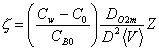
1. (25 pts total) In Lightfoot zero-order theory, the quantity z is defined by the following equation.
a. (3) What are the dimensions of this quantity in m-l-t units? (Example: the dimensions of acceleration are l-t-2.)
The quantity is dimensionless. This can be checked by evaluating the units. (Write the m-l-t units of each quantity on the right hand side and cancel, leaving no net units.) Or you can recognize that the unit is a dimensionless length ratio, by definition.
b. (4) The central purpose of the Lightfoot derivation is to find a relationship between z and another variable, termed h . What are the dimensions of h and what is the physical interpretation of h ? (Interpretation means what quantity does h represent in the dimensional, physical world?)
This quantity is also dimensionless. The only correct interpretation is that h is a particular value of the dimensionless transverse (in cylindrical coordinates, radial) distance where the interface between unoxygenated and oxygenated hemoglobin is located. The general (not particular) dimensionless radius was termed p by Lightfoot.
A test oxygenator consists of a single hollow fiber. The oxygen tension (partial pressure) of the entering blood is zero. For this (cylindrical) geometry, Lightfoot gives the relationship between z and h as:

If, under fixed conditions, all the blood entering this fiber can be oxygenated over a distance of 100 cm, i.e. the blood exiting the fiber at 100 cm has just become 100% saturated, then:
c. (9) At what distance, clearly less than 100 cm, will the unoxygenated core have a radius 50% of that of the fiber?
First use the fact that full oxygenation, which means h equals zero. occurs at Z equal to 100 cm. Looking at the relationship between z and h , note that z (h =0) = 3/32 = 0.09375. Evaluate z (0.5) and find 0.02655. Then use the ratio: 0.02655 / 0.09375 = Z(0.5)/100, finding that Z(0.5) = 28.32 cm.
d. (9) The fiber is cut so that blood flows out at the distance calculated in c. What will be the percent saturation of the blood leaving the shortened fiber? Remember that the blood is in laminar flow and the velocity profile is parabolic:
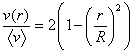
The inner circle (0<p<0.5) of the cross-section carries no oxygen. The annulus is 100% saturated. Because it is on the periphery, blood in the annulus moves slower than blood in the center. To know the composition of the mixture of saturated and unsaturated blood coming out, calculate all the oxygen emerging -all of which will come from the annulus (0.5<p<1)- and divide it by the total volume coming out . We use p for r/R and divide numerator and denominator by Vmax, or 2<v>, and also by R2 to get:

Thus even though the annulus occupies 3/4 of the area, the oxygenated blood it carries goes so slowly that the emergent mixture is only 31.25% saturated.
(Variant Problem) A test oxygenator consists of two sheets of oxygen-permeable membrane, separated by a distance 2B. The oxygen saturation of the entering blood is 60%. You may wish to take the oxygen capacity of the venous blood as a normal hemoglobin concentration (150 g/L) multiplied by its degree of unsaturation (0.4) divided by its molecular weight (68,000) and by its molar capacity (4 moles O2 per mole hemoglobin). This equals 3.53 10-3. Likewise you may wish to take the wall concentration of oxygen, as Lightfoot did, as 0.942 10-3 g-moles/L. Finally you may wish to take the concentration of oxygen corresponding to 60% saturation as 0.05 g-moles/L. For this rectangular geometry, Lightfoot gives the relationship between z and h (=x/B) as:

If, under fixed conditions, all the blood entering between the two sheets of membrane can be oxygenated over a distance of 65 cm, i.e. the blood exiting the sheets at 65 cm has just become 100% saturated, then at what distance, clearly less than 65 cm, will the unoxygenated core have a thickness 40% of that of the spacing between the two sheets of membrane?
If the area of the two membrane sheets is kept constant but the length is reduced to 2/3 of the original length, while the width is increased to 3/2 of the original width, what is the change in oxygen saturation of the exiting blood, assuming all other conditions, including the entering blood flow, to be the same? Explain briefly.
If the hematocrit of the blood is changed from 45% to 30%, what distance must be traversed in the original sheet geometry for the blood to be come fully oxygenated?
2. (25 pts. total) A drug is to be released slowly into tissue. The drug is imbedded in a porous polymer that is configured as a torus (ring with circular cross-section). The torus has a major radius, R1, of 1 cm and a minor (cross-section) radius, R2, of 0.1 cm. The principal resistance to drug release is diffusion in the part of the torus from which the imbedded drug has already dissolved. The radius of the zone in which drug has not been dissolved is designated r*. See the drawing to the right.
The organization that is developing the torus has a standard test. The torus is placed in an agitated physiological solution and held at 37 C for 105 seconds (about 1.15 days). The solution is analyzed for drug and the technician calculates the fraction of the original charge of drug that has been removed. Assume the drug loading to be 0.3 g/cc of torus. Assume the drug solubility to be 0.01 g/cc in the solution used and that the surrounding solution never approaches the solubility limit during the test.
a. (13) The technician finds 2% of the drug to have been removed in one such test. Calculate the apparent diffusion coefficient of the drug in the solution. You should use reasonable geometric approximations for the conditions stated.
The disassembly of the torus into a long, cylindrical tube has been explained. Since we need to calculate the effect of a fraction (0.02) of the drug, not the whole amount, we analyze just a circle of this cylinder. The total drug in this circle, at the outset, is r p R22. The decrease in radius necessary to remove 2% of the drug can be calculated from 2p R2 D r = 0.02 p R22. Thus D r = 0.01 R2 and the cylinder can be treated as a slab for this part of the problem. We write the basic moving-boundary equation, diffusion through the (growing) liquid film equals the rate of dissolving of the drug at the interface:
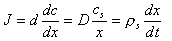
which integrated, and substituting D r for x, yields
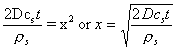
which I calculated to give a very low diffusion coefficient of 1.5 10-10.
b. (12) Predict how long it will take for 70% of the drug to be removed. Geometric assumptions that you used in part a. may no longer apply.
Here we can no longer use the slab assumption. For the diffusion part of the basic moving boundary equation:

assuming the surrounding concentration to be zero.
The dissolving part of the equation gives another value for J.
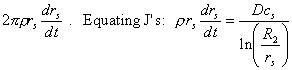
This differential equation can be solved but first we need to calculate the final value of rs that corresponds to 70% removed (30% remaining). We need the radius that gives an area that is 30% of the original circle:

The integral of the equation above, solved for dissolution time gives:

Variant problem: A skin patch (planar, slab) consists of a piece of porous polymer impregnated with a drug. When the patch is to be used it is taken from a foil pack where it has been kept dry. One side is exposed; the patch is immersed in water; and the exposed side is placed in tight contact with the skin of a patient. In earlier studies, when saturated drug solution was placed in direct contact with the patient's skin, the uptake rate was seen to be 0.05 m g /cm2-sec and was seen to decrease linearly when the concentration of drug was decreased. The diffusion coefficient of drug in the patch is estimated to be 1.0 10-7 cm2/sec, the solid concentration (r drug) 0.1 gm/cm3 and the saturation concentration 80 m g/cc. How thick can the patch be made if the delivery rate is not ever to be less than be 0.03 m g /cm2-sec? After how much time must the patch be replaced?
3. (25 pts) A solid tissue mass is to be cultured in a bundle of hollow fibers that are parallel to each other. The fibers have an external diameter of 200 micrometers and are perfused rapidly with a solution whose pO2 is 150 torr. The fiber walls are sufficiently permeable to oxygen that the controlling resistance to oxygen delivery is diffusion through the tissue mass itself. The pO2 is nowhere to be less than 20 torr; the diffusivity of oxygen in the tissue is 6 10-6 cm2/sec; and the tissue consumes oxygen at the rate of 7 10-8 g-mole/cm3-sec. Because of the rapid perfusion rate, you need not consider the decrease in pO2 down the fiber. You can also ignore the triangular region in the figure that the theory does not consider.
Use a Krogh-like model to estimate the maximum allowable gap (see figure) between fibers if necrosis is not to occur. Work carefully; be neat; explain what you are trying to do. A minimally correct answer will comprise the differential equation that must be solved: with the correct independent variable(s), the correct form for the equation, and the necessary boundary conditions. The terms in the equation and the boundary conditions should be related to the data given above. If the solution to the equation needs to be used, indicate how it is to be used. But you should be able to solve the whole thing.
Consider a ring in the tissue cylinder:

which can be integrated from the outer radius (where J is known to be zero) to a radius within the cylinder:


This is the first integration and uses the first boundary condition. Fick's law can be inserted to give, after a little manipulation:
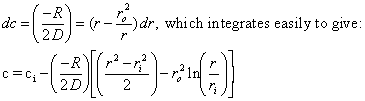
This is the second integration. It gives c(r), in general, and co (r=ro) in particular. Since co is the given lethal corner concentration, the particular equation where ro is substituted for r is to be solved by trial and error until an ro is found that produces the given co. I found that ro was 1.26 times ri the outer radius of the fiber.
Variant problem: A tissue engineering experiment is being conducted to develop an artificial blood vessel. The thickness of the vessel wall is small compared to its radius (slab assumption). Both the luminal (blood side) and outer (tissue side) surfaces of the vessel are rapidly perfused with an oxygenated solution that has an effective O2 concentration of 2 10-7 moles/cc. Use the same data, for diffusion and consumption of oxygen as was given in the mid-term problem (above). Calculate how thick the wall of this vessel can grow before some cells in its middle will be underoxygenated.
4. (25 pts. total) Several VisSim solutions were posted as part of the practice test for this mid-term.
a. (10) One of these was called tcell.vsm. This solution demonstrates switching. Choose one of the following as the most correct statement about this solution. You may explain your choice in not more than 50 words.
4-i: Switching is defined as a change in one or more intracellular variables and lasts for at least the life of a cell. Switching was made to require a minimum signal strength by including an enzyme reaction in the model. In this example switching occurred because only the substrate and not the product of the reaction could be degraded by the enzyme in the cell.
4-ii: Switching is defined as a change in one or more intracellular variables that is maintained after the stimulus causing the change is removed. In this example switching occurred because the product of the reaction was the same as the substrate and thus the more the reaction, the more the substrate. This is called positive feedback. Switching was made to require a minimum signal strength by including an enzyme reaction whose rate of product production provided the positive feedback to overcome the negative feedback of a first order reaction that dominated at low substrate concentrations.
4-iii: Switching is defined as a change in one or more intracellular variables that will persist after the stimulus causing the change is removed. In this example switching occurred because the product of the reaction was the same as the substrate and thus the more the reaction, the more the substrate. This is called positive feedback. Switching was made to require a minimum signal strength by including an enzyme reaction whose rate of substrate consumption overcame the positive feedback with negative feedback at low substrate concentrations but whose plateau let the positive feedback dominate if a high enough substrate concentration was reached during stimulation.
4-iv: Switching is defined as a change in one or more intracellular variables that recognizes the difference in binding times of different ligands. A ligand with a long koff allows a longer time for production of enough product to switch the cell. Switching was made to require a minimum signal strength by including an enzyme reaction whose rate of substrate consumption counteracted product production at low substrate concentrations.
The correct answer is 4-iii. There is at least one false statement in i, ii, and iv. In i, this statement is not correct: In this example switching occurred because only the substrate and not the product of the reaction could be degraded by the enzyme in the cell. In ii, this statement is not correct: Switching was made to require a minimum signal strength by including an enzyme reaction whose rate of product production provided the positive feedback to overcome the negative feedback of a first order reaction that dominated at low substrate concentrations. In iv, this statement is not correct: Switching is defined as a change in one or more intracellular variables that recognizes the difference in binding times of different ligands. (This is not the definition of switching.)
No variant problem. There will not be a VisSim-related problem on the final examination.
b. (15) The figure at the end of the test represents a VisSim simulation of four first-order systems in series. There are nine blocks on the diagram that are currently set to a value of unity (1). The first, at left, is the value of a constant which functions as a step introduced at time-zero, with the magnitude shown in the block. The other eight are "gain" blocks: each multiplies the signal that enters it by the value entered in the block. (In the top four, G1, ... , G4, the signal enters from the right and in the bottom four, G5, ... , G8, the signal enters from the left, as the arrows show.) The "minus" signs do not show on the picture, but the signals from G1, ... , G4 all go to a negative junction on the summing block. With all blocks set to unity, the responses are as shown in the plot block, in descending order. That means that the highest plot belongs to the signal connected to the top of the plot block, the second highest plot belongs to the signal second from the top of the plot block, etc. You are required to specify the changes in values of the constant block and the eight G-blocks that are needed to fit the information given below. This information pertains to a cell that is stimulated steadily to translate a gene segment to an intranuclear mRNA (n-mRNA) that encodes an enzyme. This intranuclear RNA is the precursor of a cytoplasmic mRNA (c-mRNA) that is translated into the protein precursor (P) of an enzyme. The precursor is processed, with losses, to produce the active enzyme (E), which like all cytoplasmic entities degrades over time.
a. The cell is stimulated to produce 0.05 transcripts per second. The half-life with respect to degradation of these primary transcripts is 1000 sec. The transport rate constant from the nuclear space to the cytoplasm is 0.007 sec-1.
b. The mRNA's appearing in the cytoplasm each contain an average of 7.1 ribosomes, and each ribosome has a mean transit time on the mRNA of 3.4 sec. The half-life of the mRNA's is 9000 sec.
c. The product of the translation is an enzyme precursor. The precursor is assembled into active enzyme in the Golgi apparatus of the cell with 75% efficiency (25% is lost). The rate constant for this process is 0.004 sec-1.
d. The enzyme has a half-life of 5 104 sec.
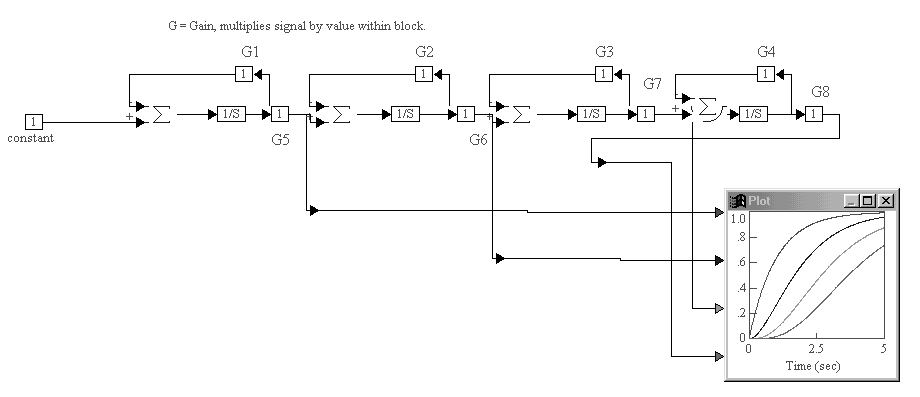
Work carefully. Most of your grade will depend on the actual numerical answers that you obtain.
Answers: constant -- 0.05; G1 -- 6.9 10-4; G2 -- 7.7 10-5 ; G4 -- 1.39 10-5; G5 -- 0.007; G6 -- 2.08; G7 -- 0.75; G8 -- 1.