Low—Order Approximations for Membrane Blood Oxygenators
E.N. LIGHTFOOT
University of Wisconsin. Madison, Wisconsin
Considerable attention has recently been paid (1, 2) to the characterization of blood oxygenators; this is because successful long term extracorporeal oxygenation could lead to striking clinical advances in such varied areas as hyaline membrane disease and pneumonia. Among the probable factors limiting permissible oxygenation time is damage to the blood resulting from both pumping and passage through the oxygenator. Hence it is important to limit both the mass transfer surface and viscous dissipation as much as possible. This paper is concerned only with membrane oxygenators as these appear to be the least damaging to blood, and hence of greatest potential interest. The problem of carbon dioxide removal will not be considered here.
All meaningful existing analyses known to the author are straight-forward numerical integrations of the combined continuity equations for dissolved oxygen and oxvhemoglobin. These have proven very expensive of computer time, to the point where many of the possibly important features of the oxygenation process have necessarily been neglected, for example allowance for finite reaction rates the coupling between oxygen absorption and carbon dioxide removal, and allowance for variable boundary concentrations. Much of the difficulty of obtaining economical numerical descriptions results from the chemical nature of the oxygen-hemoglobin system, in particular the tendency to develop very large second derivatives of oxygen concentration with respect to position in the exchanger. It is, however, just these features which lend themselves to simple and reliable approximation procedures, long used in heat and mass-transfer applications such as freezing (3) and corrosion of metals (4).
Approximations of this type, while not a complete substitute for numerical procedures, can be very useful. They provide considerable physical insight into the nature of the process under consideration and permit rapid evaluation of the importance of effects neglected in presently available numerical analyses. For these reasons the author began his recent involvement in blood oxygenation by a review of low-order approximations.
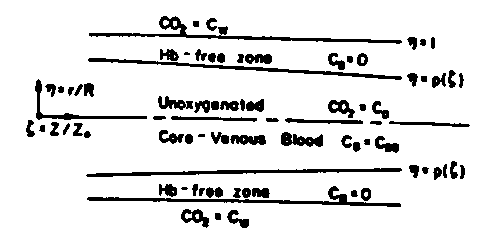
Fig. 1. Zeroth-order model of a blood oxygenator, Z0 = ReSc [CB0/(Cw-C0)]
The present communication deals with the simplest of those attempted, referred to henceforth as the zeroth-order approximation, and considers only oxygen transfer. This approximation appears to be remarkably reliable and of real utility for orientation and preliminary design purposes. It represents an extension of the technique of Marx, et al. (5) and provides greatly increased accuracy by properly allowing for convection in the flowing fluid. Higher order approximations and the problems of simultaneous oxygen and carbon dioxide transfer will be treated later.
The zeroth-order analysis owes its simplicity to the following characteristic features of the oxygenation process:
1. The rapidity of the oxygenation reactions, here considered instantaneous, as in all other available analyses of membrane oxygenators.
2. The large difference between the oxygen partial pressure in the aerating gas (normally on the order of 700 mm. mercury or higher) and the equilibrium oxygen partial pressure over entering venous blood (seldom over about 70 mm. mercury for design conditions).
3. The large ratio of chemical to physical oxygenation capacity in oxygen-saturated blood, about 60 to 1 for physiological conditions and 10 or 15 to 1 in oxygenators.
In the zeroth approximation then the system can be considered to consist of two zones, as pictured in Figure 1 for a round tube. In the outer zone it is assumed that all hemoglobin is fully oxygenated and oxygen transport is primarily by diffusion. In the central region hemoglobin is assumed to be in the same state as a entering venous blood.
The behavior of a round tube oxygenator may then be described as follows, assuming steady laminar flow.
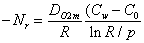
The oxygenated zone (p < 0 < R):
 (1)
(1)
where Nr, is the radial molar flux of 02 and DO2m is the effective diffusivity of dissolved 02 through blood. Other symbols are defined in the figure. In this zone diffusion is primarily radial and predominates over convection because of the low solubility of oxygen,
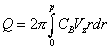
The unoxygenated region (0 < r <p):
 (2)
(2)
where Nr is the local rate of flow of unoxygenated hemoglobin down the tube, and Vz is local fluid velocity. It will be convenient for comparative purposes to assume Newtonian flow, that is, a parabolic velocity profiler For this situation
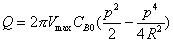 (3)
(3)
It is here that the present treatment differs in an important way from the earlier one of Marx, et al. (5).
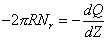
Rate of shrinkage of the venous core:
 (4)
(4)
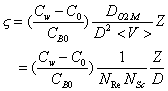
by a material balance. Hence for constant Cw
 (5)
(5)
and <V> is the flow-average velocity. Obvious modifications must be made in Equation (5) if wall resistance is appreciable. The corresponding expression for flow between parallel plates separated by a distance D is
 (6)
(6)
The  relation for round tubes is plotted in
Figure 2. It may be seen that in each case the zeroth-order analysis predicts complete
oxygenation of the venous core in a finite reactor length. It remains to determine the
fractional saturation, f, of the entering blood. The definition consistent with the
above approximation is
relation for round tubes is plotted in
Figure 2. It may be seen that in each case the zeroth-order analysis predicts complete
oxygenation of the venous core in a finite reactor length. It remains to determine the
fractional saturation, f, of the entering blood. The definition consistent with the
above approximation is
 (7)
(7)
where Q0 is the rate at which unoxygenated hemoglobin enters the exchanger. It follows from this definition that
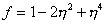 (8)
(8)
for round tubes and
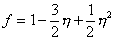 (9)
(9)
for flow between flat plates. The corresponding relation for tubes is shown in Figure 2.
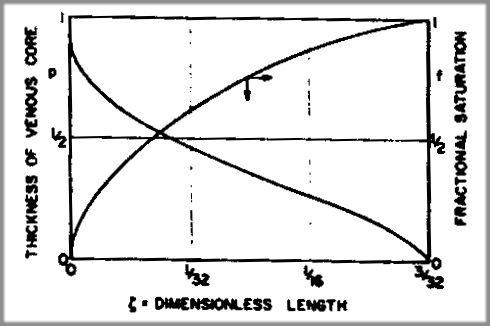
Fig. 2. Zeroth-order description of blood oxygenated is a round tube
It is now instructive to compare the above zero-order analysis with the results of numerical integration of the oxygen-hemoglobin continuity equation. We choose here calculations of Weissman and Mockros (2) based on the following conditions: [These were the conditions used to construct Weissman and Mockros’ Figure 5. These values correspond to (a rather high) 75% chemical saturation of the venous blood and (a normal value of) 94% by volume of oxygen in the aerating gas. Atmospheric pressure, not stated by Weissman and Mockros, was estimated as 745 mm. mercury, approximately normal for Chicago.]
CB0= 2.31 (10)-3 g-moles/liter
Cw= 0.942 (10)-3 g-moles/liter
C0= 0.0943 (10)-3 g-moles/liter
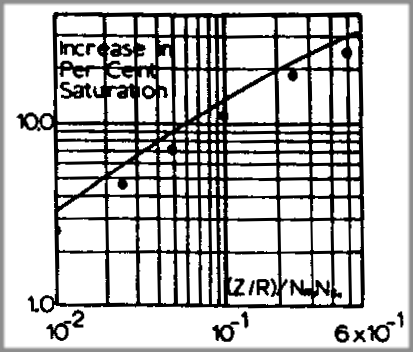
Fig. 3. Comparison of the zeroth-order model with the numerical analysis of Weissman and Mockros (2). The curve represents the numerical results of Weissman and Mockros for conditions cited is the text. The points represent corresponding predictions of the zeroth-order model.
These conditions provide a very severe test of the approximation procedure since C B0 is only about three times (C-C0). To make an allowance for the physical oxygen capacity of the system an effective value of CB0 was used, defined by
(CB0)eff = 2.31 (10)-3 + 1/2 0.85 (10)-3
This corresponds to use of the limiting transpiration effectiveness of 1/2 in film theory (6).
Comparison of the zero-order analysis with the more elaborate analysis of Weissman and Mockros is shown in Figure 3- The curve drawn in this figure is that of Weissman and Mockros; the points are representative results of the zeroth-order analysis. It can he seen that the two methods do not differ significantly (keeping in mind the uncertainties in any real apparatus), even for this rather severe test case. Similar agreement can be obtained with other published analyses.
Once again it should be stressed neither this nor other low—order approximations is a satisfactory substitute for exact numerical calculation. In fact the author is indebted to Drs. Weissman and Mockros for use of a prepublication copy of their paper. However, they are useful and are to be preferred to numerical solutions whenever high precision is not needed.
LITERATURE CITED
1.
Buckles, R. C., Ph.D. thesis, Mass. Inst. Tech, Cambridge. (June 1966).2. Weissrnan, M. H. and L F. Mockros, J. Eng. Mech. Div. A.S.C.E., to be published.
3. Carslaw, H. S, and J. C. Jaeger. "Conduction of Heat in Solids," Chap. 11, Oxford, 2nd Ed. (1959).
4. Jost, W, "Diffusion", Academic Press. New York (1952).
5. Marx, T. I., E. R. Baldwin, and D. R. Miller, Ann. Surgery. 156, 204 (1962).
6. Bird, R. B., W. E. Stewart, and E. N. Lightfoot, "Transport Phenomena, Section 21.5, John Wiley, New York (1960).
AIChE Journal, 14 (4), 669-670 1968