Gordis ENG BC3179x
Fall 2009
READING MARY ROWLANDSON
A Narrative of the Captivity and Restoration of Mrs. Mary Rowlandson (1682) was another phenomenal best seller in early New England, and it's an important text for us as well. We'll be considering this text on several different levels, in terms of various cultural contexts and in terms of formal literary questions.
The Norton Anthology introduction is a bit sketchy, particularly in its description of King Philip's War. The war lasted only about a year, from the summer of 1675 to the summer of 1676, but both sides suffered heavy losses. Half of the English towns of New England were damaged, and twelve were destroyed completely. The war cost the colonists almost �100,000. More than 600 English colonists, including 1 in 16 men of military age, were killed, and many more were taken captive. On the Indian side, the losses were even greater. Three thousand Native Americans were killed, King Philip was slain, and his wife and children were sold into slavery. As the Norton introduction says, "the independent power of the New England American Indians had ended" (NA 235).
Obviously, this text is useful in part as a mirror of its perilous times. How does it reflect Rowlandson's attitudes towards Native Americans? What kinds of language does she use to describe her captors? Does her attitude change in the course of the narrative? Do you see any indications that she develops respect for or even understanding of their culture?
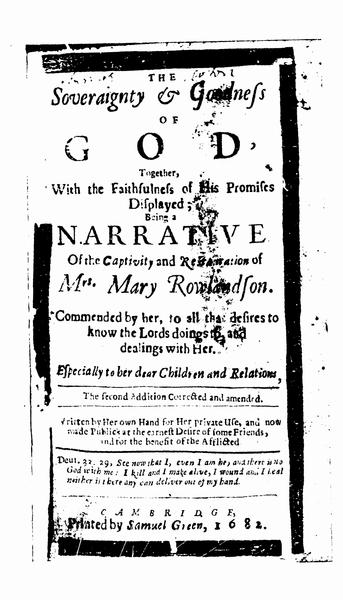
Rowlandson also discusses her faith in this text, the full title of which is The sovereignty and goodness of GOD, together with the faithfulness of his promises displayed; being a narrative of the captivity and restoration of Mrs. Mary Rowlandson, commended by her, to all that desires to know the Lord's doings to, and dealings with her. Especially to her dear children and relations. The second Addition Corrected and amended. Written by her own hand for her private use, and now made public at the earnest desire of some friends, and for the benefit of the afflicted. Deut. 32.39. See now that I, even I am he, and there is no god with me; I kill and I make alive, I wound and I heal, neither is there any can deliver out of my hand. You may want to take a few minutes to unpack the implications of the title. Then, consider how Rowlandson reconciles her faith with all of the terrible things that happen to her. How does she interpret the afflictions she suffers? How does she interpret the losses suffered by the colony as a whole? How would you compare her view of providence to the views of other authors we've studied?
Finally, consider this text in more conventional literary terms. It's one of the finest early examples of Indian captivity narrative, a genre that became very popular in both non-fictional and fictional form (think, for example, of The Last of the Mohicans). How well does Rowlandson's text read as an adventure story? How does her use of "removes" rather than chapters affect the narrative? How does the first-person narration affect the narrative? What details does she choose to include, and what details does she omit? Finally, compare the title pages of the 1682 Cambridge edition, the 1682 London edition and the 1773 edition. How do the publishers’ emphases change in the years between these editions? (For more title page images, use your uni to log into the Image Annotation Tool and look at the captivity narratives collection.)