RESEARCH
My
research focuses on the social behavior of animals, particularly primates.
My interest in these animals arises from the fact that they are
social in a particular way, which involves the establishment of
long-lasting social units and individualized social relationships. Primates share
these characteristics with some other social vertebrates, like cetaceans, elephants, hyenas and some birds.
At the
most
general level, I want to
understand how sociality relates to
behavioral patterns and ecological constraints. As a
biologist, I approach these questions from an evolutionary
perspective. However, while the
evolution of behavior is a major interest, my research has also
focused on
the ecological basis of social variation, as well as behavioral
mechanisms that allow social ties to persist in the face of competition and conflict, and also social development.
Areas of enduring interest include (i) social cooperation, (ii) demography and group size, (iii) mating strategies and mating systems, (iv) socioecology, or ecological explanations of variable social organization, and (v) the development of social relations. Longterm study of a single population of long-lived animals, which I've now done for >35 years, leads also to an interest in life history variation. In the past, I have also studied mechanisms involved in maintaining group integrity (especially conflict resolution, ownership conventions, and grooming) and social and ecological relations between sympatric species, and I remain interested in these topics as well.
Areas of enduring interest include (i) social cooperation, (ii) demography and group size, (iii) mating strategies and mating systems, (iv) socioecology, or ecological explanations of variable social organization, and (v) the development of social relations. Longterm study of a single population of long-lived animals, which I've now done for >35 years, leads also to an interest in life history variation. In the past, I have also studied mechanisms involved in maintaining group integrity (especially conflict resolution, ownership conventions, and grooming) and social and ecological relations between sympatric species, and I remain interested in these topics as well.
My "lab"
is a fieldsite in Kenya, where we use direct observation of our study
subjects to sample their behavior. In the past, I also worked on
captive animals, conducting behavioral experiments. I am
not an exclusive
devotée of field
vs. lab, or observation vs. experimentation: different questions demand
different kinds of study. I do wish field experiments were
easier! 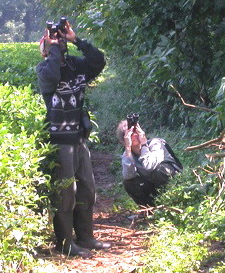
I direct
the
Kakamega Monkey Project in
the Kakamega Forest, western
Kenya,
where I began a long-term study of forest-dwelling monkeys in 1979. My students and I have combined
behavioral fieldwork with genetic, endocrinological and nutritional analyses,
undertaken in the laboratory, to gain a deeper understanding of the
behavior of our subjects.
I have also had some interchange with
human psychologists: I am interested in seeing how an evolutionary view
of social competence jives with human social cognition and social
behavior.
My main focus has been on conflict management – something that all
social animals (including humans) need to do.
PROSPECTIVE STUDENTS
The lab is not accepting PhD students at this time. For those interested in our MA program, please write and introduce yourself, and let me know what types of questions interest you.
PROSPECTIVE STUDENTS
The lab is not accepting PhD students at this time. For those interested in our MA program, please write and introduce yourself, and let me know what types of questions interest you.