Bridging Japanese Language Teaching and Culture Through Video Clips
ACTFL 2005, Baltimore Convention Center, Baltimore, MD
Saturday, November 19
Fumiko Nazikian, Columbia University ([email protected])
Miyuki Fukai, Columbia University ([email protected])
Background of Study
- Position of teaching culture in foreign language classroom
- Importance of culture in learning foreign language
- Difficulty in developing learners' sociolinguistic competence
Rationale For Using Authentic Video Clips
- Semi-authentic conversations
- Linguistic and extra-linguistic expressions
- Exposure to different speakers
- Language use integrated with culture
- High degree of empathy and involvement
- Interesting
Rationale For "Rejection"
- Realistic situation learners will encounter
- Contextual variables (e.g., interlocutors' relationship)
- Semantic formulas (e.g., apology, excuse)
- Linguistic elements (e.g., style, particles, prosody)
- Extra-linguistic elements (e.g., body language)
Video-Based Activities
1. Develop materials
- Choose scenes
- Prepare transcripts and identify "refusal"
- Digitize clips (iMovie and QuickTime Pro)
2. Upload digitized clips to streaming server
3. Deliver materials through a Web-based course management tool
- Use "Test and Quiz" function to let students fill in the blanks on transcripts
- Provide links to clips
Study
- Participants: 17 college students learning Japanese (8 intermediate and 9 advanced)
- Procedures
- Pre-test (discourse completion test)
- Multiple-choice and true-or-false test based on the transcripts
- Video viewing and transcript-based test)
- Post-test (discourse completion test; similar but different from pre-test)
- Post-activity questionnaire (5-point Likert-scale items on effectiveness of and attitudes toward video-based activities, difficulty level of videos)
- Analysis
(1) and (4): code strategies used
(2) and (3): count number of correct/incorrect answers
(5): quantify responses
Results of the Questionnaire
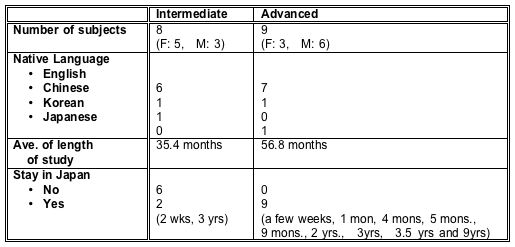
Demographic information
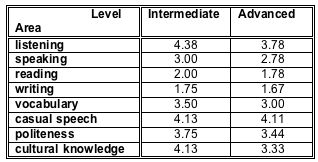
Contribution to developing language skills: Useful for listening skills and for learning casual speech
Q: How do you think this project will contribute to developing your language skills? Rate the degree of agreement with the number scale: 0 (strongly disagree) to 5 (strongly agree).
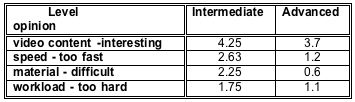
Opinions: More interesting for intermediate students; too easy for advanced students
Q: Please circle one NUMBER in each category that fits your opinion the closest: 0 (strongly disagree) to 5 (strongly agree).
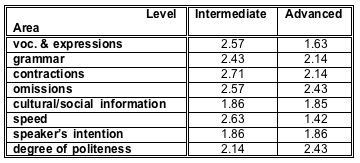
Difficulties:
(Intermediate) Contraction >> speed >> vocabulary expressions >> omissions
(Advanced) omissions >> politeness
Q: If you found the video generally difficult to understand, please circle the reasons as many as applicable. Then rate the degree of difficulty with the number scale: 1(a little difficult) to 4 (very difficult).
Conclusions, Implications, and Limitations
Conclusions/Implications
- Effectiveness of video-based activities perceived by students
- Difficulty in choosing appropriate intonation --> Possibility of video clips to expose students to actual language use in natural settings
- Support autonomous learning by using the Web as delivery method
- Ultimate/Desired procedures
- Raise students' awareness of cultural aspects of speech act by using authentic video clips
- Reinforce understanding of culture and language through explicit explanation
- Provide students with the opportunity to practice in role plays
- Limitations
- Small sample size
- No control group
Acknowledgment
This study was funded by Language Consortium. We would like to thank Dai Kojima for his assistance in preparing materials for the study.
References
- Beebe, L. M., Takahashi, T., & Uliss-Weltz. J. (1990). Pragmatic transfer in ESL refusals. In R.C. Scarcella, E. S. Andersen & S. D. Krashen (Eds.), Developing communicative competence in a second language (pp. 55-73). New York: Newbury House.
- Di Luzio, A., Gunthner, S., & Orletti, F. (Eds.) (2001) Culture in communication. Amsterdam/Philadelphia: John Benjamins Publishing Company.
- Hinkel, E. (1999). Culture in second language teaching and learning . Cambridge: Cambridge University Press.
- Hymes, D. (1974) Foundation in Sociolinguistics . Philadelphia: University of Pennsylvania Press.
- Ide, R. (1998) "Sorry for your kindness": Japanese interactional ritual in public discourse. Journal of Pragmatics 29, 509-29.
- Kramsch, C. (1993). Context and culture and language teaching . Oxford: Oxford University Press.
- Lebra, T. (1976). Japanese patterns of behavior. Honolulu: University of Hawaii Press.
- Makino, S. (2000). Amerika ni okeru nihon jijo kyiku to nihongo kyoiku no setten: "Content-Based Instruction" o megutte. Paper presented at Korea Association for Japanese.
- Omaggio, A. (1986) Teaching language in context. Boston: Heinle & Heinle.
- Valdes, J. M. (1986). Culture bound: Bridging the cultural gap in language teaching. Cambridge: Cambridge University Press.
- Wierzbicka, A. (1985). Different cultures, different languages, different speech acts. Journal of Pragmatics 9, 145-178.
- Yamada, H. (1997). Different games, different rules. Oxford: Oxford University Press.
F. Nazikian and M. Fukai / copyright 2005