Front page

ACTFL Annual Convention
November 17, 2007
Miyuki Fukai, Columbia University ([email protected])
Shinji Sato, Columbia University ([email protected])
Neriko Musha Doerr, Brookdale Community College ([email protected])
I. Sociocultural Theory: 4 Pillars
II. Blog Project
Project Goals:
1st and 2nd-year students will...
1. |
Presentation : |
Express themselves in Japanese to other learners of Japanese including their classmates. |
2. |
Interpretation : |
Interpret the simple information presented by other users of Japanese, including classmates. |
3. |
Communication : |
Respond to the comments by other learners of Japanese including their classmates. |
3rd and 4th-year students will…
1. |
Presentation : |
Express themselves in Japanese both in and outside classroom. |
|
2. |
Interpretation : |
a. |
Interpret the information presented by media or other users of Japanese including classmates. |
| b. | Think critically when looking at information and knowledge presented in Japanese by other people, media, or other sources (e.g. other blogs). | ||
3. |
Communication : |
Learn how to find and solve problems in Japanese. |
|
Levels |
Readers |
Suggested Topics |
Language |
Blog Instruction |
Frequency |
1 st -yr. |
Classmates & 1 st -yr. Japanese students from all over the world |
Simple |
Japanese/English (share their experience: happiness, frustration etc.) |
English |
1/wk or every 2 weeks |
2 nd -yr. |
Anybody |
Slightly complex |
Japanese |
English |
1/wk or every 2 wks |
3 rd -yr. 4 th -yr. |
Anybody |
Any topics |
Japanese |
Japanese |
1/wk or every 2 wks |
Timeline
Timeline |
Instruction |
2 nd week |
Learn about blogs and have technical tutorial sessions |
3 rd week |
Start the blog project (post an entry every or every 2 weeks) |
4 th -Final week |
Bring linguistic, cultural, or technical problems into the class |
6 th week |
Discuss and create criteria for the final evaluation |
Final week |
Evaluate classmates' blogs and blogs on your own |
III. Podcast Project
Project Goals: Students will…
1. |
Presentation : |
Express your opinions to a real audience in Japanese. |
|
2. |
Interpretation : |
a. |
Interpret the information presented by podcasters. |
| b. | Consider first-hand how big media operates and presents information. | ||
3. |
Communication : |
Respond to the comments posted by their listeners to blog where their podcasts are published. |
|
Recording & Editing
Publishing
Process
IV. References
Books/Articles
Useful Links
V. Appendix
Instructions provided to students
Blogging Project: Welcome to the Blogging Project! For this class I would like you to keep a blog because it provides a place: 1) To share/express your happiness, surprise, excitement, and/or frustration, as well as any questions you might have, while learning the Japanese language (or any other topics). While studying new grammar and words is very important when learning a language, it is equally important to actually use the language in a real life context. You must not wait to express yourself only when you think you have mastered the language because language learning is basically an ongoing process. In the beginning you may use English or any languages to express yourself, but I recommend that you gradually switch to Japanese whenever you feel comfortable enough to express yourself in Japanese. 2) To communicate with your classmates and other people outside of class. Language learning is not limited to what you do for the course but also includes what you do and experience outside the class. For this project I will ask you to form a group with two or three students. The purpose of the group is to encourage and monitor each other (e.g., leaving a comment on each other ' s blog and making sure everyone is following the schedule). I will ask you to change groups once or twice during the semester. I will also create links to your classmates' blogs as well as blogs by students in other sections, other levels, and other schools, so you can see what other people think and feel about Japanese language learning (as well as other topics). You are also encouraged to leave comments on these blogs. 3) To reflect (or evaluate) what you have done so far. Sometimes it is challenging to see our own progress or growth. Blogs help you to look back and see how you have changed through the course of your Japanese language learning. (How to Open a Blog Account) In order to open a new blog account, please follow the instructions. If you have any technical questions (how to open a blog, how to type in Japanese, etc.), please send an e-mail to [email protected] 1) Go to http://www.blogger.com to create your blog. 2) Send your blog address to the instructor ([email protected]). 3) Post a blog entry once a week.
You can also use pictures! (Evaluation) In the end of the semester your blog will be evaluated by the instructor, your classmates as well as yourself. We will discuss the criteria of evaluation in the middle of the semester. |
Screenshots of Blogger
Front page |
Language Selection page 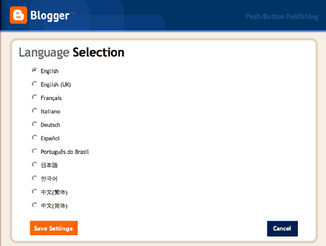 |
Setting page: Blog Authors & Blog Readers 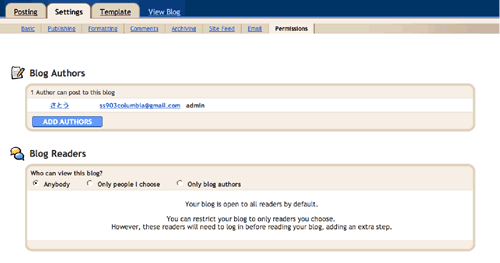 |
Podcast: Daniel's Draft Script
クラシックの音楽のソナタフォルムに関して話しましょう。音楽のクラスでどんなトピックは一番難しいか友達に聞いて,友達は「先生はソナタフォルムを教えていた時,たくさん時間がかかりましたが,あまり分かりませんでした。ソナタフォルム,へえ?」と答えました。でも,コンサートへ行って,音楽は複雑なら,楽しむためにフォルムが分かったほうがいいですね。最近クラシックはもっと複雑になったので,フォルムの分かることが欠かせません。 では,始めましょう。ソナタフォルムの一部は,最初にエキスポ,次にエキスポのレピート,次に,デフェロプメント,最後に,リーカップ。 エキスポで一部がいつも二つあります。 A と B と言わせます。 A と B でモチーフという一部があります。デフェロプメントで A と B はちょっと変わります。例えば,ときどきフューグになります。フューグはモチーフからなりますが,モチーフがいろいろな声で何回レピートします。リーカップは A と B がエキスポに同じじゃありませんが,同じようです。 モーツァルトを聞いたら,すぐ分かります。 エキスポ A B モチーフ デフェロプメントのフューグ フューグはちょっと変ですねえ。でもソナタフォルムは簡単です。ぜひモーツァルトを聞いてください! ------------------------------------------------------------------------------------------ Let's talk about sonata form in classical music. When I asked my friends what kind of topic is the most difficult in a music class, they said “Our teacher spent a lot of time teaching sonata form, but we didn't really understand. What in the world is a sonata form?” However, we should understand sonata form so that we can appreciate complex music when we go to concerts. Understanding sonata form is indispensable because modern classical music has become very complex. Let us begin. A sonata form begins with exposition, followed by a repetition of the exposition, then development, and, finally, recapitulation. Exposition always consists of two parts. Let's call them A and B. Both A and B have a motif. A and B undergo a slight change in the development stage, such as becoming a fugue. A fugue derives itself from a motif, but a motif consists of a repetition of notes. In recapitulation, A and B are not the same as they are in exposition but very similar. This will become clear to us when we listen to Mozart. Exposition A B Motif Fugue in development The fugue is a little bit strange, isn't it? But sonata form is quite simple, and I encourage you all to listen to Mozart! |
Podcast: Daniel's Final Script
ダニエルです。よろしくお願いします。音楽に関して話します。 ソナタフォルムがわからない学生が多いと思いますが,コンサートへ行って音楽が複雑なら,楽しむためにフォルムがわかったほうがいいです。私は説明するためにチェロを弾いて,例をします。 ソナタフォルムの一部は,エキスポとデフェロプメントと言い方です。最初にエクスポ A があります。 <チェロの演奏> それから, <チェロの演奏> それから,モチーフがあります。モチーフは B の一部です。 <チェロの演奏> それから,デフェロプメントがあります。デフェロプメントの中で, A と B はちょっと変わります。例えば, B <チェロの演奏> それから,リーカップがあります。リーカップは,エキスポに同じなようです。 <チェロの演奏> それから,コーダーが時々,あります。コーダーは,例えば, <チェロの演奏> コーダーは,ソナタフォルムの終わりです。じゃあ,ソナタフォルムは簡単ですね。コンサートへ行って,ぜひソナタフォルムに気いをついてください! それじゃ,さよなら。 ------------------------------------------------------------------------------------------ I am Daniel. Thank you for listening. I am going to talk about music. Although I think that there are many students who do not understand what a sonata form is, they should learn about it so that they could appreciate complex music when they go to concerts. I will explain by playing the cello and give you some examples. Sonata form consists partly of exposition and development. First, we have exposition A. <Play the cello> And then, <Play the cello> Then, we have a motif, which is a part of B. <Play the cello> Then, we have development. During the development, A and B undergo a slight change. For example, B goes like: <Play the cello> Then, we have recapitulation, which is similar to exposition. <Play the cello> And sometimes we have a coda. For example, a coda goes like: <Play the cello> A coda is the end of a sonata form. Well, sonata form is simple, isn't it? The next time you go to a concert, please pay attention to sonata form! Thank you and goodbye. |