|
COLUMBIA UNIVERSITY THE
URIARTE LAB Department of Ecology, Evolution &
Environmental Biology |
|
Interactive
effects of DROUGHT AND HURRICANES on long-term FOREST dynamics Collaborators Jess K.
Zimmerman, University of Puerto Rico Jill Thompson, CEH,
Edinburgh Tropical
forests play a critical role in carbon and water cycles at a global scale.
Rapid climate change is anticipated in tropical regions over the coming
decades. For the Caribbean, models predicts more frequent droughts and severe
hurricanes. The inherent complexity of post-disturbance successional
processes challenges our ability to provide clear predictions of the future
status of tropical forests and their global role in sustaining biodiversity
and ecosystem services. Both stochastic and deterministic processes drive
forest succession and local (stand-level) patterns are highly dependent on
physical and biotic features of the disturbed site and of the surrounding
landscape and region. Our
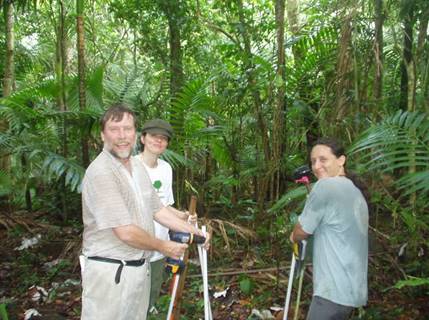
research is conducted in the Luquillo Forest
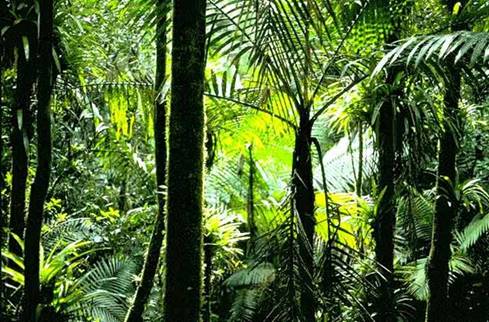
Dynamics Plot (LFDP), a 16-ha plot of subtropical wet forest in the Luquillo Experimental Forest
in Puerto Rico, part of a Long Term Ecological Research (LTER) site and the Smithsonian network of
large plots (CTFS) The LFDP has been
subject to dramatic natural disturbance. We rely on spatially-explicit,
stand-level, mechanistic models of forest dynamics that explore how variation
in life history traits (e.g., response to wind damage and drought) among tree
species determines forest resilience to hurricane disturbance and regional
drought.
Funding: National Science
Foundation LTER program. |