Whaleboats
Suspended from davits (cranes used on ships) on every whaling ship were three to five small, light whaleboats that were lowered into the water when a whale was sighted. Most ships also kept two spares stowed on top of the after house at midship.[1]
Whaleboats were perhaps the most important piece of equipment to the whaler because it was in them that the actual hunt took place. 30 feet long and six feet wide with a depth of 22 inches amidship and 37 inches at the bow and stern, whaleboats were built for speed and maneuverability. Their simple design made them strong and easy to repair, which was important on long voyages because the boats were frequently damaged during encounters with whales. They were sometimes equipped with a mast, sail, and rudder; many, however, were powered by five 16- to 18-foot long oars and were steered with a 22-foot long steering oar. [2] [3]
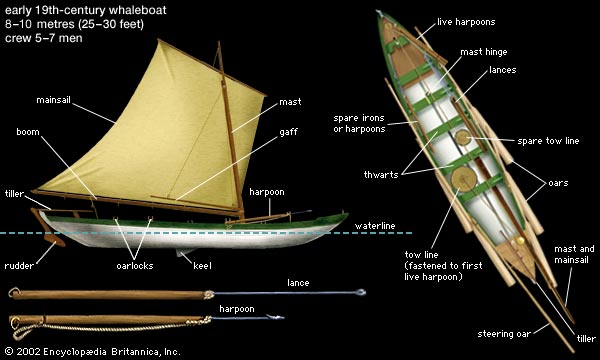
19th century whaleboat and gear[4]
Whaleboats were always equipped with a full stock of tools, which were organized meticulously so that no item would be out of place if needed at a dire moment. Near the bow, resting in cleats with their tips in sheaths were two live irons, two or three spare irons, and two or three lances. Three hundred fathoms of hemp rope was coiled in wooden tubs, a hatchet was kept in the bow box, and a water keg was lashed into its chocks. Also aboard the whaleboat were candles, a compass, lanterns, glasses, matches in lockers at the stern, a boat-hook, waif-flags, fluke-spades, canvas buckets, and paddles for approaching whales silently.
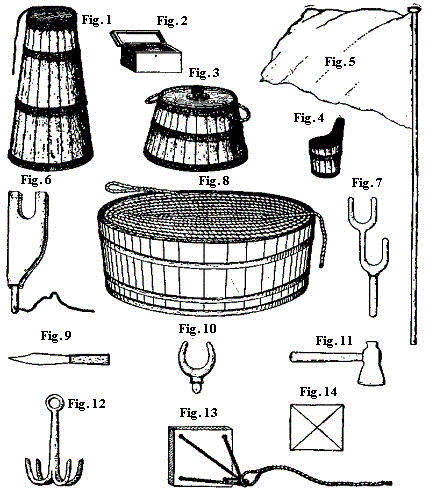
Whaleboat gear
1—Lantern keg containing matches, bread, tobacco, etc. 2—Compass. 3—Fresh-water keg. 4—Piggin for bailing. 5—Waif. 6—Tub-oar crotch (this ships through cleat in gunwale to clear oar from line when fast to a whale). 7—Double oarlock used as last. 8—Large tub and line. 9—Knife for cutting line when necessary. 10—Rowlock. 11—Hatchet. 12—Grapnel. 13—Drag. 14—Canvas nipper to protect hands when hauling line.[5]
Whaleboats were manned by a crew of six. The boatheader, usually the captain or one of the mates, stood to the stern and steered the boat; the harpooner or boatsteerer pulled the bow oar at the front of the boat; and four crewman rowed with oars amidships.[6]