Rene Chevray
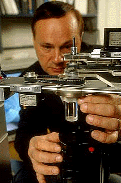
Rene Chevray is a Professor of Mechanical Engineering at Columbia University, and
the Director of the Turbulence Research Laboratory. He received his Ph.D. from the University of Iowa in 1967 and his
D.Sc. from the Claude Bernard University of Lyon in 1978. Professor Chevray can be contacted at:
- Address:
220 S.W Mudd Building
Department of Mechanical Engineering
500 W. 120th St.
New York, N.Y. 10027
- Tel:
Office (212) 854-2970
Laboratory (212) 854-2922
- Fax:
(212) 854-3304
- Email:
[email protected]
Professor Chevray's current research interests include:
- Dynamical Systems in Fluid Mechanics and Chaotic Advection: A novel method of fluid mixing
"chaotic advection" is studied from a fundamental point of view. Applications to
systems which cannot sustain high strain rates are studied; in particular, this method
is presently used to separate fetal erythrocytes from maternal blood. It is also
used to separate particles with only slight variations in size or density.
- Development of a new model of Turbulence. An apparent body force hypothesis is put
forward for turbulent flows. Important characteristics of this model include
accurate prediction of complicated turbulent shear flows, in particular for
zones of null velocity gradients where the shear stress is finite. A basic turbulent
situation, that of a distorted duct in which a grid generated turbulence is subjected
to a pure plane strain is studied experimentally to study this new model. This reorientation
of the principal axes provides an example of the evolution of the principal axes
of the Reynold's stress tensor in a shear flow.
- Coating processes with Viscoelastic Liquids: We are studying, numerically and experimentally, flows
of small scale laminar free-surface flows in order to be able to deposit one or several
liquid films on a moving substrate. These flows invariably involve non-Newtonian
viscoelastic fluids whose behavior is little understood especially in the high
Weisenberg number regime corresponding to the elastic behavior used in coating
operations.
- Drag Reduction by Polymeric Fluid: The well-known phenomenon of drag reduction by long
chain molecules introduced in a turbulent flow is still not understood. In an effort
to understand this mechanism, we are studying flows of polymeric fluids in a free
jet configuration where the total absence of walls might reveal details of the
fine structure of turbulence which is quite different with and without polymers.
Recent Publications
Full-Length Papers
- R. Chevray and J. Mathieu, Topics in Fluid Mechanics, Cambridge University Press,
graduate text- book, 1993.
- R. Chevray and P. Dutta, "Fluid Mixing by Chaotic Advection," Proceedings, First
ISHMT-ASME Heat and Mass Transfer Conference, Sukhatone et al., Ed., Vadams
Books International, 1994.
- P. Dutta and R. Chevray, "Role of Transient Velocities and Diffusion of Chaotic
Advection in an Eccentric Annulus," Proceedings, Fifth Asian Congress of Fluid
Mechanics, Daejon, Korea, June 1992.
- P. Dutta and R. Chevray, "Effects of Diffusion on Chaotic Advection in Stokes Flow,"
The Physics of Fluids A, Vol. 3, 1991, pp. 1440.
- R. Chevray, "Fractals," Yearbook of Science and Technology, McGraw-Hill
Encyclopedia of Science and Technology, 1991.
- E. Panides and R. Chevray, "Vortex Dynamic in a Plane, Moderate-Reynolds-Number
Shear Layer," J. Fluid Mech., Vol. 214, 1990, pp. 411.
- R. Chevray, "Chaos and the Onset of Turbulence," Chapter 5, Advances in Turbulence,
W. K. George and R. Arndt, Editors, Hemisphere, 1989, pp. 127-158.
- R. Chevray, "Chaotic Advection in a Shear Layer," American Physical Society, Bulletin,
34, 1989, p. 1143.
- S. Iida and R. Chevray, "Solving Laminar Boundary Layer Equations," Chapter 4,
Encyclopedia of Fluid Mechanics, N. P. Cheremisinoff, Editor, Golf, 1989, pp. 83-110.
- R. Chevray, K. Ogawara, and S. Iida, "General Aspects of Chaotic Phenomena", J.
Japan Society of Mechanical Engineers, Vol. 91, 1989, pp. 1129-1134.
- P. Dutta and R. Chevray, "Inertial Effects in Chaotic Mixing with Diffusion", J.
Fluid Mech., Vol. 285, 1, 1995.
Rene Chevray, [email protected]