Religion and International Private Law: How Faith Impacts Global Child Abduction Outcomes
Columbia University
Overview

When selecting treaty partners, states conduct meticulous evaluations of other countries and their domestic institutions to ensure compliance. In the context of private international law and family law, this perceived fairness of the potential partner states’ legal systems serves as a vital indicator for countries that seek effective partnerships. Is religion also an intermediary to this end? This study investigates the potential impact of religion on collaboration outcomes between countries by analyzing data from partnerships formed under the Hague Child Abduction Convention, building on the work of Efrat and Newman (2016). The analysis incorporates logit experiments, survival analysis, and an interview with a case attorney to substantiate the expectation of an effect of religious affiliation and state religiosity on the propensity to collaborate, providing compelling evidence that countries with identical religious affiliations are more likely to cooperate, that states with highly-intertwined religious and legal institutions exhibit decreased receptivity to collaboration, and that Muslim countries may be less likely to collaborate even after joining the Convention.
The Dataset
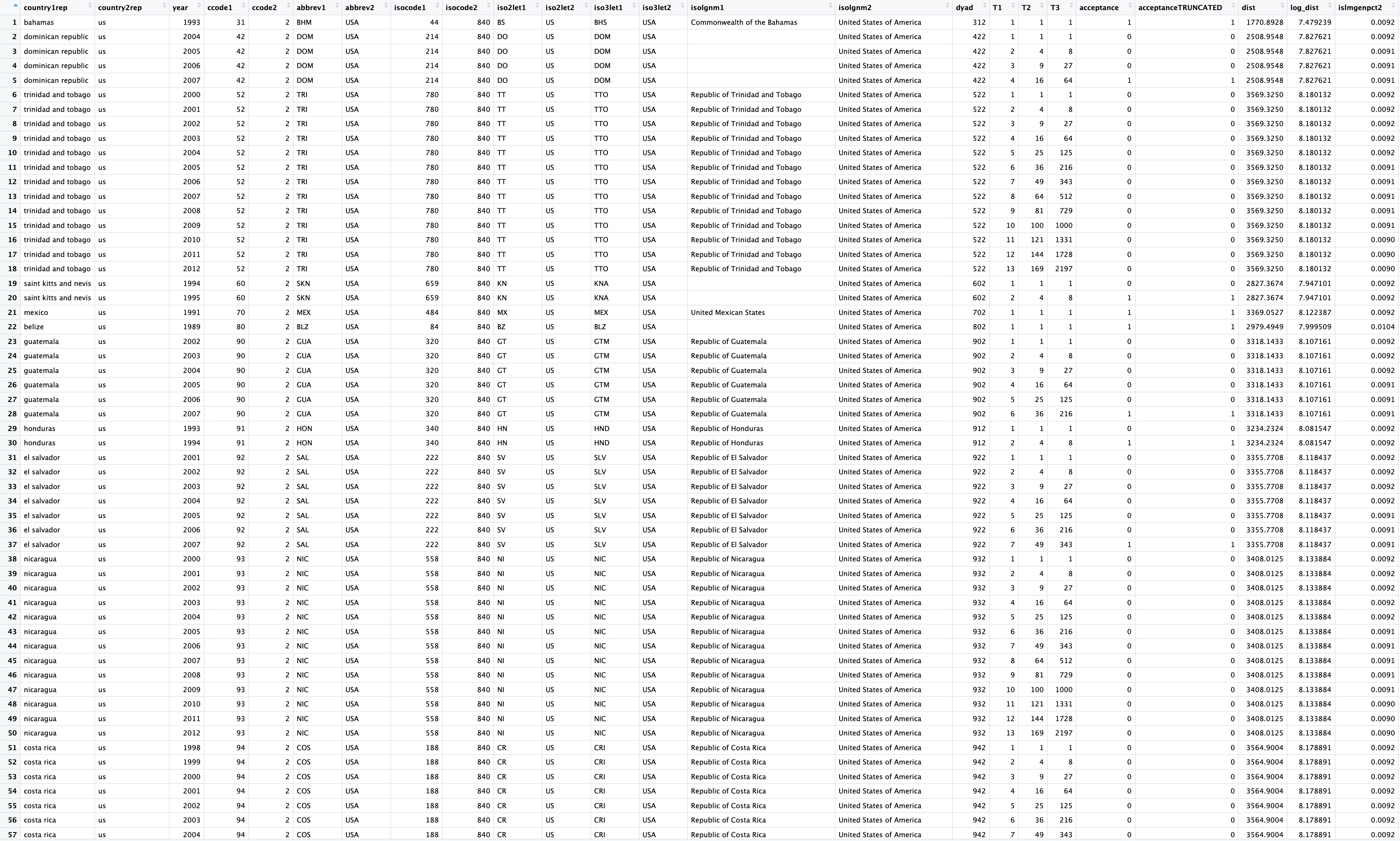
The data used to perform this analysis are largely taken from several sources; the most important is the acceptance data constructed by Efrat and Newman (2016) in their aforementioned study (hereafter referred to as “acceptance data.” In it, data on 88 countries and their individual relationships under the Hague Child Abduction Convention was compiled, covering the period from the inception of the Convention (or the earliest available year for both countries) until 2012. Constructed in dyad-year format, the first country, country1rep, represents the acceding country, while the second, country2rep, represents the accepting country; for example, if observing a dyad relationship between Country 1 and Country 2 in 2002, where country 1 is labeled country1rep and Country 2 as country2rep, we would be analyzing the status of whether an agreement was made between Country 2 and Country 1, with Country 1 being the later joiner. Thus, the acceptance variable would inform us whether or not it had occurred by that point; it being a boolean, a 0 means that an acceptance had not occurred, while a 1 would indicate that it had. Similar to the research design of Efrat and Newman (2016), relationships in which an acceptance never occurs are analyzed, and in cases where an acceptance is made, the dyad is no further observed in the ensuing years. I make use of several other variables used by Efrat and Newman (2016) as controls to better isolate for the desired effects, such as a rule of law gap indicator, as well as ideal point distance in UN General-Assembly voting and similarity of the legal system to gauge the political compatibility between the country that is acceding and the country that is accepting (Efrat and Newman 2016).
I supplemented this with data from the Religion and State Project (RAS) data created by Prof. Jonathan Fox of Bar-Ilan University in Ramat Gan, Israel. This data broadly aims to provide a systematic measure of the relationship between government and religion worldwide. Currently in its Round 3 version, the dataset measures the extent of government religion policy for 183 countries from 1990 to 2014, incorporating information on official religion, religious support, restrictions, and discrimination by the government, societal discrimination against religious minorities, and actions taken by minorities against the majority or other minorities. The dataset includes detailed variables covering various religious policies and practices, such as religious education, registration of religious organizations, restrictions on proselytizing, and more. My analysis prioritizes one particular variable applied to individual countries of the dyads – SAX – which measures “Official Religion.” Constructed on a scale ranging from 0 to 2, where “0” indicates that a state has no official religion, “1” indicates that a state has several “established” religions, and “2” noting that a state has one officially established religion; a state having a single established religion is more likely to mean that the laws of the country reflect that faith, as opposed to if there are multiple religions competing for legal authority, or none at all (Fox 2019). This variable allows for an increased ability to elucidate the degree to which religious norms and understandings manifest in the legal apparatus of a given country, serving as a good proxy of how states might interpret the degree to which religion tangibly affects laws in a potential partner. Knowing the extent to which it does allows for a better perception of how laws related to issues like child abduction may have been influenced by these factors; it might be a good predictor of a state’s own actions, and indeed even a teller of signaling to other states, whose knowledge of this might affect their own engagements with the religious state.
Finally, I amended all of this data with basic predominant-religion variables corresponding to each country, as sourced by a 2012 Pew Research poll (Hackett & Grim 2012). Controlling for religious strength, this allows for the test to evaluate for which religion is pulling the most weight in the country’s legal and political processes. Following my modifications, the data includes 18,687 observation years – representing 3332 relationships where 2073 resulted in acceptances – between countries to analyze. Taken in tandem with existing controls, RAS, and democracy data, I hope to evaluate the effect of religion on outcomes of acceptance. As mentioned in the Introduction of this section, all tests of hypotheses will include both a logistic regression with time-fixed effects, and some will include a Cox proportional hazards model. While all logistic tests include time-fixed effects to account for the hazard ratio, the tables do not include them due to space concerns. The methodology of these two tools are discussed in the “Methodology” section of the paper.
Results of Quantitative Tests
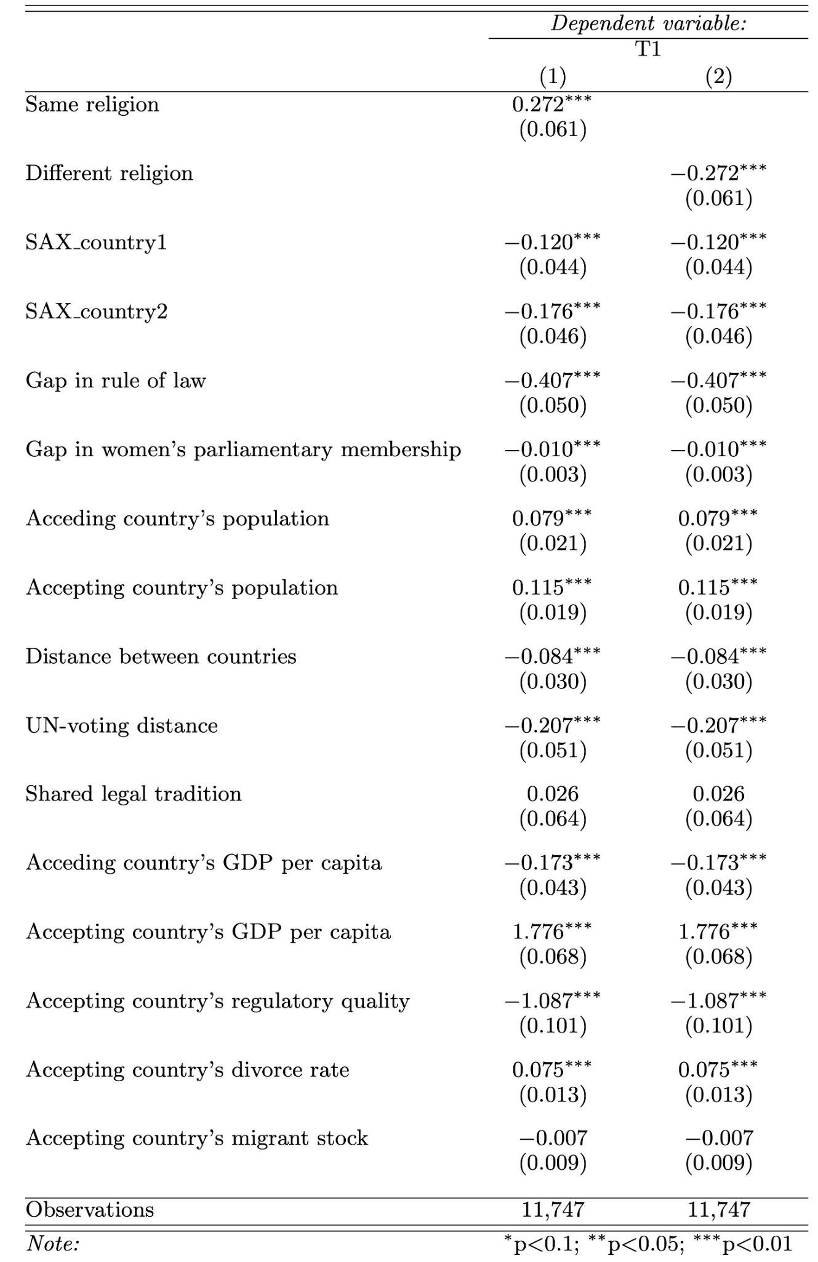
The logistic and Cox models lend credence to the idea that religious factors, as delineated by the hypotheses of this study, have an association with the outcome of acceptance. All regressions confirm the underlying assumptions behind H2, demonstrating the negative relationship that higher levels of state religiosity have on acceptance. In the case of H1, the models demonstrate a strong association between like religions and increased probabilities for acceptance among dyad pairs. Further tests help evaluate the claims behind H3, which found that Muslim countries are more averse to accepting partners than countries of other majority religious affiliations are.
According to both logistic and Cox analysis, two nations being party to the Hague Convention with identical majority religious affiliations is associated with an increase in the odds of acceptance. Among all tests, variables measuring state religiosity – SAX_country1 and SAX_country2 – promote both a substantively and statistically significant negative association with the odds of acceptance. My tests of H3, meanwhile, returned mixed results, finding that a Muslim country being an accepting country in a pair is associated with a 70% decrease in the odds of acceptance, but also failing to convincingly provide concrete findings related to how an acceding country being Muslim affects outcomes, nor any visible effect of two countries being Muslim on the outcome of acceptance. This might be due to the limited data on Muslim countries available in this dataset, or other factors.
Owing to the limitations of available data, as well as mechanisms by which to determine causality, prudence must be exercised in interpreting these results; their limitations will be discussed in the ensuing concluding section. Nevertheless, they are indeed profound, lending great insight into the hypotheses, and granting implications for scholars and policymakers alike.
Below is an example of a regression result as brought out by the tests.
Paper
Acknowledgements
I thank God for giving me the strength and aptitude throughout all of the challenging moments in completing this project. I would like to acknowledge and give my warmest thanks to my faculty advisor, Professor Andrew J. Nathan, to whom I am deeply indebted for his continuous supervision and valuable support throughout this study; he has provided me with insightful comments on my research that have been key to my accomplishment. I thank Professor John D. Huber, who led the seminar that provided the foundation for this project, and Beatrice Bonini, who served as the seminar preceptor and offered invaluable advice on research methods; their suggestions brought in threads of thought that made this research so much richer. Without their guidance, this thesis would not have been possible. My sincere appreciation goes to Devanand Mahadeva, who generously agreed to participate in my research interview, providing invaluable insights and perspectives on the subject matter. I am grateful to Professor Tonya Putnam, who provided advice and support in refining my research question and approach, doing so amid a five-hour time difference as I began considering this project while at Oxford a year ago. I also wish to thank Ohad Klopman, Anthony Lochiatto, and Professor Christian De Vos for taking time out of their days to grant their insights into my work, as well as Professor Laura Resnick Samotin, for being an exceptional teacher and mentor to me. Most of all, I dedicate this thesis to my beloved mother, whose extraordinary support and encouragement were instrumental in seeing me through the challenges of this journey. The webpage template was inspired by this project page.