Igneous rocks crystallize from a cooling silicate melt (magma or lava). They are composed of intergrown crystals of minerals such as quartz, feldspars, micas, amphiboles, pyroxenes, and olivine.
Composition
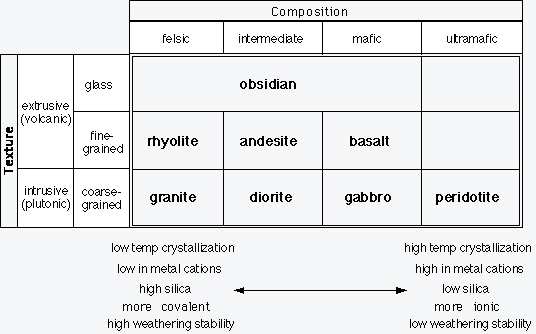
Felsic igneous rocks are silica rich and contain abundant
potassium feldspar and quartz. Felsic igneous rocks are light in
color. Mafic igneous rocks are iron and magnesium rich
and contain abundant pyroxene, and calcium rich plagioclase feldspar.
Mafic igneous rocks are dark or black in color.
Texture
Extrusive, or volcanic, igneous rocks cool and
crystallize quickly at the Earth's surface resulting in very small,
microscopic crystals. Intrusive, or
plutonic, igneous rocks cool and crystallize very
slowly beneath the Earth's surface allowing large, visible crystals
to grow. Obsidian, volcanic glass forms where lava cools so quickly
(eg., due to quenching in water) that crystals with their orderly
arrangement of atoms do not have enough time to form.
Sedimentary rocks are formed from sediments derived from the breakdown of pre-existing rocks (of any kind). First, pre-existing rocks are weathered, yielding sediments such as gravel, quartz sand and silt, clays, and dissolved ions such as calcium, iron, silica, and sodium. These sediments are transported, usually by flowing water. Eventually the different sediments will be deposited. As layer upon layer of sediment is deposited the lower-lying sediments become compacted. Finally, cements such as calcite (calcium carbonate), hematite (iron oxide), and silica are precipitated from the dissolved ions in the water forming coatings around the sediment grains that stick them together thereby forming a rock.
common sedimentary rocks - conglomerate, sandstone, shale, limestone, and coal are some.
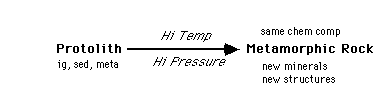
Metamorphic rocks form when some pre-existing rock is exposed to very high pressures and/or temperatures, for example when shallow crustal rocks are deeply buried in a continent-continent collision zone. There the rock re-crystallizes very slowly while remaining in the solid state in many cases forming new minerals that are stable under the high temperature and pressure conditions. If there are platy or elongate minerals in the resulting metamorphic rock they will show a preferred alignment that is perpendicular to the applied stress.
foliated metamorphic rocks - include
slate, schist, and gneiss.
non-foliated metamorphic rocks - include marble and
quartzite.