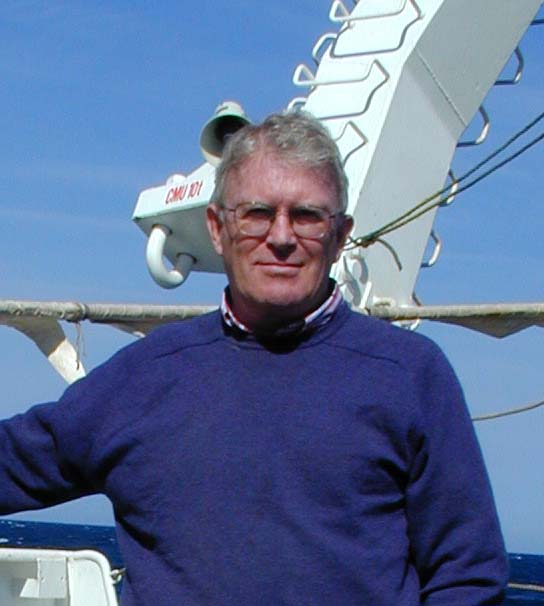
William B.F. Ryan
Marine Geology and Geophysics
Adjunct Professor & Doherty Senior Scholar
|
Lamont-Doherty
Earth Observatory
Courses |
 |
Research interests: Development of oceanographic instrumentation; seafloor topography; large-scale mass-wasting; paleoclimates and plate tectonics. My students and I, traditionally working in tutorial relationships, are both developers and users of advanced oceanographic instrumentation. We are right at home in the rift valley of a mid-ocean ridge or in the thalweg of an undersea canyon as we attempt to find out how the ocean crust is formed at spreading centers or why the continental margin is so gullied. Our research is experimental and oriented toward processes. Young scientists are expected to participate in the development of new tools, to come up with innovative analytical techniques to visualize data and to take a leadership role at sea during expeditions. We have acquired high-resolution imagery of seafloor topography and the surface texture of many mid-ocean ridges. We have followed up acoustic and magnetic remote sensing with lots of ground truth using submersible dives, coring, drilling and video photography. Students are mining these data sets with stochastic methods for describing and classifying seafloor terrains, and they are mapping active volcanic outpourings and recent displacement. On margins we are trying to understand mega-scale retrogressive mass-wasting. We hope to learn why sea floor drainage networks are so similar to those of terrestrial rivers. Our investigations have taken us to the Black and Marmara Seas where we have found evidence of catastrophic saltwater floods. Most recently we have been mapping and sampling the entire 240 kilometers of the Hudson River Estuary from New York Harbor to the Troy dam. On the horizon for 2003 and 2004 are investigations in the Aegean Sea and Eastern Mediterranean. |